
Best Well Water Softeners: 2026 South Jersey Guide
You’ve scrubbed the orange rust stains from your porcelain for the third time this week. Then you watch them bloom back overnight. It’s an exhausting cycle that many South Jersey homeowners know all too well. When your well draws from the Kirkwood-Cohansey Aquifer, you aren’t just dealing with typical hardness. You’re fighting high iron levels and acidic water that eats away at your plumbing. Finding the best water softener for well water in our area requires a strategy that understands these local quirks. You deserve a home where the water feels like a luxury, not a constant maintenance headache.
We agree that your time is better spent enjoying your home than fighting its fixtures. This 2026 guide cuts through the noise to help you choose a system built specifically for South Jersey’s unique chemistry. We’ll explore how to eliminate scale, protect your appliances, and finally achieve that “set it and forget it” maintenance plan. You’ll learn how to transform your water into an asset that supports your skin, your hair, and your peace of mind. It’s time to stop settling for “good enough” and start experiencing water that actually works for you.
Key Takeaways
- Learn why standard systems fail against South Jersey’s “clear water iron” and how to protect your equipment from premature wear.
- Discover how calculating “compensated hardness” helps you find the best water softener for well water tailored to your specific household needs.
- Understand the real-world performance of salt-based versus salt-free systems when dealing with the unique mineral content of the Pine Barrens.
- See why a complete solution often pairs a softener with an acid neutralizer to stop plumbing corrosion and restore your home’s aesthetic.
- Find out why professional water testing is the only way to avoid costly DIY mistakes and ensure long-term, “set it and forget it” reliability.
Why Well Water Requires a Different Kind of Softener
City water is a controlled environment. Well water is the wild west. In South Jersey, especially around the Pine Barrens, your well isn’t just pulling up water; it’s pulling up a complex chemical cocktail. Most national brands treat “hardness” as the only enemy. They focus strictly on calcium and magnesium. For us, iron and acidity are often the real villains. A standard “big box” store softener might work for a year or two. Eventually, the high iron levels typical of our local aquifers clog the internal valves and coat the resin beads. It’s why these generic systems often fail so quickly on a well.
Finding the best water softener for well water means looking beyond simple grain capacity. You need a system built for South Jersey’s unique “complexity.” Well water doesn’t just have minerals; it has character, and usually not the good kind. Between the high iron content and the aggressive acidity of the Kirkwood-Cohansey Aquifer, your equipment needs to be rugged. It has to be smart enough to handle shifting water chemistry without constant manual adjustments.
Hardness vs. Iron: The Double Threat
Hardness comes from calcium and magnesium minerals that create scale. However, South Jersey well water often contains “clear water iron.” This is dissolved iron that you can’t see when it first comes out of the tap. Once it hits the air or your softener’s resin bed, it oxidizes. This creates a sticky, orange sludge. The best water softener for well water must be capable of handling this iron load through specialized resin and efficient regeneration cycles. If you see orange rings in your toilet or your laundry looks dingy, your current system is likely losing the battle against iron. It’s not just failing to soften; it’s being physically smothered by the iron load.
The Aesthetic Toll of Untreated Well Water
We believe your home should be a sanctuary of clean lines and bright surfaces. Untreated well water destroys that aesthetic. Hard water minerals leave a chalky film on matte black faucets and glass shower doors. It isn’t just about the fixtures, though. Those same minerals strip the natural oils from your skin and hair, leaving you feeling dry and frustrated. Beyond what you can see, scale buildup is silently choking your high-end appliances. Tankless water heaters and designer dishwashers are particularly vulnerable. Investing in a professional-grade system isn’t just a technical fix. It’s a commitment to your home’s longevity and your own daily confidence.
Sizing Your System: Understanding Grain Capacity and Flow Rates
Sizing isn’t just about the physical footprint of the unit. It’s about the volume of minerals it can capture before it needs to regenerate. For South Jersey residents, this is where the search for the best water softener for well water gets technical. If you undersize, you’ll experience hard water “bleed through” during high-demand moments. If you oversize, you’re wasting salt and water on unnecessary cleaning cycles. Finding the sweet spot is essential for a system that truly feels “set it and forget it.”
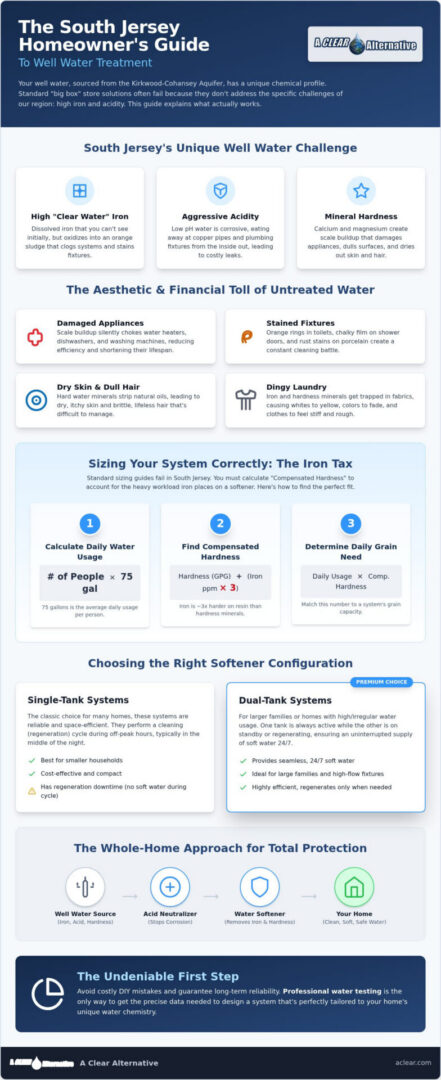
National sizing guides often ignore the “iron tax.” In our region, you must calculate compensated hardness. Iron is much heavier for resin to process than calcium or magnesium. A common industry standard is to multiply every 1 part per million (ppm) of iron by three and add that to your hardness count. This adjusted number represents the true workload. Matching this to your family’s daily water usage ensures your system doesn’t run out of capacity mid-shower.
The Math Behind the Perfect Fit
To find your ideal capacity, multiply the number of people in your home by 75 gallons, which is the average daily usage. Multiply that total by your compensated hardness. This gives you the daily grain requirement. A system should ideally regenerate every 6 to 7 days for peak efficiency. If you have four bathrooms or high-flow fixtures, the gallons per minute (GPM) rating is just as vital. Low GPM ratings lead to frustrating pressure drops when multiple faucets are running simultaneously. Starting with professional well water testing is the only way to get these numbers right before you invest.
Single-Tank vs. Dual-Tank Systems
Single-tank systems are the classic choice for smaller households. They are space-efficient and reliable, though they do have downtime during the middle of the night when the system cleans itself. For larger families or homes where water is used at all hours, dual-tank systems provide a seamless experience. When one tank reaches capacity, the second tank immediately takes over. This ensures you have soft water 24/7 without ever having to plan your laundry or cleaning around a regeneration cycle. Modern demand-initiated valves monitor your usage in real-time, making either choice far more efficient than the older, timer-based models of the past.
Salt-Based vs. Salt-Free: The Honest Truth for Well Owners
The promise of a “salt-free” water system is incredibly tempting. Nobody enjoys lugging 40-pound bags of salt into a basement every month. It sounds like the modern, low-maintenance dream. However, when you’re searching for the best water softener for well water, you have to distinguish between marketing hype and chemical reality. In South Jersey, our water isn’t just “hard.” It’s complex. Choosing the wrong technology doesn’t just waste money; it leaves your home vulnerable to the very mineral damage you’re trying to prevent.
We believe in being direct with our neighbors in Tabernacle and Shamong. While salt-free systems have their place in municipal water settings, they almost always fall short on a private well. Understanding the difference between “softening” and “conditioning” is the first step toward a home that feels truly clean and scale-free. For well owners, the choice usually comes down to physical removal versus temporary neutralization.
How Ion Exchange Works
Salt-based systems use a process called ion exchange. Think of the resin beads inside the tank as tiny, powerful magnets. These beads are coated in sodium ions. As your well water flows through the tank, the beads “swap” their sodium for the calcium, magnesium, and iron minerals. Ion exchange is the gold standard for mineral removal because it physically extracts the contaminants from your water supply rather than just neutralizing them. This ensures that the water reaching your skin, hair, and appliances is truly soft. High-capacity resin is a non-negotiable feature here; it’s designed to withstand the heavy iron loads that would quickly degrade cheaper, standard-grade resins.
Debunking the Salt-Free Promise for Wells
Salt-free systems are technically “conditioners” or “descalers.” They don’t actually remove anything from your water. Instead, they use a process like Template Assisted Crystallization (TAC) to change the structure of minerals so they don’t stick to your pipes as easily. This might help with scale in your water heater, but it does nothing for the other issues well owners face.
- Iron and Manganese: Salt-free systems do not remove iron. If your water has a metallic taste or leaves orange stains, a salt-free unit will leave those problems untouched.
- The Aesthetic Factor: Because the minerals are still in the water, you won’t get that silky feel on your skin or the bright, “like-new” look for your laundry.
- Local Performance: In areas with the high mineral complexity of the Pine Barrens, these systems often lead to deep disappointment within the first year of use.
The upkeep of a salt-based system is a small trade-off for the massive improvement in water quality. While salt-free units require zero salt, they often require expensive filter replacements that can cost more over time than a few bags of solar salt. For a true “set it and forget it” solution that protects your home’s aesthetic, ion exchange remains the only reliable path for South Jersey well water.
The ‘Whole Home’ Approach: Integrating Softeners with Filtration
In the Pine Barrens, a softener is often just the final touch of a sophisticated water strategy. South Jersey well water is notorious for its aggressive acidity and high iron levels. Simply installing the best water softener for well water without addressing low pH is like putting a luxury engine in a rusted-out car. To achieve a truly premium experience, most homeowners need a comprehensive whole house water filtration system. This modular approach ensures every tap in your home delivers water that is safe, soft, and perfectly balanced.
Sequence matters in water treatment. If you have high iron or sulfur, those contaminants should be removed before the water reaches your softener. This protects the softening resin and ensures the system doesn’t become a breeding ground for iron bacteria. By designing a system that handles filtration in stages, you ensure the longevity of your equipment and the purity of your water.
Protecting Your Pipes from Acidity
South Jersey’s Kirkwood-Cohansey Aquifer is naturally acidic. If you notice blue-green staining on your white sinks or have experienced pinhole leaks in your copper pipes, your water is “hungry.” It is literally eating your plumbing from the inside out. Integrating acid neutralizer systems into your setup is a critical first step. These systems raise the pH level to a neutral 7.0, which stops corrosion and allows your softener to work more efficiently. Without this balance, acidic water can actually damage the delicate resin beads inside your softener, shortening its lifespan significantly.
Advanced Filtration for Problem Wells
Some wells present challenges that mineral hardness alone doesn’t explain. If your water smells like rotten eggs, you likely need a dedicated iron and sulfur filtration system to strip out the hydrogen sulfide gas. For those concerned about chemical tastes or the presence of bacteria, adding carbon filtration or UV sterilizers provides an extra layer of modern security. We believe in designing modular systems that grow with your family’s needs. You can start with the essentials and add specialized stages as your water chemistry or household size changes. This flexibility is the hallmark of a modern, aesthetic-focused water strategy that prioritizes your home’s health.
Ready to build a system that handles everything from rust stains to odors? Explore our specialized iron and sulfur filtration systems to reclaim your home’s fresh scent today.
Professional Installation and Maintenance in South Jersey
DIY culture is great for painting a room or landscaping a garden. When it comes to your home’s infrastructure, the stakes are much higher. A minor mistake during installation can lead to a flooded basement or a ruined tankless water heater. The best water softener for well water is only as effective as the technician who calibrates it. We’ve seen many homeowners buy premium hardware only to have it fail because the settings didn’t account for local iron levels. Professional installation ensures your system is tuned to your home’s specific flow rate and mineral load from day one.
You can’t fix what you haven’t measured. This is why comprehensive well water testing is the mandatory first step. It provides the chemical blueprint needed to program your system’s regeneration cycles. Without this data, you’re just guessing. A local expert doesn’t just install a tank; they design a solution that protects your home’s aesthetic and your family’s comfort for the long haul.
Why Local Expertise Matters
South Jersey’s geology is unique. The water chemistry in Medford Lakes can differ significantly from a well in Tabernacle or Shamong. A national chain won’t understand the nuances of the Kirkwood-Cohansey Aquifer like a family-owned water treatment company near you. We’ve been serving this community since 1991, and we know exactly how local minerals behave. Choosing a local professional also means you have access to 24/7 emergency support. If a well pump fails or a tank develops an issue, you need someone who can be at your door quickly, not a call center in another time zone. Building a relationship with a licensed potable water professional gives you peace of mind that your water is always being monitored by someone who cares about the result.
Never Carry a Heavy Salt Bag Again
Maintenance is the part of water treatment that most people dread. Carrying 40-pound bags of salt down basement stairs is a physical burden that often leads to neglected systems. When a brine tank runs dry, your water quality drops instantly. You can eliminate this chore entirely with a water softener salt delivery service. This “white glove” approach means a professional handles the heavy lifting, monitors your salt levels, and fills the tank for you on a regular schedule. It transforms your water treatment into a true “set it and forget it” luxury. By removing the physical work, you ensure your system stays in peak condition, protecting your skin, hair, and high-end fixtures without lifting a finger.
Transform Your Home with a Tailored Water Strategy
Your home is a sanctuary, and the water running through it should reflect that quality. We’ve explored how South Jersey’s unique geology demands more than a generic hardware store fix. From calculating compensated hardness to integrating acid neutralizers, the best water softener for well water is part of a tailored approach that respects your plumbing and your personal well-being. By choosing a system designed specifically for the Pine Barrens, you eliminate the orange stains and scale that dull your daily experience.
Since 1991, our family-owned and operated team has helped neighbors reclaim their water quality. With 24/7 emergency support and a deep commitment to local expertise, we make the transition to soft water seamless and stress-free. It’s time to stop fighting your fixtures and start enjoying the luxury of pure, balanced water. You deserve a system that works silently in the background so you can focus on what matters most.
Ready to take the first step toward a scale-free home? Schedule your comprehensive well water test with A Clear Alternative today! You’re just one professional test away from a more confident, comfortable lifestyle.
Frequently Asked Questions
Can a water softener remove iron from my well water?
Yes, a high-quality softener can remove “clear water iron” through the ion exchange process. This dissolved iron is swapped for sodium ions just like calcium. However, if your iron has already oxidized into orange particles, you’ll need a dedicated iron filter. Using the best water softener for well water ensures the resin is durable enough to handle these heavy mineral loads without clogging the system’s delicate internal valves.
How often should I have my well water tested in South Jersey?
You should test your well water at least once a year for basic parameters like bacteria and nitrates. Under the New Jersey Private Well Testing Act, landlords must test every five years and provide results to tenants. If you notice new staining or a change in taste, immediate testing is vital. Professional testing provides the exact chemical data needed to calibrate your treatment system for peak efficiency and long-term reliability.
What is the difference between a water softener and an acid neutralizer?
A water softener removes hardness minerals like calcium and magnesium to prevent scale buildup. An acid neutralizer raises the pH of your water to a neutral level, preventing it from eating away at your copper pipes. In South Jersey, these systems often work as a duo. The neutralizer balances the water first, which protects the softener and your home’s plumbing from the aggressive, “hungry” water common in our local aquifers.
How long does a professional water softener system typically last?
A professionally installed water treatment system typically lasts between 15 and 20 years with regular maintenance. This is a significant leap over “big box” store models, which often fail within two to five years on complex well water. High-grade components and expert calibration make the difference. By investing in professional hardware, you’re choosing a long-term solution that maintains your home’s aesthetic and protects your high-end appliances for decades.
Is it better to get a single-tank or dual-tank softener for a family of four?
A dual-tank system is usually the superior choice for a family of four. While a single-tank unit must go offline to regenerate, a dual-tank system provides soft water 24/7. When one tank reaches its limit, the second tank immediately takes over. This ensures you never run out of soft water, even during high-demand days with back-to-back showers and laundry cycles. It’s the ultimate “set it and forget it” luxury for a busy household.
Why does my well water smell like rotten eggs even with a softener?
That distinct “rotten egg” odor is caused by hydrogen sulfide gas, which a standard softener cannot remove. Softeners are designed to handle minerals, not dissolved gasses. To eliminate this smell, you need a dedicated iron and sulfur filtration system. These systems use specialized media to strip the gas from your water supply, ensuring your home smells as fresh as it looks. Don’t let gas odors ruin your water experience.
How much salt does a typical well water softener use per month?
A typical household uses one to two 40-pound bags of salt per month. Your exact usage depends on your family’s water consumption and the “compensated hardness” of your well. Modern, demand-initiated valves are highly efficient, only regenerating when necessary to save you money. For maximum convenience, a salt delivery service can handle the heavy lifting and ensure your brine tank never runs dry, maintaining your water quality automatically.
Do I need a sediment pre-filter before my water softener?
Yes, installing a sediment pre-filter is highly recommended for all South Jersey well systems. This simple filter catches sand, grit, and large particles before they reach your softening unit. By stopping these abrasives early, you protect the softener’s internal seals and prevent the resin bed from becoming fouled. It’s an inexpensive way to extend the life of your equipment and ensure your water remains crystal clear at every tap.