
What Size Water Softener Do I Need? 2026 Sizing Guide for NJ & PA Homeowners
What if the reason your high-end appliances are failing isn’t a manufacturing defect, but a simple math error made during installation? It is a common frustration for homeowners across New Jersey and Pennsylvania. You want to protect your home, but technical jargon makes it difficult to figure out exactly what size water softener do I need. You shouldn’t have to guess whether a system can keep up with your family’s peak demand or if it will leave you with scale-clogged pipes in just a few years.
We believe water treatment should be a seamless part of your modern lifestyle, not a source of stress. In this guide, you will learn the exact formula to calculate your home’s specific requirements based on hardness levels and daily usage patterns. We will help you understand the vital difference between grain capacity and flow rate, ensuring you select a high-efficiency system designed to last 15 years or more. From handling South Jersey’s iron-heavy well water to meeting the latest 2026 plumbing codes, we are making the path to crystal-clear water simple, transparent, and perfectly tailored to your home.
Key Takeaways
- Understand that “grain capacity” measures how much hardness a system can remove before regenerating, which is far more important than the physical tank size.
- Learn the simple formula to answer what size water softener do i need by combining your daily water usage with your local Grains Per Gallon (GPG) rating.
- Avoid the “pressure drop” problem by matching your system’s Flow Rate (GPM) to your family’s peak demand periods.
- Calculate “Compensated Hardness” if you’re on a well, ensuring your system accounts for the iron levels common in South Jersey and Pennsylvania.
- Discover why a professional water analysis and plumbing audit are the only ways to guarantee a system that performs efficiently for over 15 years.
Understanding Water Softener Capacity: It’s More Than Just Tank Size
Choosing a water softener isn’t like buying a refrigerator where a larger footprint simply means more storage. If you’ve sat down to figure out what size water softener do i need, you have likely encountered numbers like 32,000 or 48,000 grains. These figures don’t describe the physical volume of the tank or how much water it holds at one time. Instead, they represent the system’s “hardness budget”-the total amount of calcium and magnesium the unit can capture before it must stop and clean itself.
Inside the tank sits the real engine of the system: millions of tiny, high-tech resin beads. These beads act like chemical magnets, pulling minerals out of your water through a process called ion exchange. The physical size of the tank can be deceptive. A sleek, modern unit might house a high-grade resin that is far more powerful than a bulky, outdated model. If you choose an undersized unit, you will suffer from “hard water breakthroughs.” This happens when the resin becomes saturated before the next scheduled cleaning, letting scale-heavy water flow into your pipes, ruining the aesthetic of your fixtures and the efficiency of your appliances. As noted by plumbing and appliance specialists at proservlv.com, this type of mineral accumulation can significantly shorten the lifespan of your home’s most expensive systems.
Grains of Hardness vs. Cubic Feet of Resin
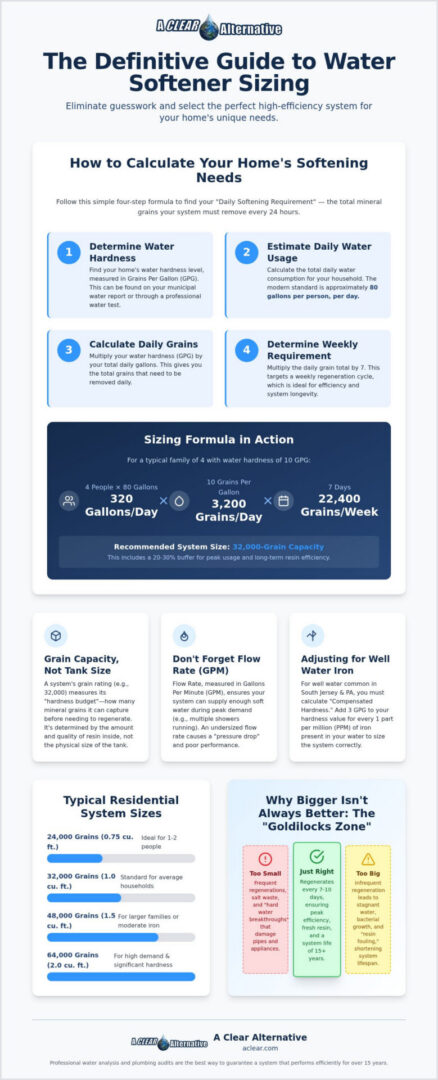
The capacity of any system is directly tied to the volume of resin packed inside. Most water professionals measure this engine in cubic feet. Generally, 1.0 cubic foot of standard resin provides a capacity of about 32,000 grains. Residential systems in New Jersey and Pennsylvania typically fall into four standard sizes:
- 0.75 Cubic Feet: Approximately 24,000-grain capacity, ideal for small apartments or couples with low water use.
- 1.0 Cubic Foot: The 32,000-grain standard for many average households.
- 1.5 Cubic Feet: A 48,000-grain powerhouse for larger families or homes with moderate iron levels.
- 2.0 Cubic Feet: 64,000-grain systems designed for high-demand homes and significant water hardness.
Why ‘Bigger’ Isn’t Always Better
It is tempting to buy the largest unit available just to be safe, but an oversized system creates its own set of problems. If a softener is too large, it may not regenerate frequently enough. When water sits stagnant in a massive resin bed for too long, it can lead to “resin fouling,” where bacteria or sediment build-up damages the beads. This reduces the lifespan of your investment and leads to excessive salt waste. To maintain a premium, efficient home, you want to hit the “Goldilocks Zone.” This is a sizing balance where your system regenerates every 7 to 10 days, keeping the resin fresh and ensuring you never have to ask what size water softener do i need again.
How to Calculate Your Grain Capacity Requirements
Accuracy is the foundation of a great user experience in your home. Determining exactly what size water softener do i need starts with a simple four-step calculation. You don’t need to be a chemist to master this, but you do need precise numbers to avoid buying a system that can’t keep up with your lifestyle. The goal is to find your “Daily Softening Requirement,” which is the total amount of mineral grains your system must remove every 24 hours.
- Step 1: Find your water hardness level in Grains Per Gallon (GPG).
- Step 2: Estimate your daily water usage. The modern standard is 80 gallons per person.
- Step 3: Multiply your GPG by your total daily gallons. This is your Daily Softening Requirement.
- Step 4: Multiply that daily number by seven to account for a weekly regeneration cycle.
The Standard Sizing Formula in Action
Let’s look at a typical household of four people with a hardness level of 10 GPG. First, multiply 4 people by 80 gallons to get 320 gallons of water used per day. Next, multiply those 320 gallons by 10 GPG. This household has a Daily Softening Requirement of 3,200 grains. By multiplying this by seven days, you find a weekly requirement of 22,400 grains.
Never buy a system that exactly matches your weekly math. We recommend adding a 20 to 30 percent buffer to your final number. This extra capacity handles houseguests, heavy laundry days, and the natural aging of the resin beads. In this example, a 32,000-grain system provides the perfect “Goldilocks” fit for efficiency and longevity. If you want to skip the guesswork, getting a professional water analysis is the most reliable way to start.
Finding Your GPG: City vs. Well Water
If you live in a town like Medford or Tabernacle and use municipal water, you can often find your hardness levels in the annual Consumer Confidence Report (CCR). However, these numbers are averages for the whole town. Your specific home might vary. If your report lists hardness in Parts Per Million (PPM) or mg/L, simply divide that number by 17.1 to convert it to Grains Per Gallon.
For those on private wells, well water testing is non-negotiable. Well water quality fluctuates based on depth and local soil composition. In South Jersey, your water might also contain iron, which “fools” standard tests and requires a more complex calculation. Knowing your exact GPG ensures your new system remains a discreet, high-performing addition to your home rather than a technical burden.
Don’t Forget Flow Rate: Why Peak Demand Matters
While grain capacity tells you how much work the system can do, flow rate determines how well it performs during your morning routine. If you focus solely on grains when asking what size water softener do i need, you might accidentally create a bottleneck in your plumbing. Flow rate is measured in Gallons Per Minute (GPM). It represents the maximum amount of water that can pass through the softener at once without a significant loss in pressure. When homeowners ask us what size water softener do i need, we often look at the number of bathrooms first to gauge potential peak demand.
In homes throughout Medford Lakes, a common complaint is the “pressure drop.” This happens when a small softener cannot keep up with the demand of multiple faucets running at once. Imagine enjoying a high-end rain showerhead only to have the pressure plummet because someone started the dishwasher. A properly sized system ensures your water remains soft without sacrificing the luxurious experience of a high-pressure shower. It is about maintaining that premium lifestyle where your home technology works for you, not against you.
Calculating Your Peak GPM
To find your peak demand, you must estimate your simultaneous water usage. A standard shower uses about 2.5 GPM, while a kitchen faucet adds another 1.5 GPM and a dishwasher contributes roughly 2.0 GPM. If you have a luxury master bath with multiple showerheads or a high-capacity soaking tub, your requirements will spike. Most modern families in New Jersey and Pennsylvania need a system that handles at least 12 to 15 GPM to maintain a seamless, high-quality experience during the busiest hours of the day.
Valve Size and Plumbing Compatibility
The hardware on top of your tank, known as the control valve, is the gatekeeper of your water pressure. Most homes have either 3/4-inch or 1-inch service pipes. Matching the valve size to your plumbing is critical for performance. A 1-inch high-flow valve allows significantly more water to pass through than a 3/4-inch version, reducing the risk of a shower pressure dip. If you are also installing a whole house water filtration system, ensuring both units have compatible high-flow valves is the only way to prevent a drop in performance. The goal is a system that works invisibly in the background, providing perfect water without you ever noticing it is there.
The South Jersey Well Water Variable: Adjusting for Iron
If you rely on a private well in Shamong or Tabernacle, your water chemistry is likely more complex than your neighbors on city lines. When asking what size water softener do i need, you cannot rely on hardness numbers alone. Iron is a common guest in South Jersey groundwater, and it is a resource hog. It coats the resin beads inside your softener, essentially stealing the capacity meant for calcium and magnesium. If you don’t account for this mineral load, your system will fail to provide that pristine, scale-free water you expect. Your home deserves better than orange-stained fixtures and prematurely failing appliances.
Iron comes in two main forms: clear-water (ferrous) and red-water (ferric). A standard water softener is excellent at removing clear-water iron through ion exchange, but only if it is sized to handle the extra burden. If your water comes out of the tap clear but turns orange after sitting, you have ferrous iron. If it is already orange or has visible sediment, a softener alone will quickly become clogged and useless. In those cases, you may need a dedicated iron and sulfur filtration system to act as a bodyguard for your softener and plumbing.
The Compensated Hardness Formula
To get the math right, we use the “Compensated Hardness” formula. According to industry standards for our region, the rule of thumb is to add 5 GPG of hardness for every 1 ppm of iron detected in your water. This adjustment ensures your resin stays clean and lasts for its intended lifespan. For example, if your water test shows 10 GPG of hardness but also 2 ppm of iron, you must size your system for 20 GPG of total hardness. Failing to make this adjustment is the most common reason why big-box store systems fail in South Jersey. They simply aren’t built for the mineral intensity of our local aquifers.
South Jersey’s Low pH and Iron Challenges
Our local groundwater is often acidic, which makes minerals more aggressive and difficult to manage. This low pH environment can cause iron to stay in solution longer, making it even more important to have an accurately sized system. Signs that your current softener is undersized for your well’s mineral load include sudden drops in water pressure, salty-tasting water, or the return of spotting on your glassware. At A Clear Alternative, we don’t believe in generic solutions. We audit your specific water chemistry to ensure your system remains a discreet, high-performing asset for your home. If you are tired of orange stains and technical confusion, contact our team for a professional water analysis today to find exactly what size water softener do i need.
Professional Sizing vs. DIY: Getting the Perfect Fit
While online calculators and big-box retail charts offer a quick answer to what size water softener do i need, they lack the nuance required for a long-term investment. These generic tools can’t see the specific plumbing constraints of your basement or the unique mineral spikes in your local aquifer. Choosing a water softener is an aesthetic and lifestyle decision that affects your skin, your hair, and the longevity of your high-end appliances. A professional on-site water analysis and plumbing audit remove the risk of buying a system that’s either too weak for your peak demand or so oversized that it wastes money every month.
Since 1991, our family-owned approach has focused on precision. Unlike national chains that treat every zip code the same, we understand the specific challenges of New Jersey and Pennsylvania water quality. A professional installation also ensures your system is perfectly integrated with salt delivery services. This creates a worry-free experience where your soft water is always available and the heavy lifting is handled for you. Professionally installed units also come with the peace of mind of a robust warranty and local expertise that a DIY box simply can’t match.
Customizing Your Water Solution
Every home has a unique rhythm. Perhaps you’re planning to expand your family, or maybe you’ve just installed a high-capacity steam shower. We tailor each system to your future plans, not just your current usage. During our audit, we evaluate your home’s physical layout to ensure the installation is discreet and efficient. You also gain access to our 24/7 emergency support, ensuring that your quality of life never dips due to a technical hiccup. It’s about giving you the freedom to enjoy your home without worrying about the mechanics behind the scenes.
Next Steps: Testing and Installation
Scheduling your consultation is the first step toward a more comfortable home. During a professional water softener consultation, we don’t just test for hardness. We look at pH, iron, and sulfur levels to give you a complete picture of your water health. This data-driven approach is the only way to answer what size water softener do i need with 100% certainty. We make the process simple, transparent, and focused on your individual needs. Ready to upgrade your home’s water experience? Contact A Clear Alternative for a professional sizing consultation today!
Invest in the Long-Term Comfort of Your Home
Finding the perfect balance between grain capacity and peak flow rate is the secret to a high-performing home. You’ve learned how to calculate your daily requirements and why adjusting for South Jersey’s iron levels is critical for system longevity. Now, it’s time to stop asking what size water softener do i need and start experiencing the difference that professional precision makes for your skin, hair, and appliances.
Since 1991, our family-owned company has served homeowners across NJ and PA with expert care and 24/7 emergency support. We don’t just install equipment; we provide a modern, lifestyle-focused solution that integrates seamlessly into your daily routine. Your home deserves a system that works invisibly to protect your investments and your well-being.
Get a Professional Sizing Consultation & Water Test Today
You’re just one professional analysis away from the clear, soft water your family deserves. Let’s build a better water future for your home together.
Frequently Asked Questions
Can a water softener be too big for my house?
Yes, an oversized system can lead to resin fouling. If the unit doesn’t regenerate every 7 to 10 days, water sits stagnant in the massive resin bed, which can encourage bacterial growth and degrade the beads. You want a system that hits the efficiency sweet spot, regenerating frequently enough to stay fresh without wasting salt or water.
How many grains of hardness is considered ‘hard’ water in NJ?
In New Jersey, water with more than 7 Grains Per Gallon (GPG) is classified as hard, while anything over 10.5 GPG is considered very hard. Many South Jersey homes on private wells see mineral levels far exceeding these benchmarks. Testing your specific supply is the only way to accurately determine what size water softener do i need to protect your fixtures.
Does a water softener affect my home’s water pressure?
A properly sized system won’t hurt your pressure, but an undersized unit or a small control valve will. If the flow rate of the softener is lower than your peak demand, you’ll experience a noticeable “pressure drop” in the shower. We use high-flow valves to ensure your water remains soft without sacrificing the luxurious feel of your plumbing.
How much water does a water softener use during regeneration?
Modern high-efficiency systems typically use between 20 and 50 gallons of water per regeneration cycle. This is roughly equivalent to running one load of laundry. Because we install demand-initiated controllers, the system only regenerates when the resin is actually saturated, ensuring you don’t waste resources on a fixed timer like older, less sophisticated models.
What size water softener do I need for a family of 4?
A standard family of four typically requires a 32,000-grain system, but the real answer to what size water softener do i need depends on your specific mineral load. If your hardness is above 12 GPG or you have clear-water iron, a 48,000-grain unit is a much better fit. This extra capacity provides a necessary buffer for heavy laundry days and houseguests.
Should I size my water softener differently if I have a high-efficiency washer?
High-efficiency washers use less water, but they don’t change your peak flow rate requirements. While your total daily gallon usage might be slightly lower, you still need a valve and tank size that can handle multiple faucets running at once. We focus on your home’s peak demand to ensure your lifestyle remains uninterrupted and your appliances stay scale-free.
How often should my water softener regenerate if it’s sized correctly?
A correctly sized water softener should regenerate every 7 to 10 days. This frequency keeps the resin bed clean and prevents mineral packing. If your system regenerates every night, it’s likely too small for your home’s hardness levels. If it goes more than two weeks without a cycle, it’s oversized and risks losing its softening efficiency over time.
What happens if I buy an undersized water softener?
An undersized system leads to “hard water breakthroughs,” where the resin becomes saturated before the next cleaning cycle. This allows calcium and magnesium to flow into your pipes, causing spots on glassware and scale buildup in your water heater. You’ll also notice your skin and hair feel less clean, as the system simply can’t keep up with your family’s needs.