
The Homeowner’s Guide to Water Softeners in Tabernacle, Shamong, & Medford Lakes (2026)
Last Tuesday, a homeowner in Medford Lakes watched their 14 month old espresso machine sputter and die, a victim of the white, crusty scale that a professional water softener could have easily prevented. You likely know the frustration of scrubbing your glass shower doors for 20 minutes only to see spots return by the next morning. It’s exhausting to deal with itchy, dry skin after a shower or to see your vibrant clothes look dingy after just three cycles in the wash. You shouldn’t have to fight your own plumbing for a sense of comfort. We agree that your home should be a place of wellness, not a source of constant maintenance chores.
Investing in a high performance filtration system is a modern lifestyle decision that protects your $1,200 water heater and cuts your monthly detergent spend by 50 percent. This guide reveals how to safeguard your Tabernacle or Shamong property while transforming your daily routine into a premium self care experience with softer hair and glowing skin. You’ll discover the best 2026 filtration technologies and how to find reliable local support to keep your South Jersey home running flawlessly and efficiently for years to come.
Key Takeaways
- Learn why South Jersey’s specific geological layers make your well water prone to mineral hardness and how it impacts your daily life.
- Discover how a professional water softener can slash your detergent usage by 50% and safeguard your home’s most expensive appliances.
- Unlock a premium lifestyle upgrade with smoother skin and shinier hair through the modern science of ion exchange.
- Find out why professional GPG testing and precise sizing are the keys to a high-performance system that fits your family’s peak usage.
- Explore how a “Total Water” approach from local experts transforms water treatment into a seamless, confidence-boosting solution for your home.
Understanding Hard Water in Tabernacle, Shamong, & Medford Lakes
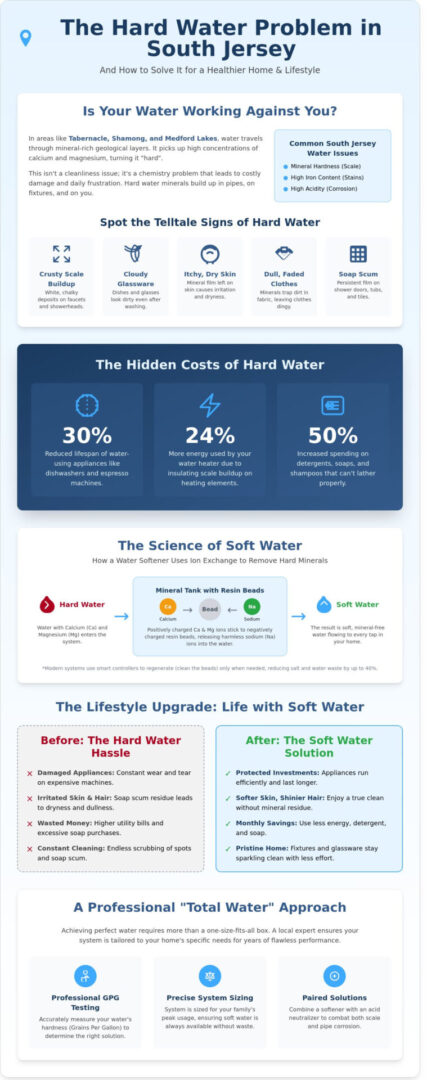
Hard water is a high concentration of dissolved minerals, specifically calcium and magnesium. In South Jersey, our water travels through ancient geological layers that are packed with these elements. As the water moves toward your home, it acts as a solvent, picking up mineral deposits every step of the way. This isn’t a cleanliness issue; it’s a chemistry problem that affects your daily comfort and your home’s infrastructure. Whether you’re pulling from a private well or a local utility, these minerals are likely present in every drop you use.
The “Scale Scourge” is the most expensive part of this process. These minerals don’t stay suspended in the water forever. They eventually settle, hiding inside your pipes and coating the heating elements in your water heater. This mineral layer acts as an insulator, forcing your systems to use 24% more energy to heat the same amount of water. Hard water minerals are the silent tax on New Jersey homeowners.
Is Your Water Hard? Spotting the Signs in NJ Homes
You don’t need a lab test to see the effects of hard water in your home. Look for these visual indicators first:
- White, chalky crust (scale) on your showerheads and faucets.
- Cloudy glassware that looks dirty even after a full wash cycle.
- Persistent soap scum on glass shower doors and tiles.
The impact on your lifestyle is even more direct. Hard water prevents soap from lathering properly, which means it stays on your body. This is why your hair feels like straw and your skin stays itchy after a shower. In Medford Lakes, where many homes feature high-end appliances like Miele or Sub-Zero, the stakes are higher. These precision machines are designed for pure water; mineral buildup can reduce their functional lifespan by 30% or more, leading to expensive repairs and early replacements.
The South Jersey Water Profile: Well vs. Municipal
Your water quality depends heavily on your specific neighborhood. Shamong well water typically features a different mineral profile than municipal supplies, often containing higher levels of iron alongside calcium. In the Tabernacle area, we frequently find that hardness is only half the battle. Many homes struggle with a combination of mineral density and high acidity. This creates a corrosive environment for your copper pipes. If you notice blue-green staining on your fixtures, you likely need to pair a water softener with an acid neutralizer to fully protect your home. For comprehensive protection against multiple water quality issues including sediment, chlorine, and other contaminants, a whole house water filtration system provides the complete solution. Investing in a professional water softener provides the foundation for better skin, cleaner dishes, and a plumbing system that actually lasts as long as it should.
How a Water Softener Works: The Science of Ion Exchange
Think of a water softener as a magnetic swap meet for your home’s plumbing. It doesn’t just block minerals like a standard carbon filter; it physically replaces them through a process called ion exchange. Inside the system, millions of tiny, negatively charged resin beads act like magnets for hard minerals. As water flows through the tank, the positively charged calcium and magnesium ions stick to these beads. In their place, the system releases a tiny amount of sodium. It’s a chemical trade that ensures hard minerals never reach your skin, your hair, or your expensive appliances.
Modern technology has made this process incredibly efficient. Older units used to run on simple timers, wasting water and salt regardless of your actual usage. Today, smart control valves monitor your specific consumption patterns in real time. They only trigger a cleaning cycle when the resin beads are actually saturated. This demand-initiated regeneration can reduce salt usage by 40% compared to legacy systems from the early 2000s, making it a sustainable choice for your home and the environment.
The Core Components: Resin Tanks and Brine Tanks
The system relies on three main parts to keep your water feeling premium. The mineral tank is the heavy lifter where the actual ion exchange happens 24/7. Next is the brine tank, which holds a concentrated salt solution. When the resin beads are covered in calcium, the brine solution flushes through to “recharge” their cleaning power. Finally, the digital control valve acts as the brain. It tracks every gallon you use and decides exactly when to start the regeneration process to maintain peak performance without wasting a drop.
Salt-Based vs. Salt-Free: What’s the Difference?
There’s a common misconception that salt-free systems are softeners. They aren’t. These are actually water conditioners. They use Template Assisted Crystallization (TAC) to change the chemical structure of minerals so they don’t stick to pipes, but the minerals remain in your water. For South Jersey well water, which often tests at 10 to 15 grains of hardness, salt-based ion exchange is the only way to truly remove the minerals. This process gives you that smooth, clean feeling on your skin and protects your plumbing from 99% of scale buildup.
Don’t worry about the taste. Softened water doesn’t taste like the Atlantic City shoreline. The amount of sodium added is minimal, often less than what you’d find in a single slice of white bread. If you’re ready to see how this technology can transform your morning routine, you can explore customized water solutions designed specifically for New Jersey homes. It’s about more than just pipes; it’s about the confidence that comes with better water quality every single day.
The Real Benefits: Why Soft Water is a Lifestyle Upgrade
Choosing to install a water softener isn’t just a maintenance task for your utility room. It’s a fundamental shift in how you experience your home. Think of it as a premium upgrade to your daily rituals. From the moment you wake up to the second you finish the evening dishes, soft water changes the texture of your life. It’s an invisible luxury that pays for itself through improved efficiency and personal confidence.
Beauty and Wellness: The Dermatological Advantage
Hard water is often the hidden culprit behind dull hair and irritated skin. The high concentrations of calcium and magnesium in New Jersey groundwater act like microscopic sandpaper. These minerals strip away your body’s natural oils and clog your pores. When you switch to soft water, you remove that abrasive barrier. Your skin retains its natural moisture, often eliminating the need for heavy, expensive body lotions. It’s a beauty secret that starts at the tap.
The freedom of a soft water routine means you can finally say goodbye to the “film” left behind by traditional soaps. In a soft water environment, products lather instantly and rinse away completely. Your hair gains a natural shine because there’s no mineral buildup weighing down the strands. It’s a modern, aesthetic approach to self-care that focuses on the purity of your water rather than the number of chemicals in your cabinet. You’ll find yourself using 50% less soap and shampoo to achieve better results, turning every shower into a high-end spa experience.
Protecting Your Home: Plumbing and Appliances
The internal infrastructure of your home deserves the same level of care as your skincare routine. Hard water creates scale buildup that acts as an insulator inside your water heater. This layer of rock forces your system to work harder, which can increase your energy bills by up to 24% according to industry studies. A water softener prevents this mineral “clogging,” ensuring your heat transfer remains efficient and your monthly costs stay low.
Just as water softeners protect your plumbing, specialized HVAC care from companies like Ultra Air Heating and Cooling ensures your climate systems remain equally efficient, preventing the energy waste that often comes from neglected home infrastructure.
For residents in older Shamong farmhouses or historic NJ properties, plumbing protection is vital. Corrosive mineral deposits can lead to pinhole leaks and restricted flow in vintage pipes. By installing a water softener, you provide invisible protection for your home’s most expensive systems. Consider these tangible impacts on your household investments:
- Dishwashers and Laundry: Soft water prevents the cloudy etching on glassware and keeps fabrics feeling soft for years longer.
- Fixture Longevity: You’ll stop scrubbing white crust off your designer faucets and showerheads.
- Appliance Lifespan: High-end appliances can last up to 30% longer when they aren’t fighting constant scale accumulation.
Soft water doesn’t just clean your home; it protects the investments you’ve made in it. It’s a smart, tech-forward decision that balances immediate aesthetic rewards with long-term financial security. You aren’t just fixing your water; you’re elevating your entire living standard.
Choosing and Maintaining a System in South Jersey
Finding the right water softener shouldn’t feel like a chore. It’s a lifestyle upgrade that protects your home and your skin. To get it right, you need a clear roadmap based on facts, not guesswork. Follow these four steps to ensure you invest in a system that actually works for your specific location.
- Step 1: Get a professional water test. You need to know your specific Grains Per Gallon (GPG). In South Jersey areas like Mount Laurel, we often see levels hitting 12 GPG or higher, which requires specific resin settings.
- Step 2: Size the system for your peak usage. Don’t look at square footage; look at how many people are using water at 7:00 AM.
- Step 3: Add pre-filtration if you live in Tabernacle. Many wells there show iron levels above 0.3 ppm, which can stain your fixtures even with a standard softener in place.
- Step 4: Prioritize efficiency. Look for systems with high-efficiency certifications to reduce salt and water waste by 25 percent compared to older models.
Sizing Your System for Your Family’s Needs
Grains of capacity refers to how much hardness the system can strip away before it needs to reset. A standard 32,000-grain unit works for small households, but larger families need 48,000 or 64,000 grains to avoid constant regeneration cycles. Flow rate is equally vital. If you live in a Medford Lakes home with three or more bathrooms, you need a system that supports 15 gallons per minute. This ensures your morning shower stays powerful even if the laundry is running at the same time.
The Maintenance Myth: It’s Easier Than You Think
Maintaining a water softener is simpler than most homeowners realize. You only need to check the brine tank and add salt pellets roughly once every 30 days. It’s a two-minute task that keeps the chemistry balanced. Modern digital valves handle the heavy lifting of regeneration automatically. To keep your system running for 15 years or more, schedule a professional check-up annually to inspect the seals and internal pistons. If you want to skip the physical labor entirely, A Clear Alternative provides a salt delivery service. We bring the bags directly to your basement and fill the tank so you never have to lift a 40-pound bag again.
Ready to experience the difference of perfectly conditioned water in your home? Schedule your professional water test with A Clear Alternative today and get a custom solution designed for your South Jersey lifestyle.
Professional Solutions with A Clear Alternative
We’ve served as the local, family-owned authority on South Jersey water since 1991. Most big-box retailers try to sell you a generic “box” and leave the rest to chance. We take a different path. Our “Total Water” approach ensures we aren’t just selling equipment; we’re solving a specific local problem. Every home in our area has a unique chemical footprint. You deserve a water softener system designed to handle the exact mineral profile of your property. To keep your home running smoothly, we provide 24/7 emergency support for our neighbors in Tabernacle, Shamong, and Medford Lakes. Water emergencies don’t wait for business hours, so we don’t either.
Why Local Expertise Matters in South Jersey
South Jersey’s geology is complex. National “one-size-fits-all” retailers often fail to account for the specific acidity and iron content found in NJ aquifers. We’ve spent over 33 years studying the ground beneath our feet. Our commitment to the Tabernacle and Shamong communities is deep-rooted and personal. Unlike standard plumbing companies, we’re also licensed potable water haulers. We provide bulk water for local pool filling and emergency water delivery when private wells fail. This local specialization means we understand the pressure and quality issues that affect your daily life better than anyone else.
Customized Integration: Softeners and More
A high-performance water softener is the foundation of a healthy home, but it works best as part of a complete ecosystem. We seamlessly integrate softening technology with UV sterilizers to provide total biological safety alongside mineral protection. For homeowners seeking the ultimate in water purity, we also offer reverse osmosis water systems that deliver bottled-quality drinking water directly from your kitchen faucet. Our white-glove installation process prioritizes your home’s aesthetics. We don’t just “hook it up.” We design the layout to be compact, clean, and easy to maintain.
The result is what we call the A Clear Alternative smile. It’s that moment of pure confidence when you realize your water is finally perfect. You’ll notice the difference in three key ways:
- Better Skin and Hair: No more “sticky” soap film or dry, itchy skin after a shower.
- Appliance Longevity: Your dishwasher and water heater can last up to 30% longer without scale buildup.
- True Cleanliness: Glassware comes out of the cycle crystal clear, and laundry feels softer than ever.
Don’t settle for “good enough” water. Experience the magical feeling of a home where every drop is pure, soft, and safe. Your journey to better living starts with a simple conversation. If you’re wondering how much is a water softener for your specific home and water conditions, our team provides transparent pricing with no hidden fees. Reach out to our team today and let’s bring that A Clear Alternative smile to your home.
Upgrade Your Home’s Lifestyle and Longevity
Living in Tabernacle, Shamong, or Medford Lakes means dealing with the heavy mineral content unique to South Jersey. You’ve seen how hard water creates stubborn scale on your fixtures and wears down your appliances prematurely. A modern water softener isn’t just a piece of equipment; it’s a commitment to a better daily experience. Since 1991, our family-owned team has helped homeowners transform their water from a hidden burden into a source of comfort. We bring the expertise of licensed potable water haulers directly to your doorstep. You deserve the confidence that comes with crystal-clear water and softer skin. With our 24/7 emergency support, you’ll never have to worry about your system’s performance. Choosing the right technology today protects your home’s value and enhances your quality of life for years to come. It’s time to move past the frustrations of hard water and embrace a cleaner, more efficient future for your household.
Ready for the soft water lifestyle? Schedule your Tabernacle water test today!
You’re just one step away from the pure, refreshing water your family deserves.
Frequently Asked Questions
Does a water softener make my water safe to drink?
Yes, a water softener makes your water safer for your plumbing and skin, but it isn’t a purification system designed to kill bacteria. It focuses on removing 100% of hard minerals like calcium and magnesium according to Water Quality Association standards. If your South Jersey well has biological contaminants, you’ll need a UV filter or reverse osmosis water system alongside it. Think of it as a lifestyle upgrade for your home’s health.
Will my water taste like salt if I install a softener in my Shamong home?
You won’t notice a salty taste in your Shamong home. The ion exchange process adds a tiny amount of sodium, typically less than 15 milligrams per quart for average South Jersey hardness levels. This is far below the 2,300 milligram daily limit recommended by the American Heart Association. It’s a discreet technology that improves your water’s feel without altering its flavor profile. You get a premium experience without the saltiness.
How often do I need to add salt to my water softener?
Most South Jersey homeowners need to add a 40-pound bag of salt to their brine tank every 4 to 6 weeks. Your specific schedule depends on your family’s water usage and the hardness level of your local supply. Checking the tank on the 1st of every month ensures you never run out. It’s a simple, 2-minute maintenance task that keeps your system running at peak performance and protects your appliance investment.
Can a water softener remove iron from my well water?
A high-quality water softener can remove clear-water ferrous iron in concentrations up to 5 parts per million. If your well water has higher levels or contains ferric iron, you’ll need a dedicated iron filter to prevent staining on your sinks and tubs. Removing these minerals protects your designer fixtures and keeps your laundry bright. It’s a smart investment for South Jersey properties dealing with heavy mineral deposits and orange staining.
What is the average lifespan of a professional water softener in South Jersey?
A professionally installed system in South Jersey typically lasts between 10 and 15 years. Modern units feature digital controls that optimize performance, though the resin beads usually lose about 1% of their effectiveness each year. Regular annual maintenance can extend this lifespan toward the 20-year mark. Choosing a premium, tech-forward model ensures you enjoy soft water and protected appliances for over a decade without the need for frequent repairs or replacements.
Do I need a water softener if I am on municipal water in Medford Lakes?
Even if you’re in Medford Lakes, a water softener is a valuable addition because municipal treatment doesn’t remove hardness. Local water often tests at 8 grains per gallon, which is high enough to cause scale buildup in your water heater and dishwasher. Softening your water is a lifestyle choice that protects your plumbing and makes your hair feel significantly softer. It’s about moving beyond basic utility to a premium home experience.
How much electricity does a water softener use?
Your system uses a very small amount of electricity, costing roughly $7 per year to operate. The digital head runs on about the same power as a small LED clock, only drawing more juice during its 90-minute regeneration cycle. It’s an energy-efficient solution that won’t spike your monthly utility bills. You get the benefits of advanced water technology without a heavy environmental or financial footprint, making it a sustainable choice for your home.
What happens if I run out of salt in the brine tank?
If the brine tank goes empty, your system can’t regenerate, and hard water will return to your pipes within 24 hours. You’ll notice soap stops lathering and spots reappear on your glassware immediately. Simply refill the tank with salt and manually start a regeneration cycle to fix it. It won’t damage the machine, but you’ll lose that silky, premium water feel until the cycle completes and the resin is cleaned.