
Reverse Osmosis Water Systems in Tabernacle, Shamong, & Medford Lakes: The 2026 Comparison Guide
What if the “pure” water coming from your Tabernacle well is actually holding your morning coffee hostage with a sharp metallic aftertaste? You’ve likely noticed that South Jersey groundwater has its quirks, from that unmistakable sulfur smell in Shamong to the 2024 NJDEP reports highlighting rising PFAS levels across Medford Lakes. It’s frustrating to feel like you can’t trust the very tap you rely on, which is why a reverse osmosis water system has become the modern standard for local homeowners who value both health and taste.
We believe your home should be a sanctuary of wellness, not a place where you’re constantly hauling heavy plastic bottles from the store. This 2026 comparison guide proves why advanced filtration is the essential final step for a healthy, high-quality lifestyle. You’ll discover how this sleek, tech-forward solution strips away microscopic contaminants to deliver bottled-quality water directly from your kitchen faucet. We’re breaking down the latest high-efficiency models and local professional support options to help you reclaim your confidence in every single pour.
Key Takeaways
- Learn why the unique mineral profile of the Pinelands and local municipal treatments make advanced filtration a necessity for South Jersey homes.
- Understand the multi-stage science behind a reverse osmosis water system and how it transforms tap water into bottled-quality purity.
- Discover the critical differences between RO, carbon filtration, and UV sterilization to ensure you choose the right protection for your family.
- See how easily an under-sink system integrates with your kitchen faucet and refrigerator ice maker for seamless, high-quality hydration.
- Gain peace of mind by learning why local expertise and licensed water safety knowledge outperform generic e-commerce brands for long-term reliability.
Why Tabernacle and Shamong Homes Need Reverse Osmosis in 2026
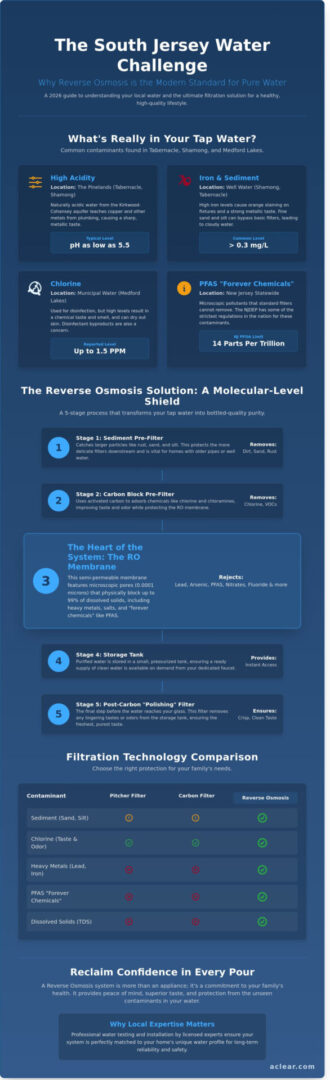
Living in the Pinelands means your tap water has a personality you probably didn’t ask for. Tabernacle and Shamong sit atop the Kirkwood-Cohansey aquifer, which provides water that’s naturally acidic, often hitting pH levels as low as 5.5. This high acidity doesn’t just taste sharp; it aggressively leaches metals from your plumbing. While your neighbors in Medford Lakes rely on municipal systems, they face a different hurdle. In 2026, Medford Lakes residents still report chlorine levels reaching 1.5 parts per million, a concentration designed to kill bacteria but one that leaves a distinct chemical aftertaste in every glass.
You need to distinguish between “working water” and “drinking water” to protect your home and your health. A standard water softener acts as your “working water” hero; it prevents scale buildup in your dishwasher and keeps your hair soft. However, it isn’t designed to purify what you consume. A reverse osmosis water system serves as the final, critical gatekeeper for your kitchen. It’s the difference between water that’s merely “treated” and water that’s actually pure. While your softener manages minerals, the RO system targets the invisible chemical load that modern living leaves behind.
- Acidity: Pinelands water often requires neutralization to prevent copper pipe erosion.
- Chlorine: Municipal residents in Medford Lakes deal with disinfectant byproducts that affect skin and taste.
- Sediment: Fine South Jersey sand and silt can bypass basic mesh filters, clouding your beverages.
The Well Water Challenge in Shamong and Tabernacle
Shamong and Tabernacle homeowners frequently battle iron levels exceeding 0.3 mg/L, which causes those frustrating orange stains in sinks. If you’ve tried a standard pitcher filter, you’ve likely noticed it fails within days. These simple carbon filters can’t handle the dissolved solids and sulfur common in local wells. A professional reverse osmosis water system uses a semi-permeable membrane to reject up to 98% of these dissolved solids, including the minerals that bypass a softener. It ensures your coffee tastes like beans, not iron.
PFAS and Emerging Contaminants in NJ
New Jersey remains at the forefront of water safety, with the NJ DEP enforcing strict 2026 standards for PFAS, often called “forever chemicals.” Current regulations target limits as low as 14 parts per trillion for PFOA. These microscopic pollutants are too small for standard filtration. RO membranes act as a molecular barrier, physically blocking these contaminants due to their size. Before you choose a system, professional water testing is your first step. It provides a baseline of your specific contaminant levels, ensuring your tech matches your home’s unique water profile.
What is a Reverse Osmosis Water System?
A reverse osmosis water system is a molecular-level filtration process removing up to 99% of impurities. Instead of simply trapping large particles like a basic pitcher filter, this technology uses pressure to force water molecules through a specialized membrane, leaving contaminants behind. It’s the same sophisticated technology used by premium bottled water brands, now scaled down for your kitchen in Tabernacle or Shamong.
Understanding how this works helps you choose the right model for your home. Most residential units are rated by Gallons Per Day (GPD), typically ranging from 50 to 100 gallons. You should also look closely at the rejection rate; high-end systems maintain a 97% to 99% efficiency in stripping away dissolved solids. This ensures your coffee, tea, and cooking water remain free from the metallic aftertaste often found in local well water. It’s a simple upgrade that delivers a massive shift in your daily quality of life.
The RO Membrane: The Heart of the System
The semi-permeable membrane is the star of the show. It features microscopic pores measuring roughly 0.0001 microns. For perspective, a human hair is about 75 microns wide. This membrane separates pure H2O from dissolved minerals and chemicals. The system flushes the “brine” or rejected water down the drain, preventing the filter from becoming a breeding ground for contaminants. Unlike boiling water, which actually concentrates heavy metals as the liquid evaporates, a reverse osmosis water system removes them entirely. It’s a cleaner, more modern approach to hydration that fits a health-conscious lifestyle.
Stages of Filtration Explained
A standard 5-stage system provides comprehensive protection through a logical, high-tech sequence:
- Pre-filtration: A sediment filter catches rust and sand. This is vital for Medford Lakes homes where older pipes or specific well conditions might introduce debris that could tear the delicate membrane.
- Carbon Stages: Two separate carbon blocks remove chlorine and organic compounds that ruin the taste and smell of your water.
- The RO Stage: This is where the molecular separation happens, removing lead, arsenic, and nitrates.
- Post-filtration: A final polishing filter ensures a crisp, refreshing finish.
- Remineralization: Many 2026 models include a final stage to add calcium and magnesium back into the water. This balances the pH level, giving you the alkaline benefits of spring water with the purity of a laboratory-grade system.
This multi-stage approach ensures your system doesn’t just work; it lasts. By protecting the membrane with initial filters, you maintain high performance for years rather than months. It’s a smart, durable investment in your family’s long-term wellness.
RO vs. Carbon vs. UV: Which is Right for Your NJ Home?
Choosing the right technology depends on what’s actually in your water. Most carbon filtration systems excel at removing chlorine and improving the “swimming pool” smell of municipal water. However, they can’t stop dissolved inorganic contaminants like nitrates or heavy metals. That’s where a reverse osmosis water system steps in. It uses a high-pressure membrane to strip away up to 99% of impurities that carbon alone misses.
While carbon systems often treat the whole house, RO is typically a point-of-use solution. You install it under the kitchen sink to provide ultra-pure water for drinking and cooking. This setup is incredibly cost-effective. Consider the math. A typical Medford Lakes family of four spends about $1,100 a year on plastic bottled water. A premium RO system offers a return on investment in roughly 12 to 15 months. You get better water without the plastic waste or the heavy lifting.
Reverse Osmosis vs. Water Softeners
Think of a water softener as protection for your home’s infrastructure. It stops scale buildup in your dishwasher and pipes. It’s for your house, but RO is for your body. Softeners use ion exchange to swap calcium for sodium. While this makes your hair soft, it adds salt to your drinking water. A reverse osmosis water system removes those sodium ions, leaving you with crisp, low-sodium water. Combining these two creates the “Perfect Pair.” The softener protects the RO membrane from clogging, and the RO ensures your coffee doesn’t taste like salt. If you’re wondering about the investment, understanding how much is a water softener in Tabernacle, Shamong, and Medford Lakes helps you budget for this comprehensive water treatment approach.
RO vs. UV Purification
Safety and purity aren’t the same thing. Ultraviolet UV sterilizers use light to scramble the DNA of bacteria and viruses, making them harmless. They are essential for many Tabernacle well owners dealing with coliform risks. UV doesn’t remove a single chemical, though. If your well has both bacteria and PFAS or lead, you need both technologies. Maintenance is straightforward. You’ll swap the UV lamp once every 12 months, while RO filters usually need a quick change every 6 to 12 months to keep the flow rate high.
Installation and Maintenance in South Jersey
Installing a reverse osmosis water system is the ultimate lifestyle upgrade for your home in Medford Lakes or Shamong. It’s a modern refinement that changes how you interact with your kitchen. The process is straightforward and discrete. Most homeowners opt for an under-sink mounting where the filtration manifold sits tucked away in the cabinet. We install a dedicated, high-end faucet through your existing soap dispenser hole or a new 1/2 inch precision drilling. This setup delivers pure water instantly without cluttering your countertops.
You don’t have to stop at the sink. We frequently integrate these systems with refrigerator ice makers and water dispensers. By running a 1/4 inch high-pressure line from the RO unit to your fridge, you bypass those expensive, less effective built-in filters. The result is crystal clear ice cubes that don’t cloud your drinks and chilled water that tastes as crisp as a premium bottled brand. It’s a seamless connection that turns your entire kitchen into a hydration hub.
The Importance of Pre-Treatment
South Jersey well water presents unique challenges that require a tailored approach. In many parts of Tabernacle, the water pH often tests below 6.5, which is acidic enough to corrode copper pipes. This is why an acid neutralizer is vital before water ever reaches your filtration unit. Without it, acidic water can cause premature failure of the equipment. A Clear Alternative customizes every system based on local well profiles to prevent iron fouling, which is common in Shamong. Protecting your RO membrane from high iron levels ensures your system reaches its full 15 year life expectancy.
Maintenance Schedules for NJ Homeowners
Your reverse osmosis water system is a high-performance tool that needs a quick check-up every 12 months. In Medford Lakes, where water hardness levels can fluctuate, we recommend changing the sediment and carbon pre-filters annually to maintain flow rates. Sanitizing the storage tank is a critical, yet often neglected, step that prevents biofilm buildup in the pressurized reservoir. You’ll know your membrane needs replacement when a TDS (Total Dissolved Solids) meter shows a rejection rate lower than 90%. While pre-filters are annual, the main membrane typically lasts 3 to 5 years with proper pre-treatment.
Troubleshooting common issues is usually a matter of simple physics. If you experience a slow flow rate or low pressure at the faucet, it’s rarely a major break. Most often, the storage tank has lost its internal air charge, which should stay at 7 psi when empty. A clogged pre-filter from a sudden spike in well sediment can also cause a drop in performance. These minor adjustments take less than 20 minutes but keep your water quality at peak levels.
Ready for a seamless installation that transforms your home? Schedule your professional system setup today and experience the A Clear Alternative difference.
Why A Clear Alternative is the Local RO Expert
Choosing a water treatment provider is about more than just buying a filter; it’s about trusting the people who safeguard your home’s most vital resource. Since 1991, A Clear Alternative has operated as a family-owned pillar in Pennsauken, Tabernacle, and Shamong. We don’t just ship boxes from a warehouse. We are licensed potable water haulers. This distinction means we adhere to rigorous safety and sanitation standards that e-commerce brands and third-party installers simply don’t face. Our team understands the chemistry of South Jersey water because we live here and drink it too.
Your peace of mind shouldn’t have business hours. We provide 24/7 emergency support for every system we install. If a component fails or a leak occurs at 3:00 AM on a holiday, you won’t be stuck talking to a chatbot. You’ll get real, local expertise. We design custom-engineered solutions specifically for the unique challenges of the Kirkwood-Cohansey aquifer. From high acidity to specific mineral imbalances, we build your reverse osmosis water system to handle exactly what’s coming out of your specific well.
Local Service vs. Big Box Brands
A “one size fits all” approach is the fastest way to ruin a water system in New Jersey. Many big box retailers sell RO units designed for municipal water, but these often fail in South Jersey wells where iron levels can exceed 5.0 ppm. Without custom pre-filtration, these generic systems clog within months. We start every project with a professional water analysis. This data allows us to calibrate your system for maximum efficiency. Our local presence also means you get consistent filter delivery and maintenance without tracking shipping dates or part numbers yourself.
- Precision Engineering: Systems built to neutralize the high iron and low pH common in Shamong and Tabernacle.
- Expert Installation: Our technicians ensure your reverse osmosis water system integrates perfectly with your existing plumbing.
- Reliable Maintenance: We keep a 35-year record of local water trends to stay ahead of emerging contaminants.
Get Started with a South Jersey Water Test
The first step toward better water is knowing exactly what’s in your pipes. We offer comprehensive lab testing that looks beyond basic chlorine. We analyze mineral content, pH levels, and potential contaminants specific to the Medford Lakes area. This isn’t a high-pressure sales pitch; it’s a scientific assessment of your home’s needs. Our commitment to the Tabernacle and Shamong communities is built on transparency and long-term results. We want you to feel confident in every glass of water you pour.
Ready to transform your home’s water quality with a team that knows your neighborhood? Schedule your professional water analysis today!
Elevate Your South Jersey Home’s Water Standards
Your family deserves water that matches your modern lifestyle. In Tabernacle, Shamong, and Medford Lakes, the 2026 standard for home wellness starts at the tap. You’ve seen how a professional reverse osmosis water system outperforms basic carbon filters by removing up to 99% of contaminants that standard NJ systems often miss. It’s not just about utility; it’s about the confidence of knowing every glass is pure and safe.
A Clear Alternative has served South Jersey since 1991. As a family-owned and operated business and a Licensed NJ Potable Water Hauler, we bring 35 years of local expertise to your doorstep. We make the transition to premium water seamless, focusing on your comfort and long-term health. You don’t have to settle for outdated filtration when modern, high-performance solutions are this accessible.
Get a Free Reverse Osmosis Quote for Your South Jersey Home
We’re ready to help you transform your home’s water quality today.
Frequently Asked Questions
Is a reverse osmosis system necessary if I have a water softener?
Yes, it’s necessary because a water softener only targets mineral hardness, while a reverse osmosis water system purifies your drinking water of toxic chemicals. Softeners exchange calcium for sodium; they don’t filter out lead, arsenic, or pesticides. By adding an RO unit, you remove 98% of the total dissolved solids that a softener leaves behind. It’s the difference between soft utility water and bottled-quality drinking water.
How much water does a reverse osmosis system actually waste?
Modern systems are incredibly efficient, typically wasting only 1 gallon for every gallon of pure water produced. Older units from 2015 used to waste 4 gallons or more for every gallon saved. Our 2026 high-recovery membranes use internal pumps to reduce wastewater by 75% compared to standard models. This ensures your Tabernacle home remains eco-friendly without sacrificing water pressure or purity.
Do RO systems remove healthy minerals from my drinking water?
Yes, the filtration process is so thorough that it removes about 95% of all minerals. While this includes healthy ones, you get most of your minerals from food anyway. We solve this by installing an alkaline remineralization stage. This adds back 25mg/L of calcium and magnesium, giving your water a crisp, refreshing taste and a balanced pH level that supports your active lifestyle.
How often do I need to change the filters in my South Jersey RO system?
You should change your pre-filters every 6 to 12 months to maintain peak performance. In areas like Shamong, high iron content can clog filters faster, so a 6-month schedule is safer for your membrane’s health. The main RO membrane usually lasts 2 to 3 years. We provide a digital TDS meter with every installation so you can track your water quality in real-time and know exactly when to swap.
Can I connect my reverse osmosis system to my refrigerator?
You can absolutely connect your reverse osmosis water system to your refrigerator’s ice maker and water dispenser. We run a dedicated 1/4 inch line from the under-sink unit directly to your appliance. This ensures your ice cubes are crystal clear and your fridge water is free from the chlorine taste often found in Medford Lakes municipal supplies. It’s a seamless upgrade for your kitchen’s functionality.
Does reverse osmosis remove PFAS and nitrates found in NJ wells?
Yes, RO technology is the gold standard for removing PFAS and nitrates from South Jersey well water. These systems eliminate 99% of “forever chemicals” and 92% of nitrates. Since some Tabernacle wells have tested near the 10mg/L federal limit for nitrates, this protection is vital for your family’s safety. It’s a simple, tech-forward solution for complex groundwater issues that traditional filters can’t handle.
Is professional installation required for an RO system in Tabernacle?
While DIY kits exist, professional installation ensures your system doesn’t leak or void its warranty. A certified technician completes the setup in about 90 minutes; they’ll calibrate the pressure tank and test your source water. This precision prevents common errors like improper drainage connections, which can waste 50 gallons of water per day if the valves aren’t seated correctly.
What is the difference between a tankless RO and a traditional system?
Tankless systems use an internal pump to provide water on demand, while traditional systems store water in a 3-gallon pressurized tank. Tankless models are 70% smaller, which saves valuable cabinet space in your kitchen. They also provide a constant flow of 600 gallons per day, so you never run out of purified water during a dinner party or a busy morning routine.