
Salt-Free vs. Salt-Based Water Softener: Which is Right for Your NJ Home?
You might think any system labeled a “softener” will give you that silky water feeling, but the truth is that one of these popular options doesn’t actually remove minerals at all. In South Jersey, where water hardness averages a stubborn 163.1 PPM, choosing between a salt-free vs salt-based water softener is about more than just plumbing. It’s a choice between simply conditioning your water or completely transforming its chemistry for a better life at home.
If you’re tired of scrubbing white crust off your high-end fixtures or dealing with itchy, dry skin after every shower, you aren’t alone. We understand the frustration of lugging heavy salt bags and the maintenance anxiety that comes with traditional systems. This guide compares the science, real-world costs, and daily lifestyle benefits of both technologies to help you find your perfect match. You’ll learn how to achieve spotless glass shower doors, renewed confidence in your hair health, and lower energy bills through peak appliance efficiency.
Key Takeaways
- Learn the fundamental difference between physically removing hard minerals and simply conditioning them to prevent scale buildup in your pipes.
- Compare the maintenance requirements and lifestyle impacts of a salt-free vs salt-based water softener to see which fits your daily routine.
- Discover the science behind Template Assisted Crystallization and Ion Exchange to understand how each technology protects your high-end fixtures.
- Identify the specific aesthetic benefits for your skin and hair that only a total mineral removal system can provide.
- Understand why a professional, lab-grade water analysis is the essential first step to ensure your investment matches South Jersey’s unique water profile.
The Hard Water Reality: Softening vs. Conditioning
Choosing between a salt-free vs salt-based water softener starts with understanding that these two systems don’t actually do the same thing. While they both tackle the problems caused by hard water, they use vastly different methods to protect your home. Salt-based softening is a physical process of removal. It uses a method called ion exchange to pull calcium and magnesium minerals directly out of your water supply. This leaves you with water that is chemically “soft” and free of the elements that cause scale.
On the other hand, salt-free conditioning doesn’t remove anything. Instead, it changes the chemical structure of minerals so they don’t stick to your pipes or fixtures. Because the minerals remain in the water, calling these systems “softeners” is actually a marketing misnomer. They are conditioners designed for scale prevention, not mineral removal. The science of water softening confirms that true softening requires the extraction of these hardness ions to change the water’s properties fundamentally.
Softening is the only process that results in zero-grain hardness.
Visible Signs You Need Water Treatment in South Jersey
You don’t need a lab coat to see the effects of hard water in your home. Walk into a bathroom in Shamong and you will likely see white, chalky rings around the base of the faucets or stubborn spots on the shower glass. This mineral crust is a constant battle for homeowners. Your laundry often pays the price too. Hard water prevents soap from lathering properly, which leaves clothes feeling scratchy and looking faded after just a few washes. Perhaps most concerning is the invisible threat: limescale. This rock-hard buildup chokes your water heater and appliances from the inside out, forcing them to work harder and driving up your monthly energy bills.
The Aesthetic Impact: Skin, Hair, and Confidence
Hard water is more than a plumbing nuisance; it is an obstacle to your daily self-care routine. When you shower in hard water, the minerals strip away your skin’s natural oils. This leads to a persistent “aesthetic fatigue” where your skin feels tight, itchy, and dull. Your hair suffers a similar fate, often becoming brittle and difficult to style regardless of the products you use. Switching to soft water provides a level of freedom you can feel immediately. It results in manageable, shiny hair and skin that retains its moisture naturally. Investing in the right system is a modern lifestyle upgrade that restores your confidence and transforms your daily ritual into a true spa-like experience.
How Salt-Based Water Softeners Work: The Science of Soft
Salt-based systems are the heavy hitters of the water treatment world. They don’t just mask the effects of hard water; they physically strip the minerals away using a process called ion exchange. Think of the resin beads inside the tank as tiny magnets. As water enters your home, these beads catch the calcium and magnesium ions and trade them for a microscopic amount of sodium. When you compare a salt-free vs salt-based water softener, this physical removal is the key differentiator. It’s why salt-based systems are the only ones that can truly claim to create soft water.
Many people notice a “slippery” feel on their skin after the first shower with a new system. You might think it’s soap that won’t wash off, but it’s actually the opposite. Hard water leaves a sticky curd on your skin that makes it feel “squeaky” clean. That slipperiness is actually your skin’s natural oils finally being allowed to breathe. It’s a sign of renewed skin health and hydration. To keep this feeling consistent, you do need to manage the brine tank. While adding salt pellets is the standard requirement, our salt delivery service removes the heavy lifting from your routine.
The Regeneration Cycle Explained
Your system works in phases to keep your water quality high. During the service phase, clean water flows freely into your Medford Lakes home. Eventually, those resin “magnets” get full. This is when the brine draw begins. The system uses a saltwater solution to wash the collected minerals off the beads and down the drain. When deciding between a salt-free vs salt-based water softener, understanding this cycle is vital. Modern “on-demand” systems are incredibly smart. They only regenerate when necessary based on your actual water usage, making them far more efficient than the older models.
Is Salt-Based Water Salty?
It’s a common myth that softened water tastes like the ocean. In reality, the amount of sodium added during the exchange process is negligible for most people. If you are watching your sodium intake for specific health and environmental impacts, you can easily use potassium chloride as a sodium-free alternative. For the ultimate “bottled water” taste at every tap, many South Jersey homeowners pair their softeners with reverse osmosis systems. This combination provides both the aesthetic benefits of soft water and the purity of professional filtration.
Checking your current hardness levels is the best way to see if this technology is right for your lifestyle. You can schedule a professional water analysis to get started today.
Salt-Free Systems: Scale Prevention Without the Salt
When exploring the choice between a salt-free vs salt-based water softener, the salt-free option often sounds like a dream for those who value simplicity and modern efficiency. These systems use a technology called Template Assisted Crystallization (TAC). Instead of pulling minerals out of your water, TAC uses specialized media to change the chemical structure of calcium and magnesium. It turns them into microscopic crystals that remain suspended in the water. Because these crystals are stable, they lose their ability to stick to your pipes and heating elements. It’s a clever way to protect your home’s infrastructure without changing the water’s mineral content.
The primary appeal here is freedom. You don’t have to haul 40-pound salt bags into your basement every month. These systems typically don’t require electricity, and they don’t produce any wastewater. When looking at the water efficiency of water softeners, salt-free conditioners often win on pure environmental impact because they don’t discharge brine into your septic system. However, there is a crucial limitation you must understand: the minerals are still present. This means you will still see white spots on your glassware and shower doors. It is a solution for scale prevention, not for total water luxury.
The Pros and Cons of Going Salt-Free
- Pro: Zero monthly maintenance. Once installed, you generally only need to worry about an annual filter change.
- Pro: Eco-friendly design. There is no salt discharge, making it a favorite for those with strict environmental restrictions.
- Pro: Compact footprint. These units are perfect for smaller utility closets where space is at a premium.
- Con: No aesthetic improvement. It won’t solve the “soap scum” issues or the dry skin and hair problems caused by hard water minerals.
Why Salt-Free Often Fails in South Jersey
In South Jersey, our water has a personality of its own. If you live in Tabernacle or Shamong, your well water likely contains high levels of iron or manganese. These minerals are the natural enemies of TAC technology. They can “poison” the conditioning media, coating it and rendering the system useless in a matter of months. This is why a salt-free vs salt-based water softener decision isn’t just about preference; it’s about chemistry.
Before you commit to a salt-free system, you must address the foundation of your water quality. Many South Jersey homes require an acid neutralizer to balance low pH levels. Without this first step, the acidity in your water will likely interfere with the conditioning process. We always recommend starting with a professional analysis to ensure your chosen technology can actually survive the unique challenges of our local aquifer.
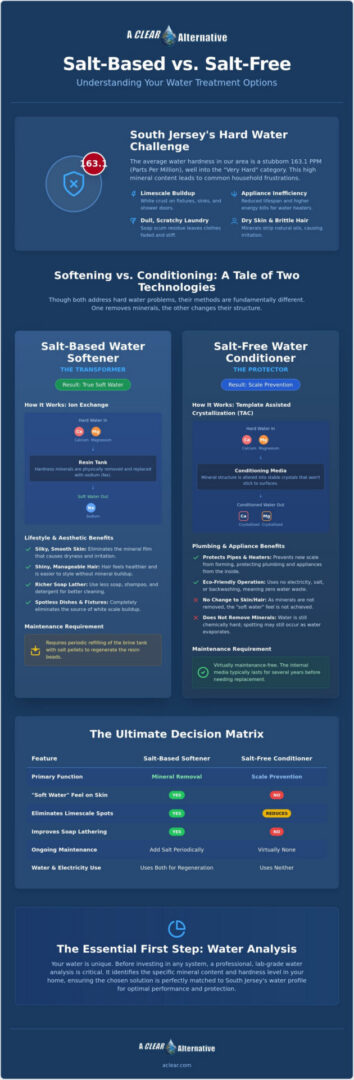
Salt-Based vs. Salt-Free: The Ultimate Decision Matrix
Deciding between a salt-free vs salt-based water softener usually comes down to one question: what do you want your water to do for you? If your goal is simply to keep your pipes from clogging with scale, a salt-free system is a capable ally. However, if you want to change how your water feels on your skin and how it treats your expensive fixtures, the two technologies aren’t even in the same league. Salt-based systems offer 100% mineral removal, while salt-free systems leave every grain of hardness behind. This fundamental difference affects everything from your morning shower to how often you have to scrub your kitchen sink.
Maintenance is the other side of the coin. A salt-based system requires you to replenish salt pellets about once a month, a task that provides the “fuel” for true softening. Salt-free systems offer a set-and-forget experience, typically only requiring a filter change once a year. While the salt-free path is easier to manage, it doesn’t provide the silky, hydrated skin feel that many homeowners crave. You’ll still be dealing with the “squeaky” feel of hard water minerals and the stubborn spots on your wine glasses that only true softening can eliminate.
Which System Should You Choose?
- Choose Salt-Based if: You want the ultimate luxury experience. It is the only choice for those who want soft skin, manageable hair, and spotless glass shower doors. It is also the necessary choice if your water hardness levels are high.
- Choose Salt-Free if: Your primary concern is protecting your plumbing and water heater from scale. It is ideal for those who prioritize low maintenance and don’t mind the aesthetic presence of minerals in their water.
- The Hybrid Approach: Many South Jersey residents find that a combination of a water softener and a carbon filtration system provides the best results, removing both hardness and chemical impurities.
The Well Water Factor
In South Jersey, the aquifer presents challenges that big-box store systems simply aren’t built to handle. If you’re on a well in Medford or Tabernacle, you likely have more than just hardness to worry about. Iron and sulfur are common local guests that can quickly ruin a standard conditioner. This is why most local homes require a professional whole house water filtration system to handle the heavy lifting before the water even reaches a softener.
Off-the-shelf systems often fail because they don’t account for the specific mineral balance of our local soil. High iron content can “blind” the media in a salt-free system, making it stop working almost immediately. To avoid a costly mistake, you need a solution tailored to your specific backyard. You can contact our experts today to see which system will actually stand up to your home’s unique water chemistry.
The First Step: Professional Water Analysis
Before you commit to either a salt-free vs salt-based water softener, you need a clear picture of what is actually in your pipes. Guessing is a luxury you can’t afford when it comes to your home’s infrastructure and your family’s comfort. While big-box retailers might suggest simple DIY strips, these often miss the complex mineral interactions common in South Jersey. A laboratory-grade well water test is the only way to ensure you are solving the right problem. It’s about moving past guesswork and making a data-driven decision for your home.
A Clear Alternative has been a family-owned staple in the community since 1991. We don’t just sell equipment; we provide 30 years of local expertise. We understand the specific challenges faced by homeowners in Tabernacle, Shamong, and Medford Lakes because we live here too. Our team calibrates every system to match the exact mineral profile of your specific neighborhood’s aquifer. This local touch is what separates professional water treatment companies from generic online vendors who don’t understand the local soil.
Customizing Your Solution
Modern water treatment is about more than just hardness. A one-size-fits-all unit from a retail shelf can’t account for the low pH or high iron levels that often plague our local wells. Your system needs to handle these variables simultaneously to protect your appliances and restore your skin’s natural glow. Professional installation also removes the risk of bypass errors or leaks that often haunt DIY projects. We ensure your system is integrated seamlessly into your home, providing a discreet and efficient solution that works from the moment you turn on the tap.
Start Your Journey to Better Water
When you schedule a consultation, you aren’t just getting a sales pitch. You’re getting a comprehensive look at your home’s health and a roadmap to a better lifestyle. We walk you through the results of your analysis and explain how different technologies will impact your hair, skin, and appliance longevity. You gain the peace of mind that comes with 24/7 local support and a team that stands behind every installation. It’s time to stop fighting with mineral crust and start enjoying the water you deserve. Schedule your South Jersey water test with A Clear Alternative today!
Transform Your Home with the Right Water Solution
Your journey to better water doesn’t have to be complicated. Whether you prioritize total mineral removal for that spa-like skin feeling or simple scale prevention to protect your plumbing, the choice between a salt-free vs salt-based water softener ultimately depends on your home’s unique chemistry. While conditioners keep pipes clear, only true softening delivers the spotless glass and hydrated hair that South Jersey homeowners love. Every well in our area tells a different story, which is why local expertise is your greatest asset.
A Clear Alternative has been family-owned and operated since 1991. We are South Jersey well water specialists who understand the specific mineral challenges of our local aquifers. With our 24/7 emergency water support, you’re never alone in maintaining your home’s quality. It’s time to stop settling for hard water and start experiencing the lifestyle upgrade you deserve. Get a Professional Water Test & Quote from A Clear Alternative and take the first step toward a clearer, more confident future today.
Frequently Asked Questions
Does a salt-free water softener actually remove minerals?
No, salt-free systems don’t physically remove minerals like calcium and magnesium from your water supply. Instead, they use conditioning technology to change the crystal structure of these minerals so they won’t stick to your pipes or appliances. When comparing a salt-free vs salt-based water softener, remember that only the salt-based version actually extracts the hardness minerals. This means you’ll still see spots on your glassware with a salt-free system.
Will a salt-based water softener make my water taste salty?
Not at all. The amount of sodium added during the ion exchange process is extremely low and generally undetectable to the human palate. Most people find that softened water actually tastes better because the harsh, metallic minerals are gone. If you’re on a strict low-sodium diet, you can easily use potassium chloride pellets in your brine tank as a completely sodium-free alternative for your Medford home.
Which system is better for South Jersey well water?
Salt-based systems are almost always the superior choice for South Jersey well water. Our local aquifers often have high levels of iron and acidity that can quickly “poison” or clog the media in salt-free conditioners. A professional salt-based system is robust enough to handle the 163.1 PPM average hardness found in our area while providing the aesthetic benefits for your skin and hair that conditioners simply can’t match.
How much maintenance does a salt-based system really require?
Maintenance is straightforward and manageable for the modern homeowner. You’ll need to check your brine tank about once a month and add salt pellets as needed to ensure the regeneration cycle works properly. Beyond that, we recommend a professional service checkup once a year to keep the valves and resin beads in peak condition. If you want a hands-off experience, our local salt delivery service handles the heavy lifting for you.
Can I use a salt-free system if I have high iron levels?
It’s not recommended for most local homes. High iron levels, common in Tabernacle and Shamong, will coat the conditioning media and stop the crystallization process entirely. For homes with significant iron, we suggest a salt-based system paired with an iron and sulfur filtration system. This combination ensures your water is both soft and clear, protecting your fixtures from those stubborn orange stains that plague many local wells.
Do salt-free conditioners protect my water heater as well as softeners?
Salt-free conditioners provide good protection against internal scale buildup, which can help your water heater last longer. However, they don’t offer the same comprehensive protection as a softener. Because softeners remove minerals entirely, they prevent 100% of the limescale that chokes heating elements. When weighing a salt-free vs salt-based water softener, the salt-based option remains the gold standard for maximizing the lifespan of high-efficiency appliances.
Is the “slippery” feel of soft water permanent?
Yes, that silky sensation is the permanent result of removing mineral friction from your water. Many people initially mistake it for soap residue, but it’s actually your skin’s natural oils finally being allowed to surface. Once your skin and hair adjust to the lack of harsh minerals, you’ll likely find you need less lotion and conditioner. It’s a sign of a healthier, more hydrated self-care routine that lasts.
What is the lifespan of a professional salt-based water softener?
A high-quality, professionally installed salt-based system typically lasts between 15 and 20 years. The longevity depends on your local water chemistry and how well you maintain the brine tank and resin beads. Systems built for the specific challenges of South Jersey often outlast generic retail units because they’re designed with durable, commercial-grade components. Regular annual checkups can help extend this lifespan even further, ensuring your investment pays off for decades.