
Protecting Appliances from Hard Water: The 2026 Homeowner’s Guide to Longevity
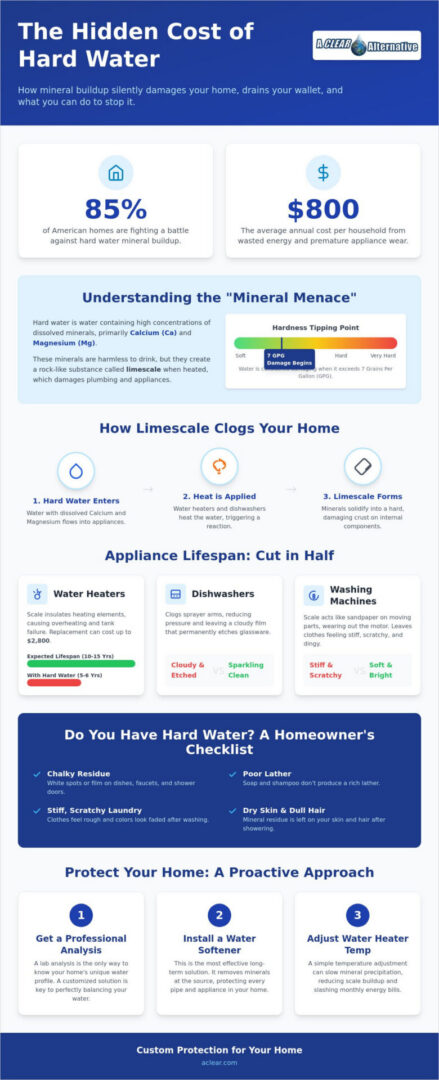
Did you know that 85% of American homes are currently losing a quiet battle against mineral buildup? You see it in the chalky residue on your dishes and feel it in the scratchy texture of your laundry. It’s more than a nuisance; hard water acts as a financial tax on your lifestyle, costing the average household about $800 every year in wasted energy and premature wear. Mastering the art of protecting appliances from hard water is the only way to stop this invisible drain on your home’s efficiency and aesthetic.
We understand how frustrating it is to invest in a modern, designer kitchen only to have limescale dull its shine. You deserve a home that feels truly clean and high-end systems that actually reach their 10-year potential. This guide will show you how to shield your most expensive investments from mineral damage and restore the brilliant clarity of your fixtures. We’ll explore the latest 2026 strategies for neutralizing minerals, from smart carbon filtration to advanced softening, so you can lower your bills and reclaim the premium living experience you’ve worked for.
Key Takeaways
- Identify the specific mineral thresholds that signal immediate danger to your home’s plumbing and designer fixtures.
- Discover how protecting appliances from hard water can double the lifespan of your dishwasher and prevent premature water heater failure.
- Compare the temporary fixes of reactive cleaning against the long-term aesthetic and financial benefits of proactive water softening.
- Learn a simple temperature adjustment for your water heater that slows mineral precipitation and slashes your monthly energy bills.
- See why a customized approach based on professional lab analysis is the only way to ensure your home’s unique water profile is perfectly balanced.
What is Hard Water and Why is it Targeting Your Appliances?
Hard water isn’t just a chemistry term; it’s a physical reality that’s likely living in your pipes right now. The “Mineral Menace” consists primarily of dissolved calcium and magnesium. These minerals enter your home through the local water supply, and in South Jersey, they’re particularly stubborn. If you live in areas like Tabernacle or Shamong, your well water often carries a much higher mineral load than municipal sources. This is where the trouble begins. Industry experts generally agree that 7 grains per gallon (GPG) is the tipping point. Once your water hits this level, it starts causing measurable damage to your plumbing and expensive fixtures.
The real damage happens when you turn up the heat. When water is heated in your dishwasher or water heater, these dissolved minerals undergo a chemical reaction. They precipitate out of the liquid and solidify into a rock-like substance called limescale. This process is why protecting appliances from hard water is so critical; once that “rock” forms inside your machines, it’s incredibly difficult to remove without professional intervention. It acts as a slow-motion tax on your modern lifestyle, degrading everything it touches.
The Science of Limescale Formation
Think of limescale as a layer of unwanted insulation. Inside your water heater, this scale coats the heating elements. Instead of heating the water directly, the element has to heat the thick layer of rock first. This “insulation effect” forces your heater to work twice as hard, driving up your energy bills and burning out components years before their time. The white crust you see on your showerhead is just the tip of the iceberg; the real destruction is happening deep inside the internal valves and pumps of your washing machine and dishwasher.
Identifying Hard Water in Your Home
You don’t need a lab coat to see the signs of mineral intrusion. If your shampoo feels like it’s just sitting on your hair instead of lathering, that’s the minerals increasing the surface tension of the water. You’ll also notice a stubborn “white film” or cloudy spots on your glassware, even after a long wash cycle. Understanding What is Hard Water helps clarify why your cleaning products aren’t working as advertised. Hard water is defined by concentrations of calcium and magnesium exceeding 7 grains per gallon (GPG), a level that significantly increases surface tension and prevents soap from lathering effectively. Spotting these signs early is the first step toward protecting appliances from hard water and restoring your home’s aesthetic brilliance.
How Scale Buildup Destroys Dishwashers, Heaters, and Washing Machines
Your water heater is often the first casualty in this mineral war. Hard water is the primary cause of premature tank failure, often cutting a unit’s life expectancy in half. Instead of the standard 10 to 15 years, homeowners in high-mineral areas like Tabernacle or Shamong might see their systems fail in just five or six years. This happens because dissolved calcium and magnesium settle at the bottom of the tank. This sediment creates a thick layer that overheats the metal and causes the tank to crack or the heating elements to burn out. Replacing a tank water heater in 2026 can cost up to $2,800, making this a very expensive consequence of untreated water.
Dishwashers suffer a similar, visible fate. Mineral deposits slowly clog the tiny holes in the sprayer arms, leading to poor water pressure and “dirty” clean dishes. Even worse, the minerals can permanently etch your expensive glassware. This creates a cloudy appearance that no amount of scrubbing can fix. In your laundry room, the internal drums of washing machines become coated in scale. This acts like sandpaper on the moving parts, wearing out the motor and leaving your clothes feeling stiff and looking dingy. Protecting appliances from hard water isn’t just about maintenance; it’s about preserving the life and look of your home’s most essential tools.
Small appliances are even more sensitive to these conditions. A high-end espresso machine or Keurig can stop working entirely within a single year if the internal heating coils are choked with scale. The precision required for these modern machines makes protecting appliances from hard water a necessity if you value your daily routines and your investment in quality kitchen tech.
The Impact on Efficiency and Energy Bills
The cost of hard water shows up clearly on your monthly utility bill. Research indicates that just 1/4 inch of scale buildup can increase your energy costs by up to 40%. Your appliances are forced to run longer cycles to reach the desired temperature, which accelerates mechanical wear and wastes resources. This “efficiency tax” means you’re paying more for a lower quality of performance. If you suspect your utility bills are creeping up, a comprehensive water test can reveal if mineral buildup is the silent thief in your home.
Gaskets and Seals: The Silent Victims
While most people focus on the metal parts, the rubber gaskets and seals are the silent victims of mineral damage. Minerals dry out these flexible components, making them brittle and prone to cracking. This often leads to slow leaks or catastrophic floods that can damage your flooring and cabinetry. The abrasive nature of scale creates a sandpaper effect on every moving seal. Once this structural damage occurs, simply cleaning the machine won’t restore its integrity. Preventing the buildup from the start is the only way to ensure your home remains dry and secure.
While managing your water quality is a key part of property maintenance, ensuring the longevity of your exterior structures is equally vital; for high-quality deck restoration and hardscaping, check out Cascade Outdoor Services.
Maintenance vs. Mitigation: Choosing the Right Protection Strategy
When you discover mineral buildup in your home, you face a choice between two very different philosophies. You can either spend your weekends scrubbing away the symptoms or invest in a solution that eliminates the cause. Reactive cleaning involves using vinegar flushes or store-bought tablets to break down existing scale. While these methods offer a temporary fix, they don’t stop the minerals from returning the very next time you run the tap. Protecting appliances from hard water requires a more permanent, proactive approach that stops damage before it starts.
While these DIY methods address the immediate symptoms, achieving a truly deep clean often requires expert help; for those seeking a pristine finish, professional house cleaning North Shore MA offers the specialized care needed to keep home interiors looking new.
The Limits of DIY Appliance Cleaning
Many homeowners rely on white vinegar as a natural descaler. It’s cheap and accessible, but it’s not without risks. Vinegar is an acid; over time, it can degrade the sensitive rubber seals and gaskets inside your modern high-efficiency machines. This can lead to the very leaks you’re trying to avoid. Additionally, the labor involved is significant. You have to remember to run descaling cycles every month, which takes time and mental energy. While monthly descaling requires constant vigilance and manual labor, a modern water softener offers a “set and forget” lifestyle that protects your home automatically.
Whole-House Softening: The Modern Standard
The most effective strategy for protecting appliances from hard water is treating the water at its entry point. Ion exchange technology removes calcium and magnesium ions before they ever reach your pipes or heater. This is the gold standard for modern home maintenance. According to the U.S. Geological Survey on water hardness, these minerals are the root cause of scale in water heaters and plumbing. By removing them entirely, you ensure that every drop of water in your home is “soft.”
For total home protection, many homeowners choose whole house water filtration systems that combine softening with carbon filtration. Modern systems are significantly more efficient than the bulky units of the past. They use less salt, less water during regeneration, and offer digital monitoring to keep you informed. Beyond the hardware, there’s the “aesthetic freedom” of soft water. You’ll notice your skin feels smoother, your hair has more shine, and your laundry stays bright and soft without the need for harsh chemicals.
Looking at the long-term ROI makes the decision even clearer. Maintaining a softener typically costs between $50 and $150 per year for salt. Compare that to the $2,800 cost of a new water heater or the $1,400 price tag for a high-end dishwasher. Choosing mitigation over maintenance isn’t just about convenience; it’s a smart financial decision that preserves your home’s value and your peace of mind.
A Homeowner’s Checklist for Extending Appliance Lifespan
Protecting appliances from hard water is a proactive journey that starts with a clear plan. While previous sections highlighted the physical damage minerals cause, this checklist provides the roadmap to stop it. Follow these five essential steps to secure your home’s efficiency and preserve your high-end fixtures for years to come.
- Step 1: Get a professional water test. You cannot fix what you haven’t accurately measured. A professional analysis reveals the exact mineral count in your water.
- Step 2: Adjust your water heater to 120°F. Lowering the temperature from 140°F to 120°F significantly slows the chemical precipitation of minerals into solid scale.
- Step 3: Audit your detergent use. Soft water is much more efficient at cleaning. You can typically use 50% less soap and still achieve a superior, spotless result.
- Step 4: Schedule regular maintenance. Like your car, your filtration and softening systems need an annual checkup to ensure they are operating at peak efficiency.
- Step 5: Inspect appliance hoses annually. Look for any “crusty” white buildup around connections. This is a primary warning sign of a pending leak or gasket failure.
The Importance of Accurate Testing
Many homeowners rely on DIY test strips from big-box stores. These are often inaccurate, especially for well water users in South Jersey. A strip might show “hard” water, but it won’t tell you the levels of iron, manganese, or acidity that also affect your plumbing. Professional well water testing in Tabernacle, Shamong, and Medford Lakes provides a laboratory-grade breakdown. Understanding these nuances allows for a customized treatment plan rather than a generic, one-size-fits-all approach that might miss critical contaminants.
Maximizing Your Softener’s Performance
A water softener is only as good as the salt you put into it. Using high-purity evaporated salt pellets helps prevent “mush” in the tank, which can lead to system clogs. Many homeowners now opt for a water softener salt delivery service to ensure they never run out or have to lift heavy bags. This service often includes a quick visual inspection to identify a “salt bridge.” A salt bridge is a hard crust that forms over the water, preventing the brine from reaching the resin. If left unchecked, your water will stay hard even if the tank looks full. Ready to see the difference for yourself? Schedule your comprehensive water testing today to build your custom protection plan.
The A Clear Alternative Approach: Custom Protection for Your Home
National brands often treat water treatment as a one-size-fits-all commodity. They ship the same generic units to every state, ignoring the specific chemistry of our local South Jersey aquifers. As a family-owned business, we’ve spent years studying the unique challenges of our region’s water supply. We know that a well in Tabernacle might have vastly different iron or mineral levels than one in Shamong, even if they’re only a few miles apart. This local expertise is the foundation of our strategy for protecting appliances from hard water.
Our process is rooted in data and precision. We begin with a comprehensive lab analysis of your water to identify every mineral and contaminant present. Once we have the facts, we move to a precision installation designed to fit seamlessly into your home’s layout. We don’t just stop at mineral hardness; we look at the health of your entire plumbing system. For many local homeowners, this includes integrating acid neutralizer systems to prevent low pH levels from corroding your copper pipes from the inside out. We also provide 24/7 emergency support, ensuring that your home’s water quality is never compromised by an unexpected mechanical failure.
Innovative Solutions for Tabernacle and Beyond
We specialize in tailoring filtration systems to the specific mineral profiles found in Medford Lakes, Shamong, and Tabernacle. Your home is a sanctuary, so we prioritize “invisible” technology that fits your modern lifestyle. Our modern systems feature sleek, compact designs that provide high-performance results without cluttering your utility space. Every installation comes with the A Clear Alternative guarantee: absolute professionalism, total transparency in pricing, and the deep local expertise that only a neighbor can provide. We believe that protecting appliances from hard water should be a seamless, worry-free experience that enhances your home’s value.
Start Your Journey to Better Water
Taking the first step toward a scale-free home is simple and stress-free. You can book your first professional water analysis through our website or via a quick phone call. During your home consultation, our experts will walk you through your lab results, explaining exactly what’s in your water and how it’s affecting your appliances. We’ll help you choose a solution that fits your budget and your aesthetic goals. You’ll know exactly what to expect from the initial test to the final installation. Don’t let mineral buildup dictate the lifespan of your expensive kitchen and laundry investments. Protect your home and appliances with a custom water solution today and finally experience the freedom of truly clean, soft water.
Reclaim Your Home’s Brilliance and Efficiency
Your home is more than just a building; it’s a reflection of your lifestyle and a significant financial investment. We’ve explored how mineral buildup acts as a silent tax on your modern appliances, but you don’t have to accept cloudy glassware or failing heaters as your reality. By moving from reactive cleaning to proactive mitigation, you ensure your designer fixtures stay as bright as the day they were installed. Protecting appliances from hard water is the most effective way to secure a home that feels truly clean and runs at peak efficiency.
As a family-owned business serving the community since 1991, A Clear Alternative provides the local expertise you need. Whether you’re looking for expert water treatment companies near Tabernacle, Shamong, and Medford Lakes or require 24/7 emergency support, our team is ready to help. It’s time to stop fighting the symptoms and start enjoying the freedom of perfectly balanced water. Book Your Comprehensive Water Analysis with A Clear Alternative today. You deserve the peace of mind that comes with a protected, modern home.
Frequently Asked Questions
Can hard water actually make my dishwasher leak?
Hard water is a leading cause of appliance leaks. Over time, mineral deposits accumulate on rubber gaskets and seals, causing them to lose their natural flexibility and become brittle. Once these essential components crack, water can seep through during a cycle. This often leads to slow, hidden leaks that cause expensive damage to your cabinetry and flooring before you even notice a problem.
How often should I descale my appliances if I don’t have a water softener?
You should aim for monthly descaling if you aren’t using a professional mitigation system. In regions with very high mineral content, like Shamong or Tabernacle, this rigorous schedule is vital for protecting appliances from hard water. However, you should remember that manual cleaning only treats the visible symptoms. It won’t prevent the internal damage occurring deep within your machine’s pumps and valves where you can’t reach.
Is it worth getting a water softener for an older home with existing scale?
It’s definitely worth the investment for any home, regardless of age. While a softener won’t instantly vanish decades of rock-hard buildup in old pipes, it stops the damage from progressing further. It also ensures that any new, high-end appliances you purchase are protected from the moment they’re installed. This preserves your home’s modern efficiency and prevents you from paying for avoidable repairs on newer tech.
Does hard water affect my energy bills?
Hard water significantly inflates your monthly utility costs by forcing your machines to work harder. When scale coats the heating elements in your dishwasher or water heater, those machines must run longer and hotter to reach the desired temperature. This added strain wastes significant energy and can increase your water heating bills by as much as 40%. It’s an invisible tax on your home’s monthly budget.
What is the difference between a water filter and a water softener?
A water filter removes specific contaminants like chlorine, lead, or sediment to improve safety and taste. A water softener, however, uses ion exchange to physically remove the calcium and magnesium minerals that cause scale. While a filter makes your water safer to drink, a softener is the tool specifically designed for protecting appliances from hard water. For total protection, many homeowners combine both technologies.
Can I use vinegar to protect my washing machine from hard water?
Vinegar can help as a temporary descaler, but it isn’t a safe long-term solution. Because vinegar is acidic, frequent use can actually degrade the sensitive rubber seals and plastic components inside modern high-efficiency washing machines. It’s much better to treat the water at the source with a softener. This approach protects your machine’s structural integrity without the risk of causing leaks or component failure over time.
How do I know if my water is ‘hard’ without a professional test?
You can spot the signs through daily observation without a lab kit. Look for a stubborn white film on your glassware, “chalky” deposits on your designer faucets, or laundry that feels scratchy and stiff. If your premium soap or shampoo struggles to produce a rich lather, your water likely has a high mineral concentration. These aesthetic cues are your home’s way of asking for a better water solution.
Will a water softener affect the taste of my drinking water?
Most people find that softened water tastes “cleaner” or “smoother” because the metallic mineral edge is gone. While the process adds a tiny amount of sodium, it’s usually negligible for most healthy adults. If you prefer zero sodium or want bottled-quality water from your tap, pairing your softener with a reverse osmosis system is the perfect aesthetic and lifestyle choice for your modern kitchen.