
Reverse Osmosis System for Home Brewing in Medford Lakes: The 2026 Guide to Perfect Batches
You’ve spent weeks perfecting your grain bill and hop schedule, only to take that first sip and find a metallic tang or a medicinal finish. It’s a frustrating reality for many Medford Lakes brewers. Local well water data shows that over 15% of samples exceed iron standards, and shifting alkalinity can easily turn a bright IPA into a muddy mess. You shouldn’t have to choose between buying endless jugs of distilled water or settling for “good enough” batches.
Installing a reverse osmosis system for home brewing Medford Lakes homes can handle is the ultimate upgrade for your craft. It’s about more than just filtration; it’s about taking total control of your profile. By stripping away the iron, acidity, and chlorine, you create a professional-grade blank canvas. This guide will show you how to achieve flawless consistency and faster brew days with a system designed for the unique mineral challenges of our local water. You’ll finally have the freedom to build any water profile from scratch and brew with total confidence. Let’s look at how you can turn your tap into a precision tool for better beer.
Key Takeaways
- Learn how to bypass the specific mineral challenges of the Pinelands aquifer that often cause metallic or medicinal off-flavors in local batches.
- Discover the science of the “blank canvas” and how removing nearly all dissolved solids allows you to build the perfect water profile for any beer style.
- See why a professional reverse osmosis system for home brewing Medford Lakes outperforms standard carbon filters and softeners when it comes to hop clarity and malt balance.
- Master the logistics of brew day by calculating your specific water demand and selecting a system capacity that eliminates the wait for fresh water.
- Explore how custom-tailored filtration hardware can turn your Medford Lakes well water into a consistent, brewery-quality resource for every pour.
Why Medford Lakes Homebrewers are Turning to Reverse Osmosis
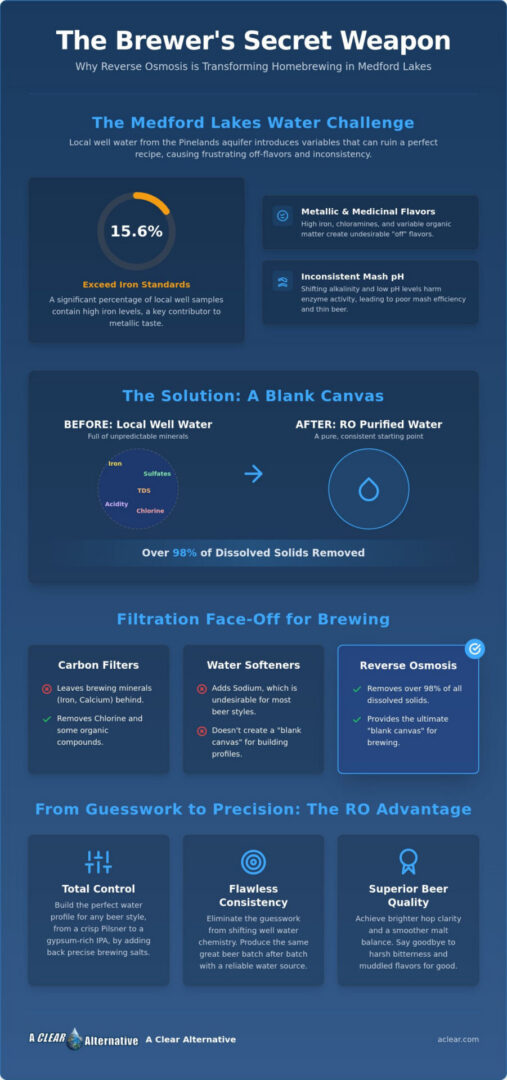
If you’ve ever tasted a batch that was technically perfect but still felt “off,” your water is likely the culprit. In Medford Lakes, we aren’t just dealing with standard tap water issues. We’re brewing with water from the Pinelands aquifer, which brings a unique set of challenges that can ruin even the most expensive grain bill. A reverse osmosis system for home brewing Medford Lakes setups provides the ultimate solution by stripping away over 98% of dissolved solids. This isn’t just about cleaning the water; it’s about total chemical control. By understanding the science of reverse osmosis, you can see how this technology forces water through a semi-permeable membrane, leaving behind the minerals and contaminants that cause harsh bitterness and medicinal flavors.
The Medford Lakes Water Profile: Beer Killer?
Our local well water is notorious for its high iron content. Recent data shows that 15.6% of well samples in Medford Lakes exceed iron standards. Iron doesn’t just taste metallic; it actively interferes with yeast health and promotes oxidation. When combined with the low pH levels found in nearly 2% of local wells, your mash efficiency suffers. Enzymes need a specific pH range to convert starches into fermentable sugars. Without a reverse osmosis system for home brewing Medford Lakes brewers often struggle with inconsistent gravity readings and thin, lackluster mouthfeel. Seasonal shifts and drought conditions, like the current 2026 drought warning, only make these variables harder to track. You can’t hit a moving target, and Medford Lakes water is always on the move.
Consistency: The Secret to Award-Winning Homebrew
Professional brewers don’t guess. They start with a blank canvas. Whether you want to replicate the soft, mineral-free water of Pilsen or the gypsum-rich profile of Burton-on-Trent, you need a starting point that is near zero. RO water removes the guesswork. It eliminates the “medicinal” off-flavors caused by chloramines and the variable organic matter found in South Jersey wells. When you strip the water down, you gain the freedom to build it back up with precision. This psychological shift is huge. You’ll stop worrying about the tap and start focusing on your recipe. It’s the difference between hoping for a good batch and knowing you’ll produce one. It’s about the confidence that every ingredient in your kettle is there because you chose it, not because your well provided it.
The Science of the Blank Canvas: How RO Transforms Brewing Water
Creating a professional batch starts with stripping away the interference. A reverse osmosis system for home brewing Medford Lakes enthusiasts use is a sophisticated multi-stage laboratory right in your home. It begins with sediment pre-filters that catch the larger debris common in local wells. The real magic happens at the semi-permeable membrane. This barrier is incredibly tight. It targets the microscopic level to ensure you know exactly what contaminants are removed by RO, including the heavy minerals that plague South Jersey. By the time the water reaches your kettle, it has lost nearly all its Calcium, Magnesium, Sodium, and Sulfates. You’re left with a “blank canvas” that is predictable and pure.
However, “pure” water isn’t actually the goal for the mash. Yeast needs specific nutrients to thrive, and hops need mineral ions to “pop.” If you brew with 100% RO water without adjustments, your beer will taste flat and the fermentation might stall. This is why tracking your Total Dissolved Solids (TDS) is vital. A simple handheld meter lets you verify your membrane is doing its job. Once you have that near-zero baseline, you can build the water back up to match any world-class beer style. It’s about precision. You aren’t just brewing; you’re engineering the perfect environment for your ingredients.
Building Your Water Profile from Scratch
With an RO base, you gain total command over your Sulfate-to-Chloride ratio. This is the “seasoning” of your beer. Want a crisp, biting West Coast IPA? Crank up the gypsum. Looking for a silky, chocolatey Stout? Lean into the calcium chloride. Using RO water makes mash pH calculations in software like Bru’n Water incredibly simple because you don’t have to account for the “noise” of local alkalinity. You just add what you need. If your raw water is particularly harsh, starting with a professional Iron and Sulfur Filtration System ensures your RO membrane doesn’t have to do all the heavy lifting alone.
Protecting the Membrane from Medford Lakes Iron
Medford Lakes well water can be aggressive. High iron levels and low pH don’t just affect the taste of your beer; they can “foul” or damage a standard RO membrane quickly. Iron creates a slimy buildup that chokes the system, while acidic water can degrade components over time. Integrating an acid neutralizer or a dedicated iron filter before your RO unit is a smart move. It protects your investment and ensures your “blank canvas” remains consistent for years. This pre-treatment ensures your system runs at peak efficiency, giving you high-flow water every single brew day without the risk of equipment failure.
Comparing RO to Other Filtration for Medford Lakes Brewing
Many local brewers start with a basic carbon filter or haul heavy jugs of distilled water from the supermarket. These methods are better than nothing, but they often fall short of the precision required for elite batches. A dedicated reverse osmosis system for home brewing Medford Lakes setups provides a level of consistency that simple filters simply can’t match. It bridges the gap between the unpredictability of raw well water and the high cost of buying bottled water every week. Think of it as an investment in your hobby’s future. You’re trading the inconvenience of plastic waste and heavy lifting for a permanent, high-flow solution right at your sink.
In the same way that health-conscious individuals explore Direct Product Sales via E-commerce for pure supplements from Sunshine Valley, brewers are finding that direct control over their water source is the most efficient path to quality.
RO vs. Carbon: Why the Pinelands Needs More
Standard carbon filtration is excellent at removing chlorine or chloramines. However, it does nothing to lower the variable alkalinity or high mineral content found in our local Pinelands aquifer. If you run a Total Dissolved Solids (TDS) test on carbon-filtered water, you’ll see the numbers remain almost identical to your raw tap water. You’re still brewing with the same iron and minerals, just without the chemical smell. Carbon filters are a half-measure that leaves your mash pH at the mercy of the aquifer’s seasonal changes. When you calculate the long-term value, RO water wins on every metric. You eliminate the grocery store run entirely. No more lugging 15 gallons of water through a parking lot just to start your brew day.
The “Softener Trap” for Brewers
Your home might already use a water softener to protect your plumbing from scaling. This is a smart choice for your home’s longevity, but it’s a trap for your mash tun. Softeners replace calcium and magnesium with sodium ions. Brewing with high sodium levels often leads to a round but potentially salty or harsh flavor that masks delicate hop notes. You should never brew with water straight from a standard softener. An RO system installed after your softener is the pro-level move. It pulls out that added sodium and any lingering impurities. This gives you the clean, empty slate needed for building brewing water that lets your grain and hops shine. If you’re still weighing your options, check out our guide on What Is a Water Softener & Do I Need One in NJ? to see how a complete home system supports your brewing goals.
Planning Your Brew Day: Capacity and Installation for Local Homes
Don’t let your brew day grind to a halt before you’ve even cracked a grain bag. Most residential units are rated by GPD (Gallons Per Day), but those numbers can be misleading for a high-volume hobby. A 50 GPD unit produces roughly two gallons per hour under ideal conditions. If you’re brewing a 10-gallon batch, you might need nearly 18 to 20 gallons once you account for the mash, sparge, and boil-off. Waiting nine or ten hours for water isn’t an option. This is why planning your reverse osmosis system for home brewing Medford Lakes setup requires a focus on storage and flow rather than just membrane production speed.
You have two main choices for storage: pressurized tanks or atmospheric reservoirs. Standard residential tanks are compact but only hold about 2.5 to 3.2 gallons of actual water. For a serious brewer, this is barely enough for the mash. Atmospheric reservoirs, like a dedicated food-grade brute can or a larger plastic tank, allow you to collect the full volume you need overnight. If you prefer a cleaner look, you can daisy-chain multiple pressurized tanks together. This keeps your system tucked away under a sink or in a basement brew corner while providing the volume needed for a full boil. If you’re ready to upgrade your brew house, you can get a professional Reverse Osmosis System tailored to your specific batch sizes today.
Sizing Your System for 5 and 10 Gallon Batches
For 5-gallon brewers, a 50 or 75 GPD unit paired with a 10-gallon storage tank is usually the sweet spot. If you’ve moved up to 10-gallon batches, you’ll want to look at 100 GPD membranes and potentially a permeate pump. These pumps use the energy of the wastewater to push more product water into the tank, increasing efficiency and fill speed. Many Medford Lakes brewers find success by “planning for the night before.” By setting up an auto-shutoff valve, you can fill your Hot Liquor Tank (HLT) while you sleep, ensuring you have every drop ready the moment you hit the power on your burner.
Maintenance for High-Volume Users
High-volume use means your filters work harder. Because Medford Lakes well water has shown iron exceedances in 15.6% of samples, your sediment and carbon pre-filters are your first line of defense. If you notice your tank takes longer to fill, it’s a sign these filters are clogging. You should also implement a simple sanitization protocol for your storage tanks every six months to prevent biofilm buildup. Keep a handheld TDS meter near your brew stand. It’s the only way to verify your membrane is still stripping away the minerals that would otherwise ruin your carefully planned water chemistry. Staying on top of these small tasks ensures your “blank canvas” stays pure for every single pour.
Professional RO Solutions with A Clear Alternative
You’ve done the research and you know your water needs a change. A generic filtration system from a big-box store isn’t built for the specific mineral load of the Pinelands. A reverse osmosis system for home brewing Medford Lakes residents install needs to be both rugged and precise. We don’t just sell filters; we design solutions that integrate perfectly with your existing home infrastructure. If your home already utilizes our acid neutralizers or iron and sulfur filtration systems, we can calibrate your RO unit to work in perfect harmony with them. It’s about creating a seamless, high-flow path from your well to your kettle.
Our “Brew-Ready” consultation is a deep dive into your specific hobby needs. We look at your average batch size, your brew frequency, and your available storage space. Whether you’re a weekend warrior with a 5-gallon kettle or a high-volume brewer with a 1-barrel electric system, we match the hardware to your demand. You get the peace of mind that comes with local support. If a fitting leaks or a membrane fouls right before a high-stakes brew day, we’re right here in the community to help get you back online. In a town where 15.6% of wells have iron issues, having a local expert who knows the aquifer is your best insurance policy for great beer.
Start with a Professional Water Analysis
A home test strip is fine for a quick check, but it won’t give you the granular data needed for modern water chemistry software. You need to know the exact parts per million of calcium, magnesium, and alkalinity to build an accurate profile. Our lab-grade analysis identifies “membrane killers” like high iron or extreme acidity before they ruin your new equipment. This is especially vital during the current 2026 drought warning, as water tables shift and mineral concentrations can change. Knowing your baseline is the only way to protect your investment and your yeast. Start by checking out our guide on Well Water Testing in Tabernacle, Shamong, and Medford Lakes to understand what’s in your specific tap.
The Benefits of a Family-Owned Local Partner
Choosing a local, family-owned partner means you’re getting a specialist who understands Medford Lakes plumbing and water quirks. We ensure every installation is clean, efficient, and respects local standards. We even offer scheduled filter replacement services so you never have to remember a maintenance date. Your only job should be perfecting your recipes and hitting your gravity targets. Ready to take the leap and master your water chemistry? You can get a custom RO quote for your home brewery and start your journey toward professional-grade consistency today. It’s time to stop worrying about your well and start focusing on your craft.
Take Total Command of Your Kettle
You’ve seen how the unique mineral profile of Medford Lakes can turn a great recipe into a frustrating batch. By stripping away the iron and unpredictable alkalinity, you’re finally in the driver’s seat. You have the science of the blank canvas on your side, allowing you to build the exact water profile for any beer style you desire. A professional reverse osmosis system for home brewing Medford Lakes homes can handle ensures that every brew day is faster, more consistent, and completely free of the medicinal off-flavors that plague local wells.
Don’t settle for water that holds your hobby back when you can have brewery-quality results at your fingertips. We’ve been family-owned since 1991 and are licensed South Jersey water treatment experts who specialize in the specific Pinelands challenges you face every day. It’s time to stop fighting your tap and start mastering your craft with the precision you deserve. Upgrade your brew water with a custom RO system from A Clear Alternative. Your best batch is just one pure drop away. Let’s get brewing.
Frequently Asked Questions
Is RO water too pure for brewing beer?
Yes, in its raw state, RO water lacks the minerals that yeast and hops need to perform their best. It’s technically “too pure” for a direct mash. However, that’s exactly why it’s the gold standard. A reverse osmosis system for home brewing Medford Lakes setups provides a blank slate. This allows you to add precise amounts of calcium, gypsum, or salt to match any classic beer style perfectly.
How much water does a reverse osmosis system waste during a 10-gallon brew day?
Standard residential systems typically have a waste-to-product ratio of about 4:1. If you need 15 gallons of brewing water, you might send 60 gallons to the drain. You can significantly improve this efficiency by using a permeate pump or a high-efficiency membrane. These upgrades can bring the ratio down to 1:1 or 2:1, which is much better for our local water conservation efforts during drought warnings.
Can I install a reverse osmosis system myself in my Medford Lakes home?
You can certainly install a basic under-sink unit if you’re comfortable with light plumbing. However, Medford Lakes homes often have unique well water challenges like high iron or low pH. Professional installation ensures your RO system integrates correctly with existing acid neutralizers or iron filters. This protects your membrane from fouling and ensures you have the high flow rate required for large brew day demands.
How long does it take to collect 15 gallons of RO water for brewing?
It depends on your system’s Gallons Per Day (GPD) rating and your home’s water pressure. A common 50 GPD membrane produces about two gallons per hour. Collecting 15 gallons would take roughly 7.5 hours of continuous runtime. We recommend using a large storage tank or pre-filling your Hot Liquor Tank the night before. This ensures you aren’t waiting around for water when you’re ready to mash in.
Do I need to add minerals back to RO water for every batch?
You’ll need to add minerals back for almost every style you brew. While some soft beers like a Bohemian Pilsner require very little, yeast still needs a baseline of calcium for a healthy fermentation. Using a reverse osmosis system for home brewing Medford Lakes gives you the control to hit the perfect Sulfate-to-Chloride ratio. You’ll achieve crisp IPAs or silky stouts without the interference of local well water minerals.
Will an RO system remove the sulfur smell from my Medford Lakes well water?
Yes, the RO membrane and the associated carbon pre-filters are very effective at removing the “rotten egg” smell caused by hydrogen sulfide. It solves the problem for your brewing water, but it won’t fix the smell in your showers or other household taps. If sulfur is a house-wide issue, we usually suggest a dedicated iron and sulfur filtration system to protect your RO membrane and improve overall air quality.
What is the difference between a residential RO and a commercial brewing RO?
The main differences are production capacity and delivery speed. Residential units are designed to fill a small three-gallon tank slowly over several hours. Professional brewing systems feature much larger membranes, often 200 GPD or higher, and include high-flow delivery pumps. These setups allow you to pull five gallons of water in just a few minutes, which is essential when you’re managing a complex 10-gallon brew day.
How often should I change the filters if I brew once a week?
If you’re brewing once a week, you’re considered a high-volume user. You should replace your sediment and carbon pre-filters every six to twelve months to keep the main membrane safe. The RO membrane itself typically lasts two to three years depending on your local sediment levels. We recommend using a handheld TDS meter to check your water regularly. Once the mineral rejection rate drops below 90%, it’s time for a replacement.