
How to Improve Well Water Taste: A Homeowner’s Guide to Fresh, Clean Water in 2026
You’ve just brewed a fresh pot of premium coffee for your morning guests, but one sip reveals that familiar, metallic tang that ruins the experience. It’s an all too common scenario for the 43 million Americans who rely on private wells. You want your home to be a place of comfort and quality, yet stubborn stains on your fixtures and a lingering aftertaste in your tea suggest otherwise. It’s frustrating when you feel like you have to apologize for the very water that comes from your own land.
We believe your water should be a source of pride, not a hidden inconvenience. If you’re looking for how to improve well water taste, the secret lies in a precise diagnostic approach. You don’t need to settle for “good enough” when bottled-water quality is entirely within reach. In this guide, you’ll discover why your water tastes off and learn the professional filtration strategies used in 2026 to restore a crisp, refreshing profile to every tap. We’ll break down the latest technology and show you how to gain total clarity on what’s in your water, ensuring your home life feels as modern and refined as it should.
Key Takeaways
- Identify common flavor profiles, such as metallic tangs or sulfur odors, to understand the specific mineral imbalances affecting your well.
- See why professional testing is the essential first step to distinguish between basic safety and the premium, bottled-water taste you deserve.
- Explore modern solutions for how to improve well water taste, including Reverse Osmosis for kitchen taps and whole-house iron or sulfur filtration.
- Learn the simple maintenance habits that prevent flavor degradation and keep your home’s water system running with effortless efficiency.
- Discover why local geological expertise is the key to solving unique water quality challenges specific to the South Jersey region.
Identifying the ‘Flavor Profile’ of Your Well Water
Your morning glass of water should be a refreshing start to the day, not a puzzle for your taste buds. Before you can decide how to improve well water taste, you have to decode what your senses are telling you. Think of your water’s flavor as a direct reflection of the earth beneath your home. While municipal water often tastes of chlorine, well water carries the unique signature of local minerals and gases. Identifying these specific notes is the first step toward reclaiming a crisp, clean profile for every tap in your house.
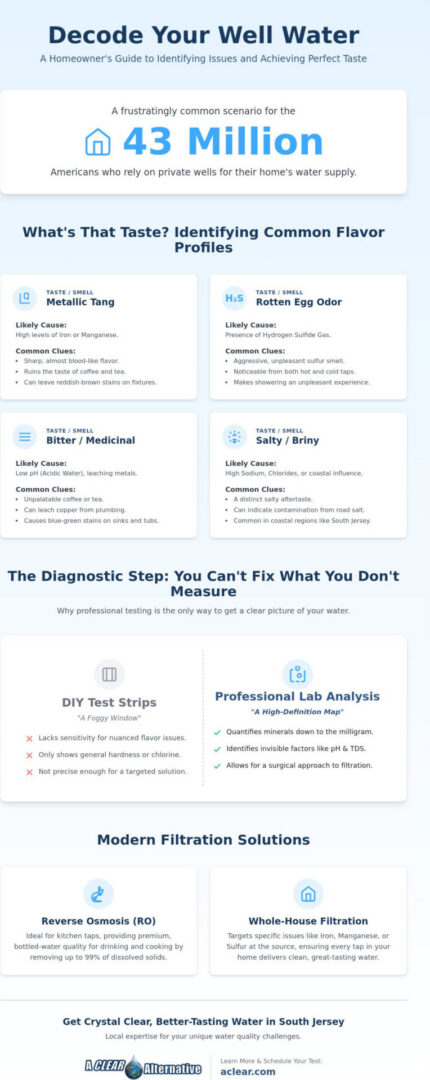
South Jersey homeowners frequently encounter a distinct metallic tang. This usually points to high levels of iron or manganese, which are common in our local aquifers. If your water has a sharp, blood-like flavor, these minerals are likely the culprits. Another unmistakable profile is the “rotten egg” odor. This is caused by hydrogen sulfide gas trapped in the groundwater. It’s aggressive, unpleasant, and can make even a simple shower feel like a chore.
Many people overlook the bitter or medicinal taste that makes coffee and tea unpalatable. This is often a sign of low pH. Acidic water is naturally “hungry” and leaches copper from your home’s plumbing as it sits in the pipes. If you notice a salty or briny note, you might be dealing with high sodium levels or the influence of coastal brackish water. Each of these profiles requires a specific strategy to fix, moving you closer to that desired bottled-water quality.
Why Sensory Clues are Your First Warning
Your fixtures often tell the story before you even take a sip. Blue-green stains on your porcelain or chrome are a classic red flag for acidic water and copper leaching. This acidity is what creates that unpleasant, bitter flavor. You can also try the “Coffee Test.” High mineral content interferes with the delicate oils in your favorite beans, turning a premium brew into a metallic disappointment. In the context of secondary EPA water quality standards, palatability is defined as the aesthetic appeal of water based on its taste, odor, and appearance rather than its direct health impact.
The Science of Groundwater Chemistry
The “mouthfeel” of your water is often determined by Total Dissolved Solids (TDS). High TDS creates a heavy or “dirty” sensation on the tongue. Organic matter can also seep into the well, introducing earthy or musty undertones that feel like you’re drinking from a forest floor. It’s also vital to remember that well water isn’t static. Its taste can change seasonally. Heavy spring rainfall can wash new organic material into the aquifer, while summer droughts can concentrate minerals, making existing flavor issues even more pronounced. Understanding these shifts helps you maintain a consistent, high-quality experience year-round.
The Diagnostic Step: Why Professional Testing Is Essential
You can’t fix what you haven’t measured. While your taste buds are excellent at sounding the alarm, they aren’t precise enough to tell you exactly how to improve well water taste. There’s a significant difference between water that’s legally “safe” to drink and water that’s actually enjoyable to consume. Many homeowners rely on basic annual tests that only check for total coliform or nitrates. While these are vital for health, they don’t explain why your tea tastes like a copper penny or why your shower smells like a swamp. Professional testing bridges the gap between basic safety and a premium drinking experience.
You might see advice online suggesting cheap DIY test strips from a big-box store. These kits are often like looking through a foggy window. They might show a color change for general hardness, but they lack the sensitivity to detect the nuanced mineral imbalances that ruin flavor. Invisible factors like pH levels and specific dissolved solids can drastically alter the “mouthfeel” of your water without changing its appearance. If you live in South Jersey, understanding the specific geology of your town is vital. We’ve compiled a Well Water Testing in Tabernacle, Shamong, and Medford Lakes: Essential Guide for Homeowners to help you navigate these local nuances.
What a Lab Analysis Reveals
A certified lab analysis provides a high-definition map of your water chemistry. It quantifies iron and manganese levels down to the milligram, allowing for a surgical approach to filtration. It also identifies the presence of hydrogen sulfide gas, which is the source of that aggressive sulfur odor. Beyond minerals, a lab can detect specific bacteria that contribute to musty or “wet dog” smells. Most importantly, it measures your pH level with precision. This tells us if your water is acidic enough to leach metals from your pipes, which is a primary cause of bitter, medicinal tastes.
Moving from Data to Action
At A Clear Alternative, we don’t believe in guesswork. We use these detailed test results to customize a filtration strategy that fits your home’s unique needs. It’s also important to test water at the source, before it enters your plumbing, as well as at the tap. This comparison helps determine if the taste issue is coming from the well itself or if your pipes are contributing to the problem. To maintain that crisp, bottled-water quality, we recommend a professional check-up every 12 to 24 months. If you’re ready to see exactly what’s in your glass, starting with comprehensive water testing is the most direct path to clarity.
Comparing Solutions: Which System Fixes Your Taste Issue?
Once you have your test results, the path to better water becomes clear. You aren’t just buying a generic filter; you’re selecting a specific technology to neutralize the chemistry of your well. If you’re wondering how to improve well water taste, the answer depends on whether your goal is pure drinking water at the kitchen sink or a refreshing, odor-free experience throughout the entire home. Matching the right system to your specific “flavor profile” is the only way to achieve permanent results.
Reverse Osmosis (RO) Systems are the gold standard for the kitchen. They use a semi-permeable membrane to strip away the “salty” or “chemical” notes that basic filters miss. It’s the simplest way to get that crisp, bottled-water quality for your morning coffee. For those dealing with a metallic taste from iron and manganese, an Iron and Sulfur Filtration System is the heavy lifter. These systems oxidize and trap minerals before they can stain your sinks or ruin your tea.
Acid Neutralizers are a crucial, often overlooked solution in our region. They raise the pH of your water, stopping the leaching process that creates a bitter, copper flavor. Without one, even the best filters can’t stop the metallic tang caused by acidic water eating away at your pipes. Finally, Carbon Filtration Systems act as the ultimate polish. They use activated carbon to absorb organic odors and earthy notes, leaving you with water that smells as clean as it looks.
Whole House Systems vs. Point-of-Use
Deciding between a whole-house system and a point-of-use unit comes down to your lifestyle needs. A point-of-use RO system is perfect if you only care about the flavor of your drinking and cooking water. However, if that rotten egg smell is following you into the shower or your laundry is coming out stained, you need a more comprehensive approach. Our Whole House Water Filtration Systems for Tabernacle, Shamong, & Medford Lakes: The 2026 Homeowner’s Guide provides a deeper look at how to protect your entire home. While whole-house systems require a higher initial investment, they protect your plumbing and ensure every tap provides a premium experience.
Targeting Specific Contaminants
Modern technology allows us to be surgical. Iron filters don’t just strain the water; they use oxidation to physically change the state of minerals so they can be trapped and flushed away. This is the most effective way to eliminate that blood-like metallic flavor. RO systems remain the best defense against high TDS and nitrates, which are often responsible for a heavy or “off” mouthfeel. For homes where biological growth might be a concern, Ultraviolet (UV) Sterilizers ensure that your water’s flavor isn’t compromised by microscopic organic matter. By matching the right tech to your specific test results, you’re not just filtering water; you’re upgrading your daily life.
Maintaining Your System for Long-Term Flavor Consistency
Installing a premium filtration system is a transformative decision for your home. It’s the difference between tolerating your water and truly enjoying it. But the journey doesn’t end at installation. If you want to know how to improve well water taste permanently, the answer is proactive maintenance. A “set it and forget it” approach eventually leads to a return of those metallic tangs or earthy odors you worked so hard to eliminate. When filter media becomes exhausted, its capacity to absorb impurities or neutralize acids drops significantly. This allows minerals to bypass the system, slowly degrading the flavor profile of your morning coffee and evening tea.
Filter Replacement Cycles
Consistency is key to maintaining that crisp, refreshing mouthfeel. Your Reverse Osmosis (RO) system is a precision instrument, and its membrane is its most critical component. If you notice a sudden drop in water pressure or a subtle “chemical” taste returning, it’s a clear sign your membrane needs attention. Similarly, an acid neutralizer works by slowly dissolving media into your water to balance its pH. This media must be replenished regularly to prevent your water from becoming acidic and bitter again. While some tasks are simple, a professional system check-up ensures that every valve and sensor is calibrated for maximum efficiency.
The Role of Softener Salt in Taste
If you have a water softener, the quality and level of your salt directly impact the flavor of every glass you pour. When your brine tank runs low, the system can’t effectively strip away hardness minerals. This results in a “chalky” or “heavy” taste that feels dated and unpleasant. Conversely, using low-grade salt can sometimes lead to a “briny” feedback in the lines. High-quality salt ensures your system regenerates properly, keeping your water feeling light and clean. For many homeowners, the biggest challenge isn’t the maintenance itself, but the heavy lifting involved. That’s why we offer a Water Softener Salt Delivery Service in Tabernacle, Shamong & Medford Lakes to keep your system running without the physical strain.
Regular care protects your investment and your daily quality of life. Don’t wait for the bad taste to return before taking action. You can keep your water at its aesthetic peak and ensure your system never runs dry by signing up for our salt delivery and maintenance service today.
South Jersey’s Choice for Better-Tasting Water
Achieving the perfect glass of water isn’t a generic task. It’s a local science. In our corner of New Jersey, the earth tells a different story than it does in other regions. If you’re searching for how to improve well water taste, you need a partner who understands the specific mineral makeup of Tabernacle, Shamong, and Medford Lakes. A Clear Alternative has been a family-owned legacy of water excellence since 1991. We don’t just look at pipes and pumps; we focus on how your water impacts your self-image and daily comfort. We bridge the gap between complex water chemistry and the simple, modern joy of a clear glass of water.
Our team provides 24/7 emergency support for your water treatment systems because we know that water issues don’t follow a business schedule. Whether it’s a sudden change in flavor or a system malfunction, we’re here to ensure your home remains a sanctuary. It’s about giving you back your confidence and removing the embarrassment of serving “well water” to your guests. We treat your water as a lifestyle choice, ensuring it meets the highest aesthetic and quality standards available in 2026.
Serving Tabernacle, Shamong, and Beyond
Our commitment to this community goes beyond technical service. We understand that South Jersey’s unique Pine Barrens environment creates specific challenges that national brands often overlook. The sandy, porous soil in our area often leads to highly acidic water. This requires specialized acid neutralizers tailored specifically to our local geology to prevent that bitter, metallic tang. If you’re comparing your options for local service, check out our guide on Expert Water Treatment Companies Near Tabernacle, Shamong, and Medford Lakes: 2026 Homeowner’s Guide. We want you to feel empowered and informed about the water flowing through your home.
Your Path to Better Water Starts Here
Getting the water you deserve is a simple, streamlined process. It starts with professional testing and ends with a custom-installed solution that fits your home’s aesthetic and functional needs. There’s no reason to settle for water that smells like sulfur or leaves your morning coffee tasting like iron. You’ve worked hard for your home, and every detail, down to the water in your glass, should reflect that quality. Stop settling for “good enough” and start enjoying the crisp, refreshing profile of truly clean water. Contact us today for a comprehensive water analysis! and take the first step toward a bottled-water experience at every tap in your house.
Elevate Your Home Life with Every Glass
Your journey toward premium water doesn’t have to be complicated. By understanding your water’s unique flavor profile and investing in professional lab analysis, you’ve already taken the most important steps. You now know that the secret of how to improve well water taste lies in matching modern technology, like Reverse Osmosis or acid neutralizers, to your specific local geology. Whether you’re removing a metallic tang or a stubborn sulfur odor, the result is a home that feels more refined and a kitchen that serves nothing but excellence.
Since 1991, A Clear Alternative has helped homeowners across the Tri-State area reclaim their confidence in their water. As a family-owned local business, we pride ourselves on bridging the gap between technical chemistry and your daily quality of life. We’re here for you with 24/7 emergency water support, ensuring your systems never skip a beat. Stop settling for water that holds your home back. Schedule Your Comprehensive Well Water Analysis Today and rediscover the joy of a truly refreshing drink. You deserve water that is as crisp and clear as your lifestyle.
Frequently Asked Questions
Is it safe to drink well water that tastes like metal?
A metallic taste is usually caused by high levels of iron or manganese, which are considered aesthetic contaminants rather than immediate health risks. However, that blood-like flavor can also hide more serious issues like lead or copper leaching from your home’s plumbing. While the minerals themselves might not harm you, the underlying acidity causing the leaching is a concern. Professional water testing is the only way to confirm your water is safe while you explore how to improve well water taste.
Will a pitcher filter make my well water taste better?
Pitcher filters provide a minor improvement by reducing chlorine, but they are often overwhelmed by the heavy mineral loads found in private wells. They lack the capacity to remove significant amounts of iron, sulfur, or hardness minerals that cause the most common taste complaints. You’ll likely find yourself replacing expensive cartridges every few weeks. For a permanent, bottled-water quality experience, a dedicated Reverse Osmosis system or whole-house filtration is a much more effective lifestyle choice.
Why does my well water taste like dirt even with a filter?
An earthy or “dirty” taste is typically caused by organic matter or geosmin in the groundwater, which standard sediment filters cannot stop. These microscopic particles pass right through mesh or pleated filters that only target physical debris. You need a specialized carbon filtration system to absorb these odors and flavors. If the taste persists, it may also indicate that your existing filter media is exhausted and needs a professional refresh to restore its effectiveness.
How much does it cost to fix bad-tasting well water in NJ?
The investment required depends entirely on your water’s specific chemistry and the volume of water your household uses. A simple point-of-use system for drinking water will have a different price point than a comprehensive whole-house iron and sulfur filtration setup. Because South Jersey’s geology varies so much between towns, we recommend starting with a lab analysis. This ensures you only invest in the technology you actually need rather than a generic, one-size-fits-all solution.
Can low pH make my water taste bitter?
Yes, low pH is a primary cause of bitter or medicinal flavors in well water. When your water is acidic, it aggressively leaches copper and other metals from your pipes and fixtures as it sits. This chemical reaction introduces a sharp, unpleasant tang that ruins the flavor of food and beverages. Installing an acid neutralizer balances the pH, protecting your plumbing and instantly creating a more neutral, crisp taste profile for your entire home.
What is the best system for removing a rotten egg smell from well water?
An iron and sulfur filtration system is the gold standard for eliminating that aggressive “rotten egg” odor. These modern systems use a process called oxidation to turn dissolved hydrogen sulfide gas into a physical particle that can be trapped and flushed away. It’s a clean, efficient solution that works without the need for harsh chemicals. This technology ensures that your water smells as fresh as it tastes, whether you’re filling a glass or taking a shower.
Does a water softener improve the taste of drinking water?
A water softener improves the “mouthfeel” of your water by removing the calcium and magnesium that cause a chalky, heavy sensation. While it makes the water feel lighter and prevents scale buildup, it doesn’t remove chemical tastes or odors. Some people also notice a very slight change in flavor due to the ion exchange process. For the ultimate drinking experience, many homeowners pair a water softener with a Reverse Osmosis system to achieve total flavor clarity.
How often should I test my well water if the taste changes?
You should schedule a professional test immediately whenever you notice a shift in flavor, odor, or clarity. Changes in taste are often early warning signs of shifts in the local aquifer or a sign that your filtration equipment needs maintenance. Even if the water tastes fine, the EPA recommends testing for bacteria and nitrates annually. Regular check-ups are a vital part of how to improve well water taste and ensure your system provides consistent, premium results year after year.