
Does Hard Water Cause Dry Skin? The Science and the Solution for NJ Homeowners
What if your morning shower is actually the reason your expensive luxury moisturizers aren’t working? It’s a frustrating cycle for many New Jersey homeowners who deal with itchy, flaky patches despite a dedicated routine. You might wonder, does hard water cause dry skin, or is it just your genetics? The truth is that mineral-heavy water doesn’t just sit on your skin; it creates a microscopic shield of calcium and magnesium that blocks hydration from ever reaching your pores. With eczema prevalence in New Jersey now exceeding 13%, the quality of your home’s water has never been more critical to your self-care.
You’ve likely spent a fortune on serums and lotions only to feel that familiar, tight hard water itch the moment you towel off. It’s exhausting to feel like you’re fighting a losing battle against your own tap. We’re here to help you reclaim your natural glow and finally achieve the clear, hydrated skin you deserve. This guide breaks down the latest 2026 research on the skin barrier and explores the modern filtration technology that transforms your water from a source of irritation into a daily beauty treatment.
Key Takeaways
- Understand how “soap scum” isn’t just on your shower door; it’s a mineral film on your skin that traps bacteria and clogs pores.
- Learn why the answer to “does hard water cause dry skin” lies in the way calcium and magnesium strip away your natural protective oils.
- Discover the scientific link between mineral-heavy water and the increased prevalence of chronic conditions like eczema in New Jersey.
- Identify why the unique water chemistry in Tabernacle, Shamong, and Medford Lakes makes professional laboratory testing essential for your skin health.
- See how a high-quality water softener serves as the ultimate skincare investment for lasting hydration and a natural glow.
The Hidden Link Between Hard Water and Your Skin’s Health
Your skincare routine doesn’t start with a serum, a cleanser, or an expensive night cream. It starts the moment you turn on the faucet. For many homeowners in South Jersey, the water flowing through their pipes is the silent saboteur of their aesthetic goals. Before we can address the damage, we have to understand the source. What is hard water? Scientifically, it’s water that contains high concentrations of dissolved minerals, primarily calcium and magnesium ions. While these minerals are naturally occurring, they transform your daily shower into an abrasive experience that leaves your skin feeling stripped and vulnerable.
Have you ever stepped out of the shower and felt an immediate, uncomfortable tightness across your face or shoulders? That “hard water itch” isn’t in your head. It’s a physical reaction to mineral deposits left behind on your skin. If you live in Medford Lakes or Tabernacle, this is likely a year-round struggle. You aren’t just washing with water; you’re washing with a mineral cocktail that disrupts your skin’s natural pH balance. When you consider that your water is the foundation of every self-care ritual you perform, it’s easy to see how poor water quality can undermine even the most sophisticated beauty regimen.
While water quality is a major factor, comprehensive skin protection also involves managing your home’s indoor environment; for example, Sun Guard Tint provides specialized window films that block UV rays, preventing further irritation and dryness caused by sun exposure.
Is Your Water Actually ‘Hard’?
You don’t need a lab coat to spot the signs of mineral-heavy water. Look for white, crusty buildup on your showerhead or stubborn spotting on glass doors. You might notice your favorite soap barely produces a lather, requiring you to use twice as much product just to feel clean. Many people mistake “squeaky clean” skin for a job well done. In reality, that squeak is the sound of friction caused by mineral residue. Hard water is essentially a solution of dissolved rock that leaves a physical film on your body.
Why Lotions Alone Can’t Fix the Problem
Many people ask, does hard water cause dry skin, because they’re tired of the endless cycle of moisturizing. You apply thick creams and expensive oils, yet the flakiness returns within hours. This happens because the minerals in your water act as a microscopic barrier. They sit on the surface of your dermis, physically blocking your skincare products from penetrating where they’re needed most. It’s a frustrating experience that goes beyond aesthetics. Persistent skin discomfort can take a real emotional toll, making you feel less like yourself and more self-conscious about your appearance. Until you fix the water, you’re only treating the symptoms of a much deeper issue.
How Minerals Like Calcium and Magnesium Sabotage Your Skin Barrier
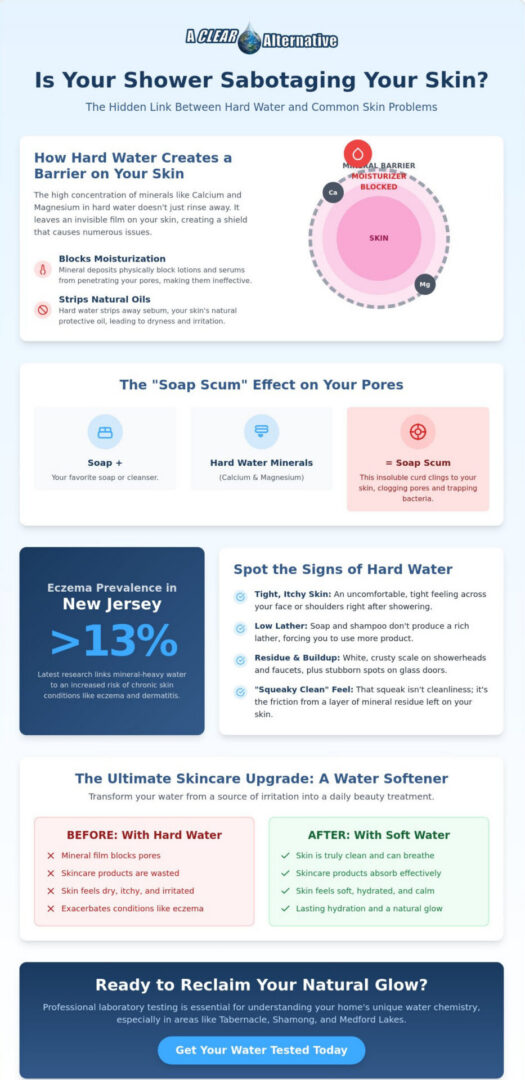
When you mix hard water with your favorite cleanser, a chemical reaction occurs that most people never see coming. The high levels of calcium and magnesium ions in your water don’t just stay in the pipes. They react with the fatty acids found in traditional soaps to create an insoluble curd. This is the exact same substance that forms “soap scum” on your glass shower doors. If it’s tough enough to require a scrub brush on your tile, imagine the impact it has on your delicate facial skin. Instead of rinsing away cleanly, this mineral curd clings to your body, leaving a heavy residue that can’t be removed with water alone.
This residue acts like a suffocating blanket for your pores. It traps dirt, sweat, and environmental pollutants against your skin, which often leads to unexpected breakouts and localized irritation. Beyond just surface-level issues, these minerals actively strip away your sebum. Sebum is the natural lipid layer your body produces to keep moisture in and irritants out. When this protective oil is gone, your skin loses its elasticity and resilience. Many people ask, does hard water cause dry skin, but the reality is even more complex. It doesn’t just dry you out; it fundamentally breaks down your skin’s ability to heal itself.
The ‘Soap Scum’ Effect on Your Pores
The film you see on your bathroom fixtures is currently sitting on your skin. This “curd” is incredibly difficult to rinse off. While washing with soft water creates a rich, fluffy lather that glides away, hard water creates a sticky paste. This paste settles into your pores, leading to a specific type of “clogged pore” acne that topical treatments struggle to fix. You might find that your skin feels dirty even after a long shower because that mineral shield is literally holding onto bacteria. If you’re tired of the film, installing a water softener is often the first step toward a truly clean complexion.
Disrupting the Acid Mantle
Your skin has a natural defense mechanism called the acid mantle. This slightly acidic layer is your first line of defense against dehydration and harmful bacteria. Unfortunately, hard water is typically aggressively alkaline. Every time you wash, these alkaline minerals neutralize your natural acidity, leaving your skin defenseless and highly sensitive. What Dermatologists Are Starting to Say is that this constant pH disruption is a primary trigger for chronic sensitivity. Healthy skin is naturally acidic, while hard water is aggressively alkaline. When these two forces clash, your skin’s barrier loses its integrity, making it nearly impossible to maintain a hydrated, healthy glow without intervention.
Beyond Dryness: Hard Water, Eczema, and Dermatitis
It is easy to dismiss a little flakiness as a seasonal annoyance. You might tell yourself it’s just the weather or a lack of moisturizer. However, for many New Jersey families, the answer to the question “does hard water cause dry skin” is actually the start of a much more serious conversation about medical skin conditions. When mineral concentrations are high, your water stops being a source of hydration and starts acting as a chronic irritant. This isn’t just about aesthetics; it’s about the health of your body’s largest organ. With the prevalence of eczema in New Jersey now exceeding 13%, understanding the environmental triggers in your home is vital for long-term relief.
The relationship between mineral-heavy water and Atopic Dermatitis is more than anecdotal. Recent research from 2026 confirms that the high levels of calcium and magnesium found in local aquifers can physically damage the skin barrier. This damage leaves you vulnerable to a “vicious cycle” of discomfort. The minerals cause an itch, the scratching breaks the skin, and the leftover mineral residue then seeps into those micro-tears. This often leads to secondary infections or severe flare-ups that topical steroids can only temporarily mask. For residents in our area, breaking this cycle requires looking past the medicine cabinet and into the plumbing.
Hard Water and Eczema: The Connection
Studies published in 2025, including a large-scale UK Biobank cohort study, found that living in hard water areas is significantly associated with an increase in eczema prevalence. Children and infants are particularly at risk because their skin barriers are thinner and more permeable than those of adults. The minerals act as a physical abrasive, microscopic “stones” that rub against sensitive patches of skin all day long. Identifying the specific mineral profile of your home through professional well water testing is the first step toward creating a safe, soothing environment for your family.
Sensitive Skin and the ‘Hard Water Itch’
If you feel a distinct “prickling” or “crawling” sensation on your skin immediately after towel-drying, you’re experiencing the classic hard water itch. This sensation occurs regardless of your skin type. While oily skin might face more clogged pores, dry and combination types often see increased redness and sensitivity. You’ve likely noticed that even high-end “sensitive skin” soaps fail to provide relief. This is because those gentle formulas still react with the dissolved rock in your water to create the irritating curd we discussed earlier. When you’re wondering, does hard water cause dry skin, remember that the minerals are neutralizing your skin’s natural defenses, making even the mildest products feel aggressive.
Testing Your Water in Tabernacle, Shamong, and Medford Lakes
The water landscape in South Jersey is as unique as the Pine Barrens themselves. While many national articles offer generic advice, homeowners in Tabernacle, Shamong, and Medford Lakes face a specific set of challenges that require localized expertise. You might spend hours researching “does hard water cause dry skin” while the real culprit is a complex mix of minerals and low pH levels hiding in your well. Our region relies heavily on groundwater from systems like the Potomac-Raritan-Magothy aquifer, which naturally dissolves sedimentary deposits. This results in water that isn’t just hard; it’s often aggressive and chemically imbalanced.
A professional laboratory analysis is the only way to get a true picture of what is happening in your home. While “DIY” home kits can give you a basic idea of chlorine or hardness, they often miss the subtle nuances of South Jersey water chemistry. A comprehensive test examines the foundation of your home’s health. It reveals the exact mineral count, the presence of heavy metals, and the acidity levels that could be sabotaging your skincare routine. At A Clear Alternative, we’ve provided this level of detailed, family-owned service since 1991. We understand that your water isn’t just a utility; it’s a vital part of your family’s daily comfort and self-confidence.
Local Water Challenges in South Jersey
Residents in Tabernacle and Shamong frequently deal with more than just hardness. The groundwater here is often naturally acidic. This low pH can lead to the corrosion of your plumbing and the presence of blue-green stains in your sinks. When combined with mineral hardness, acidic water becomes even more irritating to sensitive skin. If you notice a metallic taste or find that your skin feels perpetually “stripped” after washing, you should consult our Acid Neutralizer Systems guide. Additionally, iron and sulfur are common local issues. In Medford Lakes, data from private well testing shows that over 15% of wells exceed iron limits, which can lead to localized skin staining and unpleasant odors.
What to Look for in Your Test Results
When you receive your results, you’ll likely see measurements in Grains per Gallon (GPG) or Parts per Million (PPM). Water is generally classified as “hard” at 7 GPG and “very hard” at 10.5 GPG. Even “moderately hard” water, which is common in Medford Lakes, can be enough to trigger the “does hard water cause dry skin” cycle. Your report will also highlight secondary contaminants like lead, copper, or nitrates. These elements can exacerbate existing skin conditions or cause new sensitivities. Understanding these numbers is the first step toward reclaiming your glow. For a transparent and professional evaluation of your home’s water, schedule A Clear Alternative water testing today to ensure your family is protected.
Reclaiming Your Glow: Why a Water Softener is the Ultimate Skincare Upgrade
Investing in a water softener is more than a home maintenance task. It’s an investment in your daily comfort and long-term self-confidence. When you eliminate the minerals that answer “yes” to the question, does hard water cause dry skin, you change the way you feel every single morning. Soft water allows your cleansers to do exactly what they were designed to do: lift away impurities and rinse away completely. Without that sticky mineral curd on your body, your skin finally feels truly clean, breathable, and receptive to the products you already own. It’s the difference between fighting your water and letting your water work for you.
Think of this as your “esthetic ROI.” You could continue spending hundreds of dollars every year on thick specialty creams that only sit on the surface of mineral-clogged pores. Or, you could choose a permanent solution that addresses the root cause of the irritation. Modern whole house water filtration systems don’t just protect your plumbing and appliances; they protect your glow. By removing the harshness from every tap in your home, you create an environment where your skin, hair, and even your favorite linens can thrive without chemical interference.
The Transformative Power of Soft Water
The first thing you’ll notice after an installation is the texture. Soft water has a distinctively silky feeling that many people initially describe as “slippery.” This isn’t residue. It’s actually the absence of the abrasive minerals that used to scrape against your skin and hair. You’ll find your hair feels lighter and more voluminous, while your scalp stays hydrated without the need for heavy clarifying treatments. Even your clothes and towels will feel softer against your body. Soft water prevents fabrics from becoming stiff and scratchy, which is a major relief for anyone dealing with chronic sensitivity or the “hard water itch” mentioned earlier.
Choosing the Right Solution for Your Home
A one-size-fits-all unit from a big-box store rarely accounts for the specific iron levels or acidity found in Shamong, Tabernacle, or Medford Lakes wells. You deserve a system that’s custom-tailored to your home’s unique chemical profile. At A Clear Alternative, we provide the local expertise and support that only a family-owned business can offer. We don’t just install equipment; we provide the freedom to feel comfortable in your own skin again. Schedule your professional water analysis today and stop the dry skin cycle for good. It’s time to reclaim your natural radiance and enjoy the luxury of truly clean water.
Take the First Step Toward Radiant, Healthy Skin
You don’t have to settle for itchy, uncomfortable skin as a byproduct of living in South Jersey. We’ve explored how mineral buildup acts as a physical barrier to your skincare and how the aggressive alkalinity of your tap water can trigger chronic conditions like eczema. Stop wondering does hard water cause dry skin and start treating the source of the irritation with a permanent solution. Your home should be a place where your beauty routine flourishes, not a place where it’s sabotaged by dissolved rock.
Creating a truly healthy home goes beyond just water quality; maintaining optimal air conditions is equally important for skin health, and you can discover Nature Carer Environmental Solutions to see how advanced climate control systems can complete your home wellness environment.
As a family-owned and operated team serving the area since 1991, we understand the specific chemistry of our local aquifers. We’re licensed potable water haulers and treatment specialists who offer 24/7 emergency support to keep your home running smoothly. Your journey to hydrated, resilient skin begins with a clear understanding of what’s in your pipes. Schedule Your Professional Water Analysis Today and transform your shower into the ultimate skincare upgrade. You deserve to feel confident and glowing every single day.
Frequently Asked Questions
Can hard water cause itchy skin after a shower?
Yes, hard water often causes a prickly or itchy sensation immediately after you dry off. This happens because the minerals in the water react with your soap to create a sticky film that stays on your skin. This residue strips away your natural oils and causes persistent irritation. If you find yourself reaching for lotion the second you step out of the tub, your water chemistry is likely the culprit.
Is hard water responsible for my sudden acne breakouts?
Yes, hard water can definitely trigger or worsen acne breakouts. The mineral curd created by calcium and magnesium blocks your pores and prevents natural sebum from escaping. This creates a perfect environment for bacteria to grow. Many people who ask, does hard water cause dry skin, also find that their skin becomes congested and prone to inflammation because of this suffocating mineral layer.
Will a showerhead filter fix my dry skin issues?
No, a standard showerhead filter will not solve your hard water problems. These filters are usually designed to remove chlorine and odors, but they lack the technology to remove dissolved calcium and magnesium. To truly soften your water and protect your skin, you need a dedicated water softener. This system removes the minerals at the entry point of your home, ensuring every tap provides skin-friendly water.
How do I know if my well water is hard without a professional test?
You can spot the signs of hard water by looking at your bathroom fixtures and your laundry. If you see white, chalky buildup on your faucets or stubborn spots on your shower glass, your water is likely high in minerals. You might also notice that your clothes feel stiff or that you need a lot of soap to get a decent lather. These are clear indicators of mineral-heavy water.
Can hard water cause hair loss or thinning?
Hard water doesn’t usually cause direct hair loss, but it makes your hair brittle and prone to breakage. The minerals create a coating on the hair shaft that prevents moisture from getting in, leading to dullness and tangles. Over time, mineral buildup on the scalp can also cause irritation and dryness, which may negatively impact your hair follicles and overall scalp health.
Is soft water better for babies with sensitive skin?
Yes, soft water is significantly better for the delicate skin of infants and young children. Since a baby’s skin barrier is much thinner than an adult’s, it’s more susceptible to the abrasive nature of calcium and magnesium. Using soft water helps maintain their natural pH balance and reduces the risk of developing early childhood skin conditions like atopic dermatitis or cradle cap.
What is the best water hardness level for healthy skin?
The ideal water hardness level for healthy skin is 0 Grains per Gallon (GPG). Water is generally considered hard once it reaches 7 GPG. While some people can tolerate moderate hardness, those with sensitive skin often notice a massive improvement in hydration and clarity once their water is completely softened. Achieving this balance is the most effective way to stop the cycle of irritation.
Does hard water make eczema symptoms worse?
Yes, hard water is a known trigger that makes eczema symptoms significantly worse. The mineral residue acts as a physical irritant that further damages an already compromised skin barrier. When you consider the question, does hard water cause dry skin, it’s important to realize that for eczema sufferers, this dryness quickly turns into painful inflammation and flare-ups that are difficult to manage without fixing the water quality.