
Hard Water Spots on Dishes Solution: How to Get Spotless Glassware in 2026
You’ve just finished hosting a beautiful dinner, but as you hand a glass of wine to your guest, you notice those stubborn, cloudy streaks that make even your cleanest glassware look neglected. It’s incredibly frustrating to spend your evening hand-drying or re-washing plates when you should be relaxing. If you are tired of the extra work, you aren’t alone. Many homeowners are searching for a reliable hard water spots on dishes solution to reclaim their kitchen’s aesthetic and protect their investment.
We understand that these spots are more than just an eyesore; they are a constant reminder of the mineral buildup that could be shortening the life of your dishwasher. You shouldn’t have to choose between your free time and a spotless home. This article will show you how to eliminate those mineral deposits forever. We will cover everything from simple maintenance hacks to the modern, professional systems that offer a true “set and forget” lifestyle. Get ready to discover how the right water chemistry can transform your daily routine, protect your appliances, and restore your confidence in every pour.
Key Takeaways
- Understand why calcium, magnesium, and even silica in New Jersey water create that stubborn cloudy film on your favorite glassware.
- Discover the ultimate hard water spots on dishes solution by comparing temporary DIY hacks with the “set and forget” freedom of professional systems.
- Learn how to protect your expensive dishwasher’s heating elements and spray arms from permanent mineral damage before it is too late.
- See why standard store-bought filters often fail against the unique mineral profiles found in areas like Medford Lakes and Shamong.
- Find out how custom-engineered water treatment can restore your confidence when serving guests and reclaim your time from endless hand-drying.
Why Your Dishes Come Out Cloudy: Understanding Hard Water Spots
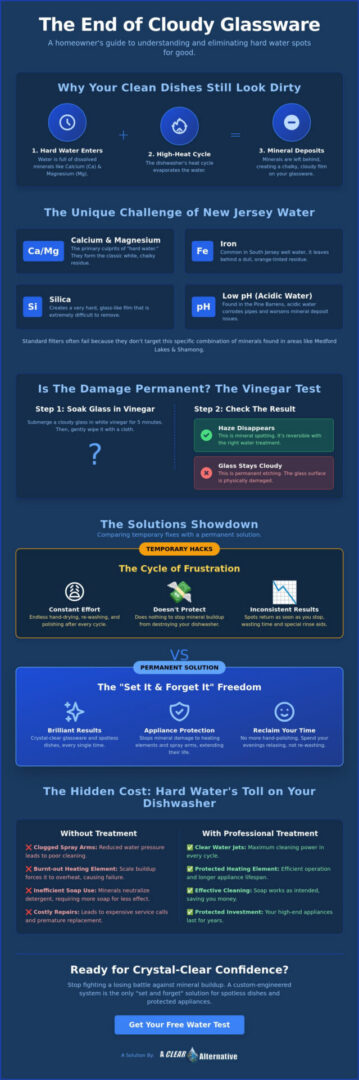
Your kitchen is a reflection of your personal style and attention to detail. You’ve likely spent time selecting the perfect minimalist glassware or high-end porcelain, yet a persistent white haze often ruins the look. It’s not a reflection of your cleaning habits. It’s a matter of chemistry. Those white, chalky rings are actually solid mineral deposits. If you’ve ever wondered what is hard water?, it’s simply water containing high concentrations of dissolved calcium and magnesium. When water evaporates during a high-heat drying cycle, these minerals stay behind. They bond to your plates, creating a film that makes even the newest items look aged and neglected.
The Chemistry of the Cloudy Film
Heat acts as a powerful catalyst inside your dishwasher. As temperatures rise to sanitize your loads, dissolved minerals precipitate out of the water much faster. This is why the residue feels so difficult to remove. Most standard detergents aren’t built to handle this. They are designed to strip away food oils, but they can’t “cut through” liquid rock. High mineral levels can even neutralize your soap, preventing it from lathering properly. As the rinse water evaporates, it leaves behind a concentrated, chalky residue that dries into that signature cloudy film.
Spotting vs. Etching: Can Your Dishes Be Saved?
It is vital to distinguish between a surface deposit and permanent structural damage. You can perform a simple “vinegar test” to find out if your glassware can be restored. Soak a cloudy glass in white vinegar for a few minutes. If the haze wipes away, you are dealing with mineral buildup. This is great news because a professional hard water spots on dishes solution can fix this easily. However, if the glass stays cloudy, it has likely been etched. Etching is a permanent chemical reaction where the glass surface is microscopically pitted. It usually happens when water is too soft or detergent is too aggressive. Protecting your glassware from day one is the only way to ensure it stays crystal clear for years.
The Science of Spotting: Minerals, Silica, and NJ Water Quality
Living in South Jersey means your water has its own unique personality. In towns like Tabernacle, Shamong, and Medford Lakes, the water doesn’t just come from a municipal pipe; it often comes from deep within the local aquifer. This water is naturally soft in some ways but carries a complex mineral load that makes finding a hard water spots on dishes solution more difficult than a simple store-bought fix. The U.S. Geological Survey explains water hardness as the amount of dissolved calcium and magnesium, but for local residents, iron and silica are often the real culprits behind those unsightly streaks.
South Jersey iron can turn your “white” spots into a dull, orange-tinted residue that ruins the look of your kitchen. Even worse is silica, which creates a hard, glass-like film that mocks your cleaning efforts. Because every well is different, the first step to crystal-clear glassware is a professional well water testing session. This identifies exactly what is in your water so you aren’t guessing with your expensive appliances. Knowing your mineral profile is the secret to a spotless home.
Why South Jersey Well Water is Different
The Pine Barrens region is known for its acidic water. This low pH doesn’t just corrode your pipes; it changes how minerals behave in your dishwasher. When your water is acidic, it can hold more minerals in a dissolved state until they hit the high heat of your dishwasher. This is why many local homes require acid neutralizer systems to balance the chemistry before it reaches your kitchen. Balancing the pH is often a critical part of a comprehensive hard water spots on dishes solution for Tabernacle and Medford Lakes residents.
The Hidden Role of Silica
If you’ve tried the vinegar soak and the spots didn’t budge, you’re likely dealing with silica. Silica spots are distinct from calcium; they look like smooth, translucent drops fused to the glass. Traditional water softeners are excellent at removing calcium, but they often struggle with silica. Some Medford Lakes residents find a “sand-like” residue in their dishwasher filters, which is a clear sign that silica is present. Solving this often requires a secondary filtration step or a custom-engineered approach to ensure your glassware stays truly transparent and your confidence remains high when hosting.
Short-Term Hacks vs. Long-Term Solutions for Spotless Glassware
Dealing with cloudy glasses shouldn’t be a part-time job. If you’re currently reaching for a gallon of vinegar every time you run a cycle, you know how exhausting the cycle of hand-polishing can be. You want to spend your evenings enjoying your home, not scrubbing mineral rings off your favorite wine glasses. While many homeowners search for a quick hard water spots on dishes solution, there is a massive difference between managing the symptoms and curing the cause. The U.S. Geological Survey highlights the core causes of cloudy dishes and glassware as the mineral residue left behind after evaporation, and no amount of manual drying can change your water’s chemistry.
Choosing between a DIY hack and a professional system is really a choice between constant effort and total freedom. Rinse aids and citric acid boosters can help, but they require you to remember to buy and refill them constantly. They are a band-aid for a deeper issue. Investing in a high-quality water softener is the ultimate lifestyle upgrade that removes the minerals before they ever touch your kitchen. It’s a “set and forget” approach that protects your aesthetic and your time.
The DIY Route: Vinegar and Citric Acid
Vinegar is the most common DIY remedy because its acidity can dissolve calcium. However, using it as a permanent hard water spots on dishes solution is a chore that never truly ends. If you use it, you must be careful; vinegar is acidic enough to eventually dry out and crack the rubber seals and gaskets inside your dishwasher. Beyond the risk of leaks, these methods only treat the water once it’s already inside the machine. They do nothing for your laundry, your shower, or the pipes hidden behind your walls. It’s a repetitive, manual process that keeps you tethered to the sink.
The Professional Route: Water Softening
Modern water treatment systems are designed to be discreet and highly efficient. They work in the background, using ion exchange technology to swap out hardening minerals for harmless ions before the water reaches your tap. This means every drop of water in your home is treated, not just what goes into the dishwasher. You’ll find yourself using significantly less detergent, saving money on energy bills, and extending the life of your expensive appliances. It is a modern solution that delivers the crystal-clear results you expect without the daily hassle of manual intervention.
How to Stop Hard Water Damage Before It Becomes Permanent
The spots on your glassware are an early warning sign. While the aesthetic frustration is real, the true danger of hard water lies where you can’t see it. Inside your dishwasher, mineral scale is quietly accumulating on critical components. This isn’t just about a hard water spots on dishes solution for your wine glasses; it’s about saving your high-end appliances from an early grave. When calcium and magnesium bake onto heating elements, they create a thick, insulating crust. Your machine has to work twice as hard to reach the same temperature, which eventually leads to total mechanical failure.
Neglecting your water quality is an expensive gamble. You can evaluate the impact on your home right now by looking for these red flags:
- A white, chalky residue on the dishwasher’s interior walls or floor.
- Clogged spray arm nozzles that prevent water from reaching every dish.
- A “gritty” texture on plates that should be smooth.
- Faucets and showerheads showing visible crust or reduced water flow.
If you notice these signs, the damage is already starting. Professional water treatment is the only way to halt this process. You can maintain your system’s peak performance without any heavy lifting by using a water softener salt delivery service, ensuring your home stays protected year-round.
Protecting Your Appliance Investment
Modern high-efficiency dishwashers are precision instruments. They use less water than older models, which sounds great for the environment, but it means the mineral concentration in each cycle is significantly higher. A “hard water cycle” setting on a machine is rarely enough to combat the aggressive well water found in South Jersey. Replacing a premium dishwasher can cost well over $1,000, not including installation and the stress of a broken kitchen. Investing in a professional water softener is a proactive choice that pays for itself by doubling the lifespan of your appliances and reducing energy consumption.
Beyond the Kitchen: A Whole-House Aesthetic
The benefits of soft water extend far beyond your dinnerware. Think about the clarity of your glass shower doors and the mirror-like finish on your bathroom faucets. Hard water creates a “soap scum” effect that leaves a film on everything it touches, including your clothes, skin, and hair. Soft water allows your soaps to lather perfectly, leaving your laundry feeling plush and your skin feeling hydrated. It’s the secret to achieving a “magazine-ready” home where every surface gleams and maintenance is effortless. To see how a custom system can transform your daily life, schedule a comprehensive water test today and reclaim your home’s brilliance.
Professional Water Treatment: The A Clear Alternative Difference
You deserve a home that works for you, not the other way around. Reclaiming your time from endless scrubbing and polishing starts with choosing a partner who understands the specific challenges of South Jersey water. Since 1991, A Clear Alternative has provided family-owned expertise that goes far beyond what a generic “big box” store can offer. We don’t just provide a hard water spots on dishes solution; we custom-engineer systems designed for the unique mineral profiles found in your own backyard. Generic filters often fail because they are built for averages, but your water is specific to your land.
Our approach focuses on your quality of life and the long-term health of your home. We believe that technology should be discreet, efficient, and completely reliable. That is why we offer 24/7 emergency support across New Jersey, Pennsylvania, and Delaware. You aren’t just buying equipment. You are investing in a lifetime of professional support and the freedom that comes with perfectly clear water. When your water is right, everything from your morning coffee to your evening glass of wine feels more refined.
Our Local Expertise in Tabernacle and Medford Lakes
The geology of the Pine Barrens is beautiful, but it is notoriously difficult on plumbing. When searching for water treatment companies near me, it’s vital to find a team that understands how local acidity and silica levels interact. We begin every relationship with a personalized water analysis. This data-driven approach ensures that we address the root cause of your spotting issues rather than just treating the symptoms. Our commitment to the Tri-State community’s health means we provide solutions that protect both your family and your high-end appliance investments.
Seamless Installation and Maintenance
We believe the path to better water should be as smooth as the water itself. Our professional installation process is designed to be quick and non-disruptive, fitting seamlessly into your modern lifestyle. Once your system is live, our ongoing support takes the guesswork out of maintenance. From automated salt delivery to timely filter replacements, we handle the details so you don’t have to. It is the ultimate “set and forget” hard water spots on dishes solution that restores your confidence and keeps your home gleaming. Schedule your professional water test today and see the difference!
Reclaim Your Time and Your Kitchen’s Brilliance
You have seen how specific mineral profiles in South Jersey, especially silica and iron, turn your daily cleaning routine into an exhausting chore. You have also learned that while vinegar and boosters offer a temporary fix, they can’t match the long-term freedom of a custom-engineered system. The ultimate hard water spots on dishes solution isn’t found in a bottle of rinse aid; it’s found in balancing your home’s chemistry at the source. By addressing the mineral content before it reaches your dishwasher, you protect your expensive appliances and ensure every glass is ready for a magazine-ready pour.
Since 1991, our family-owned team has helped homeowners enjoy the luxury of crystal-clear water and spotless results. With 24/7 emergency support and our status as a licensed potable water hauler, we are committed to your home’s quality and your peace of mind. It is time to stop scrubbing and start enjoying the aesthetic clarity you deserve.
Get Your Professional Water Analysis and Say Goodbye to Spots
Your home is your sanctuary, and every detail should reflect your standards. Take the first step toward a simpler, more beautiful lifestyle today. We are here to help you achieve the lasting brilliance your glassware deserves.
Frequently Asked Questions
Is vinegar safe to use in my dishwasher for every load?
No, you shouldn’t use vinegar in every load. While it’s a popular DIY fix, vinegar is highly acidic and can eventually degrade the rubber gaskets and seals inside your machine. This leads to costly leaks and mechanical issues. It’s much safer to use a dedicated rinse aid or invest in a permanent hard water spots on dishes solution that treats the water before it enters the appliance.
Can hard water spots permanently damage my expensive glassware?
Yes, hard water can lead to a condition called etching. While mineral spots can be wiped away with a mild acid, etching is a permanent physical change where the glass surface becomes microscopically pitted. This happens when high heat and minerals react over hundreds of cycles. Once glass is etched, it’s impossible to restore, making proactive water treatment essential for protecting your collection.
Why does my dishwasher have a white film on the inside walls?
That white film is a clear sign of calcium and magnesium carbonate buildup. As the water evaporates during the high-heat drying cycle, these minerals solidify on every surface they touch. This buildup doesn’t just look bad; it clogs your spray arms and coats the heating elements. Finding a reliable hard water spots on dishes solution is the only way to prevent this scale from destroying your machine’s efficiency.
Will a water softener also help with my dry skin and hair?
How much salt does a typical whole-house water softener use?
Salt usage varies based on your water’s hardness and your family’s water consumption. A typical household of four usually goes through one 40-pound bag of salt per month. Modern, high-efficiency systems are designed to be much more conservative than older models. They only regenerate when necessary, which saves you money and reduces the frequency of refilling the brine tank in your utility room.
Do I need a special detergent if I have hard water?
You don’t need a special brand, but you’ll certainly need to use more of it. Hard water minerals neutralize the active cleaning agents in your soap. This forces you to use significantly more detergent to achieve the same level of cleanliness. Once you have soft water, you can often cut your detergent usage by half, saving money while getting much better results on your plates and glassware.
What is the difference between a water conditioner and a water softener?
A water softener physically removes calcium and magnesium ions through a process called ion exchange. It’s the only way to truly “soften” the water. A water conditioner typically changes the chemical structure of minerals so they don’t stick to surfaces as easily. While conditioners help reduce scale buildup, they don’t provide the same soap-saving benefits or the “slippery” feel that a true softener delivers.
How often should I have my home water tested in New Jersey?
You should have your water professionally tested at least once a year. New Jersey’s unique geology means that mineral levels and pH can shift due to seasonal changes or local environmental factors. If you’re on a private well, regular testing isn’t just a good idea; it’s a vital part of home maintenance that ensures your treatment systems are always calibrated to provide the best possible water quality.