
7 Telltale Signs of Hard Water: Is Your South Jersey Home at Risk in 2026?
That white, chalky crust building up around your faucets isn’t just an eyesore. It’s a warning sign. If you’ve been scrubbing soap scum off your shower walls, pulling dull, lifeless hair out of the drain, or watching your dishwasher slowly ruin your glassware, you’re likely already living with the most common signs of hard water, and your home is paying the price every single day.
You’re right to be frustrated. When you invest in quality appliances, premium skincare, and a home you’re proud of, the last thing you need is your water quietly working against all of it. Hard water is exactly that kind of silent disruptor: invisible in the tap, but destructive over time.
The good news? This is a problem with a precise, professional fix. In this article, you’ll learn the seven telltale signs that hard water has taken hold in your South Jersey home, what each one is actually doing to your pipes, skin, and appliances, and how a simple water test can give you the clarity and confidence to take back control.
Key Takeaways
- The signs of hard water go far beyond surface-level stains — from chalky limescale on your faucets to dull hair and ruined glassware, each symptom points to a deeper problem silently damaging your home.
- South Jersey homeowners are especially vulnerable because local groundwater naturally picks up high concentrations of calcium and magnesium as it filters through the region’s soil and rock.
- Hard water doesn’t just affect what you see — it attacks your pipes, water heater, and appliances from the inside out, quietly driving up energy bills and shortening the lifespan of your most expensive home systems.
- You don’t need to guess: simple at-home tests can give you early clues, but only a professional water analysis can tell you exactly what you’re dealing with and what solution is right for your home.
- A properly matched water softening system doesn’t just fix the problem — it transforms your daily experience, from softer skin and richer lather to spotless dishes and water that finally works with your home instead of against it.
What is Hard Water and Why is it So Common in South Jersey?
At its core, hard water is simply water that carries an elevated concentration of dissolved minerals, primarily calcium and magnesium. As rainwater percolates down through layers of soil, limestone, and rock, it picks up these minerals along the way. By the time it reaches your tap, it’s carrying a mineral load that your pipes, appliances, and skin were never designed to handle.
Water hardness is measured in two ways you’ll likely encounter:
- Grains per gallon (GPG): The standard used by most water treatment professionals. Anything above 7 GPG is considered hard; above 10.5 GPG is very hard.
- Parts per million (PPM) or mg/L: The unit used in lab reports. One GPG equals roughly 17.1 PPM.
Knowing which measurement your water report uses matters. A reading of 180 PPM sounds alarming until you realize it’s just over 10 GPG. That context is exactly what a professional water test provides.
The Geology of the Pine Barrens and Your Water
South Jersey sits above a network of aquifers that draw from the Kirkwood-Cohansey formation, a geological layer rich in sand, clay, and mineral deposits. Homeowners in Shamong and Tabernacle who rely on private wells are pulling water directly from these formations, and that water picks up iron and manganese in addition to calcium and magnesium. The result is a hard water profile that can stain fixtures, clog pipes, and leave unmistakable signs of hard water throughout the home. Even municipal water customers aren’t automatically protected; treatment processes vary, and mineral content can still exceed comfortable thresholds depending on the source and distribution infrastructure serving your neighborhood.
Hard Water vs. Acidic Water: Know the Difference
These two problems are often confused, but they leave very different clues. Hard water deposits show up as white, chalky scaling on faucets and showerheads. Acidic water, which has a low pH, typically leaves blue-green stains on sinks and fixtures as it slowly corrodes copper pipes. Some South Jersey homes deal with both simultaneously, which is why you might need a water softener working alongside an acid neutralizer to fully protect your plumbing system.
The bottom line: no two wells are identical. Your neighbor’s water test results won’t tell you what’s actually coming out of your tap. That’s the only honest starting point.
7 Common Signs of Hard Water You Shouldn’t Ignore
Hard water leaves clues everywhere. The problem is that most homeowners chalk these clues up to cheap products, bad luck, or just the way things are. They’re not. Each of the following signs of hard water is your home sending you a specific, readable signal. Here’s what to look for.
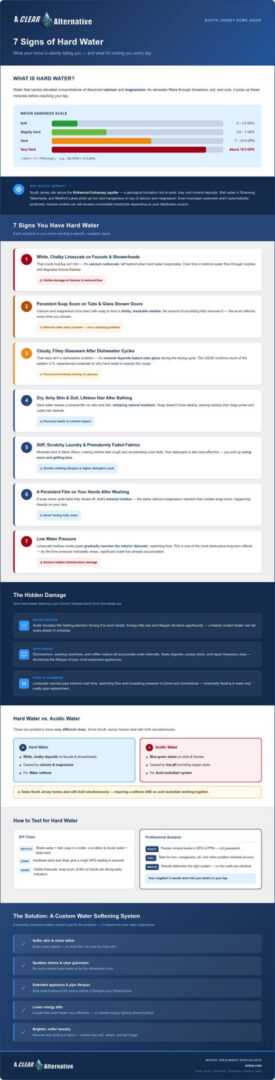
- White, chalky limescale on faucets and showerheads. That crusty buildup isn’t dirt. It’s calcium carbonate, left behind when hard water evaporates. Over time, it restricts water flow through showerhead nozzles and slowly degrades fixture finishes.
- Persistent soap scum on tubs and glass shower doors. Calcium and magnesium ions react with soap to form a sticky, insoluble residue. No amount of scrubbing fully removes it because the scum reforms every time you shower.
- Cloudy, filmy glassware after dishwasher cycles. That haze isn’t a dishwasher problem. It’s mineral deposits baked onto glass during the drying cycle. Water hardness levels according to the USGS show that much of the eastern U.S. experiences moderate to very hard water, which is exactly the range that causes this kind of permanent-looking etching on your favorite glasses.
- Dry, itchy skin and dull, lifeless hair after bathing. More on this below, because it deserves its own conversation.
- Stiff, scratchy laundry and prematurely faded fabrics. Covered in detail in the Kitchen and Laundry section below.
- A film on your hands after washing. If soap never quite feels fully rinsed off, that’s the mineral residue talking.
- Low water pressure. Limescale buildup inside pipes gradually narrows the channel water flows through. It’s slow, invisible, and expensive to fix once it’s advanced.
The Aesthetic Impact: Your Hair and Skin
This is the sign most articles gloss over, and it’s the one that affects your daily confidence most directly. Hard water doesn’t just make your skin feel dry; it actively prevents your cleanser and shampoo from doing their jobs. Calcium and magnesium ions interfere with soap’s ability to lather, which means you’re rinsing with a mineral film still clinging to your skin and scalp. The result is pores that can’t fully clear, a scalp prone to buildup, and hair that looks flat no matter what you spend on products.
For anyone managing eczema, psoriasis, or chronic dandruff, hard water is a genuine aggravator. Research published in dermatology literature has linked hard water exposure to increased skin barrier disruption, particularly in children with existing eczema. Switching to a premium moisturizer or a salon-grade shampoo won’t solve it. If the water itself is the problem, the water is where the fix needs to start.
Kitchen and Laundry Red Flags
Spotty silverware and cloudy glasses are frustrating, but the laundry impact carries a real financial cost. Mineral ions bind to fabric fibers during washing, trapping residue that stiffens the weave and dulls color over time. White fabrics gray gradually. Bright colors fade faster than they should. You compensate by adding more detergent, which actually makes the problem worse by leaving even more residue behind when the minerals prevent it from fully dissolving and rinsing clean.
If you’ve been doubling up on detergent pods and still pulling scratchy towels out of the dryer, your water is working against your washing machine. A professional water test from a local specialist like A Clear Alternative can confirm whether hard water is the root cause before you replace another appliance or restock another cabinet.
The Hidden Damage: How Hard Water Destroys Your Home’s Infrastructure
The stains on your faucets and the film on your glasses are frustrating. But they’re surface problems. The real cost of hard water is happening somewhere you can’t see: inside your pipes, wrapped around your water heater’s heating elements, and grinding away at the internal components of every appliance that uses water in your home. By the time the damage becomes visible, it’s already expensive.
Plumbing Problems and Clogged Pipes
Think of limescale buildup the way you’d think about cholesterol in an artery. It doesn’t block flow all at once. It accumulates gradually, layer by layer, until the channel narrows enough to cause real problems. Calcium carbonate deposits cling to the interior walls of your pipes and harden over time, restricting water pressure and forcing your entire plumbing system to work against itself.
The risk compounds when hard water combines with acidity. As the U.S. Geological Survey definition of water hardness makes clear, mineral content and pH are distinct but related factors in overall water quality. When acidic water runs through pipes already stressed by scale deposits, the result can be pinhole leaks: small, insidious breaches in copper plumbing that cause slow water damage long before anyone notices a problem. For Medford Lakes homeowners with older plumbing infrastructure, this combination is a genuine structural risk worth taking seriously before the first sign of water damage appears in a wall or ceiling.
The Financial Toll on Major Appliances
Your water heater is where hard water does its most expensive work. Sediment settles at the bottom of the tank and bakes onto heating elements with every cycle. The heater has to burn more energy to push heat through that insulating layer of scale, and the efficiency loss is significant: some industry reports cite reductions of up to 25% in water heater efficiency in heavily scaled units. That’s not a one-time cost. It’s a monthly surcharge on every energy bill, compounding year after year.
The same calcification process attacks dishwashers and washing machines from the inside. Valves clog. Spray arms scale over. Internal seals degrade faster than they should. Some appliance manufacturers explicitly note in their warranty documentation that damage caused by untreated hard water may not be covered, meaning the signs of hard water in your home could directly affect your ability to make a warranty claim on a brand-new appliance.
The math is straightforward. A whole house water filtration system is a one-time investment that protects every water-using appliance you own. Replacing a water heater, a washing machine, or a section of corroded plumbing is not. Prevention isn’t just the smarter choice here; it’s the cheaper one.
How to Test for Hard Water: DIY Tricks vs. Professional Analysis
Suspecting hard water is one thing. Knowing what you’re actually dealing with is another. The good news is that you can run a quick reality check at home right now. The honest news is that what you find will only tell you part of the story.
Start with the soap suds test. Fill a clear plastic bottle about one-third with water straight from your tap. Add roughly ten drops of pure liquid dish soap, cap it, and shake it vigorously for about ten seconds. If the water turns cloudy with very few bubbles, and the liquid looks flat and milky rather than foamy, that’s a reliable early indicator of hard water. Soft water produces a generous, lasting lather almost immediately. Hard water doesn’t.
Your morning cup of tea or coffee can tell you something too. If you notice an oily-looking film floating on the surface, or if the flavor tastes unexpectedly flat or bitter, dissolved minerals are interfering with the extraction. It’s a subtle sign, but once you know what you’re looking for, it’s hard to ignore.
These tests are useful for spotting the signs of hard water quickly. But they stop well short of giving you actionable information.
The Limitations of DIY Testing
Store-bought test strips are a step up from the bottle test, but they come with a significant blind spot. They’ll confirm that your water is hard, but they can’t tell you why, or what else is in it. Minerals like iron, manganese, and sulfur are common in South Jersey well water and require completely different treatment approaches. A test strip won’t detect bacteria, nitrates, or lead either. Choosing a water softener based on strip results alone is like buying glasses based on a blurry selfie; you might get close, but you won’t get it right. A softener that’s sized or configured incorrectly for your actual water chemistry won’t protect your appliances or your family the way it should.
What a Professional Water Analysis Reveals
A professional analysis goes far deeper. It measures your exact mineral load in grains per gallon, tests for secondary contaminants specific to your local aquifer, and screens for biological threats that no at-home kit can reliably detect. For homeowners relying on private wells in Tabernacle, Shamong, or Medford Lakes, well water testing is the only way to build a complete picture of what’s actually flowing through your home.
A Clear Alternative uses those detailed lab results to design a solution that fits your specific water profile, not a generic package pulled off a shelf. That precision matters. Every well is different, and a family-owned specialist with over three decades of experience in South Jersey’s unique geology brings a level of local knowledge that a national brand simply can’t replicate.
Don’t guess at a problem this significant. Schedule a professional water test with A Clear Alternative and get the clarity your home deserves.
Restoring Your Water: Why a Custom Softening Solution is the Answer
Once you’ve identified the signs of hard water in your home, the next step isn’t just about maintenance. It’s about a total upgrade to your quality of life. Modern water softeners don’t just filter your water; they use a process called ion exchange to physically pull calcium and magnesium out of the flow. By replacing these minerals with soft ions, the system ensures your water won’t cling to your skin or crust over your fixtures.
The transformation is immediate and visible. You’ll notice a luxurious, rich lather from your soaps that you simply couldn’t achieve before. Your skin will lose that tight, itchy post-shower feeling, and your hair will regain its natural shine and softness. In the kitchen, the “cloudy glass” phenomenon disappears, leaving you with sparkling dishes that finally look as clean as they are. This isn’t just about plumbing; it’s about restoring the aesthetic brilliance of your home and your own self-confidence.
Beyond the look and feel, the financial impact is significant. When your water is soft, you’ll find yourself using significantly less soap, shampoo, and laundry detergent to get better results. You’re also stopping the internal destruction of your appliances, extending the lifespan of your dishwasher and water heater by years. To make the transition effortless, a water softener salt delivery service ensures your system never runs dry, taking the heavy lifting out of your home maintenance routine.
Choosing the Right System for Your South Jersey Home
Not all softeners are created equal. While big-box stores offer generic units, they often struggle with the specific mineral density found in Tabernacle and Shamong wells. High-efficiency models are designed to use less salt and water during regeneration cycles, making them a smarter, more sustainable choice for modern homes. Local expertise is the missing ingredient here. Understanding the specific balance of iron and pH in our local aquifers is the only way to calibrate a system for peak performance and long-term reliability.
The A Clear Alternative Difference
We’ve been family-owned and operated since 1991, and we’ve spent those decades learning exactly what South Jersey water needs. We don’t believe in one-size-fits-all solutions because we know your home and your well are unique. We treat your water like our own, ensuring every installation is precise and every customer feels supported. With 24/7 emergency support available for our neighbors in Medford Lakes and the surrounding areas, you’ll never have to worry about your water quality again. We’re here to help you move past the frustrations of mineral buildup and into a home that feels truly refreshed.
Ready to see the difference for yourself? Schedule your professional water test today and take the first step toward a clearer, more comfortable home.
Take Back Your Home’s Brilliance
Living with the signs of hard water doesn’t have to be your “new normal.” From the chalky buildup on your fixtures to the hidden scale clogging your water heater, these issues are more than just minor inconveniences; they’re preventable costs that add up over time. By choosing a custom softening solution, you aren’t just protecting your plumbing. You’re investing in softer skin, more vibrant hair, and the peace of mind that comes with knowing your home is running at peak efficiency.
Since 1991, A Clear Alternative has been the family-owned choice for South Jersey homeowners who value local expertise and personalized care. We understand the unique mineral challenges of our local aquifers and offer 24/7 emergency water support to ensure your quality of life never falters. You deserve water that works for you, not against you.
Stop the scale and save your home. Book your South Jersey Water Test with A Clear Alternative!
Your journey to clearer water and a more comfortable home starts with a single test. Let’s make 2026 the year you finally say goodbye to hard water for good.
Frequently Asked Questions About Hard Water
Is hard water safe to drink?
Yes, hard water is generally safe to drink. The calcium and magnesium it contains are naturally occurring minerals, and consuming them through water poses no established health risk for most people. In fact, some research suggests these minerals may contribute modestly to daily dietary intake. The real concern with hard water isn’t what it does to your body when you drink it; it’s what it does to your pipes, appliances, and skin over time.
Can hard water cause skin rashes or eczema?
Hard water won’t cause eczema on its own, but it’s a well-documented aggravator for people who already have sensitive or compromised skin. The mineral residue it leaves behind after bathing disrupts the skin’s natural barrier, making it harder for moisture to stay in and easier for irritants to get through. If you or your children are managing persistent skin conditions that don’t respond to topical treatments, your water quality is worth investigating seriously.
How do I know if I have hard water or just a bad water heater?
Look for the signs of hard water elsewhere in your home first. If you’re also seeing chalky white buildup on faucets, soap scum that won’t quit, and cloudy glassware, your water heater’s performance problems are almost certainly a symptom of the same root cause. A failing water heater on its own won’t produce crusty fixtures or filmy dishes. If those other clues are present, hard water is the more likely culprit, and replacing the heater without treating the water means the new one will scale up just as fast.
Will a water softener fix the blue-green stains in my sink?
No, and this is an important distinction. Blue-green staining is caused by acidic water corroding copper pipes, not by hard water minerals. A water softener addresses calcium and magnesium through ion exchange but doesn’t raise your water’s pH. Fixing blue-green stains requires an acid neutralizer, which works differently and targets acidity directly. Some South Jersey homes need both systems running together, which is exactly why a professional water test matters before you invest in any single solution.
How much does a water softener cost to install in South Jersey?
We don’t publish pricing here because the right system for your home depends entirely on your water test results, your household size, and the specific mineral profile of your well or municipal supply. A unit sized incorrectly for your actual water chemistry won’t protect your appliances the way it should, and an oversized system wastes salt and water unnecessarily. Contact A Clear Alternative directly for an accurate assessment based on what’s actually in your water.
Does hard water affect the taste of my coffee and food?
It does. Dissolved calcium and magnesium interfere with how water interacts with coffee grounds and tea leaves during brewing, often producing a flat, muted, or slightly bitter result even with quality beans. The same mineral interference affects the flavor of anything cooked in water, from pasta to soups. Soft water extracts flavor compounds more cleanly, which is why coffee brewed with treated water often tastes noticeably brighter and more balanced without changing anything else in your routine.
Can I install a water softener myself, or do I need a pro?
DIY installation kits exist, but they come with real risks. Sizing a softener incorrectly for your water’s mineral load means the system either under-treats your water or wastes salt regenerating more often than necessary. For South Jersey well owners dealing with iron and manganese alongside hardness, an improperly configured system can actually make secondary staining worse. Professional installation ensures the unit is calibrated to your specific water chemistry from day one, which protects both your investment and your plumbing.
How often do I need to add salt to my water softener?
Most households add salt every four to eight weeks, but the actual frequency depends on your water hardness level, your household’s daily water usage, and how your system’s regeneration cycle is programmed. Harder water and larger families mean faster salt consumption. Checking your brine tank monthly is a good habit. If keeping up with salt deliveries feels like one more thing on an already full list, A Clear Alternative offers a salt delivery service so your system stays topped up without you having to think about it.