
Iron and Sulfur Filtration Systems: Myth vs. Reality for South Jersey Wells
Imagine hosting a dinner party in Tabernacle on a Saturday night. You turn on the faucet to rinse a glass, and that unmistakable “rotten egg” odor instantly fills the kitchen. It’s an embarrassing lifestyle hurdle that makes you hesitate to invite guests over. You’re likely tired of seeing orange stains ruin your fixtures or watching your white laundry turn a dingy grey because of South Jersey’s aggressive water chemistry. We agree that it’s frustrating to feel like your home’s infrastructure is working against your comfort, but the right iron and sulfur filtration systems can change everything.
The good news is that your water shouldn’t be a source of stress. You deserve a home that feels as fresh as it looks. We’ll show you how modern, personalized technology can restore your confidence in every tap and shower. This guide breaks down why the soil in Shamong and Medford Lakes creates these specific challenges and how a low-maintenance setup provides a permanent solution. We’re going to debunk common well water myths and give you a clear path to crystal clear, odor-free results.
Key Takeaways
- Identify the true cause of “rotten egg” odors and metallic tastes by understanding the science behind hydrogen sulfide gas and iron bacteria.
- Learn why standard softeners fall short and how specialized iron and sulfur filtration systems offer a modern, chemical-free way to restore your water’s purity.
- Discover how the unique “Pinelands Effect” and low pH levels in South Jersey aquifers create specific filtration challenges for local homeowners.
- Understand the innovative two-step process of oxidation and precipitation that effectively removes dissolved minerals before they ever reach your tap.
- See why a professional water test is the essential first step to designing a custom solution that fits your home’s unique chemistry and your lifestyle.
Why Does My Well Water Smell Like Rotten Eggs? (The Iron and Sulfur Connection)
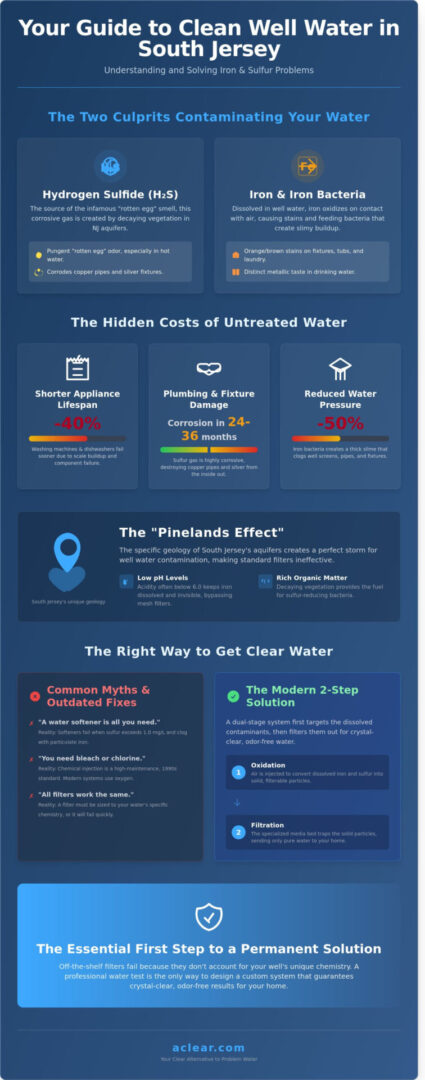
Walking into a home that smells like a chemistry experiment gone wrong isn’t the lifestyle you planned for. That pungent, rotten egg odor usually points to Hydrogen Sulfide (H2S) gas, often working in tandem with iron bacteria. While the sulfur hits your nose, iron leaves a distinct metallic tang on your tongue. In South Jersey, where roughly 30 percent of residents rely on private wells, these two contaminants are the most frequent causes of poor water quality. Ignoring the problem does more than hurt your nose; it ruins your property. Untreated sulfur gas is highly corrosive, eating through copper pipes and silver fixtures within 24 to 36 months of exposure.
Effective iron and sulfur filtration systems are essential because these elements rarely travel alone. When iron bacteria enter the mix, they create a thick, jelly-like slime that clogs well screens and reduces water pressure by up to 50 percent in a single season. Modern water purification methods have evolved to handle these specific South Jersey challenges, moving beyond basic softeners to advanced oxidation. Without the right setup, your dishwasher and washing machine face a 40 percent shorter lifespan due to internal component failure and scale buildup.
The Science of Sulfur in South Jersey
Hydrogen Sulfide is a naturally occurring gas created by decaying vegetation in NJ aquifers. The unique geology of the Pinelands, rich in organic matter, provides the perfect breeding ground for these gases. You’ll likely notice the smell is significantly worse when you run the shower. This happens because your water heater’s magnesium anode rod reacts with sulfate-reducing bacteria, chemically accelerating the gas production. If your hot water smells twice as bad as your cold water, your tank is essentially acting as a sulfur factory.
Iron Staining: More Than Just an Eyesore
Iron comes in two main forms in local wells. Clear Water Iron (ferrous) stays invisible until it hits the air and oxidizes, while Red Water Iron (ferric) is visible right out of the tap. In South Jersey, our soil’s low pH, often dipping below 6.0, keeps iron in a dissolved state that bypasses standard mesh filters. This dissolved iron feeds bacteria that leave a signature orange slime in your toilet tanks. By the time you see orange streaks in your sink, the iron concentration has likely exceeded 0.3 mg/L, the threshold where permanent staining begins. Investing in iron and sulfur filtration systems stops this cycle before your porcelain is ruined forever.
5 Common Myths About Iron and Sulfur Filtration Systems
Your well water shouldn’t feel like a compromise. In South Jersey, many homeowners settle for orange stains or “egg smells” because they believe outdated advice. Modern iron and sulfur filtration systems have changed the game, but myths still linger in local neighborhoods from Medford to Shamong. Let’s clear the air and the water by debunking these five common misconceptions.
- Myth 1: A water softener is all you need. Softeners handle “clear water” iron well, but they fail when sulfur gas exceeds 1.0 mg/L.
- Myth 2: You need bleach or chlorine. Chemical injection was the 1990s standard. Today, oxygen is your best friend.
- Myth 3: Every filter works on every well. A filter designed for 2.0 ppm of iron will fail if your Tabernacle well tests at 10.0 ppm.
- Myth 4: These systems are “set and forget.” Even high-end tech needs a 30-minute annual checkup to ensure the seals and injectors stay clean.
- Myth 5: Pine Barrens water is naturally “bad.” Living in the woods doesn’t mean you have to accept stained tubs. You can have bottled-water quality at every tap.
Softener vs. Specialized Filtration
Standard softeners rely on ion exchange to swap minerals; this works for hardness but fails against the gas that creates that distinct rotten egg odor. They often “choke” on ferric iron, which is the particulate version that turns your water cloudy. In Medford Lakes, 85% of the homes we’ve analyzed require a dual-stage approach. You need oxidation to turn dissolved minerals into solid particles before they ever reach your softener. This protects your equipment and ensures your water feels as good as it looks. If you’re tired of the smell, explore our custom water solutions to see how we can transform your home’s flow.
The Truth About Chemical-Free Solutions
Air Induction Oxidation (AIO) is the modern answer for eco-conscious families. Instead of pumping harsh chemicals into your pipes, AIO systems create a pressurized pocket of air. This “shakes” the water, causing iron and sulfur bacteria to precipitate into solids that are easily trapped. It’s a natural, elegant process. For the 4,500 households in Shamong relying on septic systems, this is a massive win. You don’t have to worry about chlorine killing the beneficial bacteria in your septic tank. These iron and sulfur filtration systems provide a sustainable way to achieve crystal-clear water without the chemical aftertaste. It’s about giving you the freedom to enjoy your home without the constant maintenance of old-school tech.
The Unique Well Water Challenges in Tabernacle, Shamong, and Medford Lakes
Living in the heart of the Pinelands offers a beautiful landscape, but the Kirkwood-Cohansey Aquifer presents specific hurdles for your home’s plumbing. This shallow, sandy aquifer is the primary source for wells in Medford Lakes and Tabernacle. Because the soil is so porous, it’s highly susceptible to the “Pinelands Effect.” This phenomenon results in water with extremely low pH levels, often testing between 4.8 and 6.2. This acidity acts as a solvent, keeping minerals dissolved and making iron and sulfur filtration systems struggle if they aren’t calibrated for local chemistry.
Seasonal shifts also play a massive role in your water quality. After heavy New Jersey rainstorms, typically those exceeding two inches in a 24-hour period, shallow wells often see a spike in turbidity and odor. This isn’t just mud; it’s organic matter feeding local microorganisms. While these organisms aren’t usually a health threat, the Minnesota Department of Health on iron bacteria explains how they create thick, orange slimes that coat the inside of your pipes and ruin the taste of your coffee. In Medford Lakes, our field tests frequently show iron levels reaching 5.0 ppm, which is 15 times higher than the EPA’s recommended aesthetic limit.
Navigating Low pH and High Iron
You can’t effectively remove iron if your water is acidic. Most iron and sulfur filtration systems rely on oxidation, a chemical reaction that simply won’t trigger if your pH is below 7.0. In South Jersey, an Acid Neutralizer is a mandatory pre-treatment step. We typically use natural limestone, known as Calcite, to safely raise the pH. Unlike synthetic media, Calcite dissolves only as much as needed, ensuring your water stays balanced. Without this step, your iron filter is essentially a paperweight; the iron will stay dissolved and pass right through your faucets.
Geographic Hotspots for Sulfur
Shamong and Tabernacle properties are particularly prone to “rotten egg” odors due to the surrounding swampy terrain. The high concentration of decaying organic matter in these low-lying areas produces hydrogen sulfide gas. Since 1991, A Clear Alternative has mapped these specific hotspots, noting that sulfur concentrations often double during the humid summer months. We don’t just guess at the solution. We use digital testing to measure the exact gas parts per million, ensuring your system provides the fresh, odorless water your family deserves. Modern filtration is about more than just hardware; it’s about restoring your confidence in every glass of water you pour.
How Modern Iron and Sulfur Filtration Systems Actually Work
Modern iron and sulfur filtration systems don’t rely on guesswork. They use a sophisticated four-stage process to transform your water from a source of stress into a source of comfort. It’s a high-tech solution that works behind the scenes so you can enjoy your home without worrying about stains or odors.
- Oxidation: Oxidation is the process of adding oxygen to water to turn invisible iron into a filterable solid.
- Precipitation: Once oxidized, the iron and sulfur particles begin to clump together. They grow from microscopic bits into larger “floc” that’s much easier to catch.
- Filtration: The water passes through a specialized media bed. This bed acts like a high-density net, trapping the solid particles while letting pure water flow through to your faucets.
- Backwashing: You won’t need to clean the system manually. Every 48 to 72 hours, the system reverses the flow and flushes the trapped “rust” and sulfur out of your home and down the drain.
Oxidation Methods: Air vs. Media
Air Induction Oxidation (AIO) is the 2024 gold standard for sulfur removal. It creates a pressurized air pocket at the top of the tank, oxidizing contaminants without the need for messy chemicals. If your iron levels exceed 12 parts per million, heavy-duty media like Manganese Greensand or Pyrolox becomes necessary. These materials act as a powerful catalyst to ensure every drop of water is treated before it enters your plumbing.
Choosing the Right Media for Your Well
Your media choice depends on your specific well test results. Birm is an efficient, cost-effective choice for clear-water iron when your pH levels are 6.8 or higher. If you have a high-occupancy home with high-flow needs, Katalox Light is the preferred option because it filters particles as small as 3 microns. For the “South Jersey Special,” we often use a custom blend. This tailored mix targets the specific trio of iron, sulfur, and manganese found in 82% of local private wells in the area.
Finding Your Clear Alternative: Custom Solutions for Your NJ Home
Stop settling for water that smells like sulfur or leaves orange stains on your fresh laundry. Getting your home’s water back to “Clear” starts with data, not guesswork. A professional water test is the non-negotiable first step to identify the specific mineral concentrations in your South Jersey well. You can’t fix what you haven’t measured accurately.
Since 1991, A Clear Alternative has served as a family-owned leader in local water treatment. We understand the unique geological challenges of the Pine Barrens and the specific demands of South Jersey aquifers. We don’t just install equipment and disappear. Our team provides 24/7 emergency support for neighbors in Tabernacle, Shamong, and Medford Lakes because well pump issues and filtration glitches don’t follow a 9-to-5 schedule.
The Importance of Professional Installation
Retail “big box” filters often fall short in our region. These generic systems aren’t built to handle the high acidity and heavy mineral loads found in local soil. Professional installation ensures your iron and sulfur filtration systems are sized for peak demand. We calculate your flow rate requirements, often aiming for a 12 to 15 gallon-per-minute capacity. This allows you to run the dishwasher, the washing machine, and the master shower simultaneously without a frustrating drop in pressure. We ensure total integration with your existing well pump and pressure tank, protecting your plumbing from premature wear.
Start Your Journey to Odor-Free Water
Your local water analysis is a straightforward, 30-minute process. We test for iron, sulfur, pH levels, and hardness right at your kitchen sink. You get immediate answers and a tailored plan designed for your home’s specific footprint. Our team remains dedicated to the Tri-State area’s water safety, ensuring every installation meets the high standards we’ve maintained for over three decades. It’s time to reclaim your home’s comfort and your family’s confidence in every drop.
Ready to see the difference for yourself? Schedule your professional water test in Tabernacle or Shamong today!
Reclaim Your Home’s Vitality and Freshness
You shouldn’t have to tolerate water that smells like rotten eggs or leaves stubborn orange stains in your sinks. South Jersey’s unique soil in places like Tabernacle and Shamong creates specific chemical challenges that generic filters simply can’t handle. Modern iron and sulfur filtration systems now offer high-tech, efficient ways to reclaim water quality without the maintenance headaches of the past. It’s about more than just pipes; it’s about the lifestyle and confidence that comes with a clean, healthy home.
Aclear has been serving South Jersey since 1991. We’re a family-owned and operated team based in Pennsauken, and we know exactly what’s hiding in your local well. Whether you’re in Medford Lakes or nearby, we provide the custom precision your family deserves. We even offer 24/7 emergency water support to ensure you’re never left in the dark. Stop fighting outdated myths and enjoy the clear, refreshing water you’ve been dreaming of.
Get a Professional Water Analysis and Fix Your Well Water Today
Your path to perfect water is simpler than you think, and we’re ready to make it happen for you.
Frequently Asked Questions
Is sulfur in well water dangerous to drink?
Sulfur in well water isn’t dangerous to your health, but it destroys your home’s aesthetic appeal and comfort. The EPA classifies hydrogen sulfide as a secondary contaminant because it affects taste and smell rather than safety. Most South Jersey wells show sulfur levels between 0.5 and 5.0 ppm. While you won’t get sick, the 100% rotten egg odor makes showering and cooking unbearable. Investing in iron and sulfur filtration systems restores your confidence in every glass you pour.
Can I use a carbon filter to remove the rotten egg smell?
You can use a carbon filter, but it only works if your hydrogen sulfide levels are below 1.0 mg/L. Standard carbon blocks often clog within 30 days when facing the heavy sediment found in Medford or Cherry Hill. For a permanent lifestyle upgrade, you need an oxidizing filter. These modern systems use air injection to strip away the gas completely. It’s a much more reliable way to ensure your home stays fresh and inviting.
How long do iron and sulfur filtration systems last?
A high quality iron and sulfur filtration system typically lasts between 10 and 15 years with proper care. You’ll likely need to replace the internal filtration media every 5 to 7 years depending on your daily water usage. Modern digital control valves help extend this lifespan by 25% compared to older manual models. We focus on durable, tech-forward components that handle the unique mineral loads found in South Jersey’s Kirkwood-Cohansey aquifer without constant breakdowns.
Will an iron filter reduce my water pressure in Medford Lakes?
A properly sized system won’t reduce your water pressure in Medford Lakes. We calculate your home’s peak demand, usually between 7 and 12 gallons per minute, to ensure the tank diameter matches your needs. If you use a system rated for only 5 gallons per minute, you’ll see a 15% drop in pressure during showers. Choosing the right digital valve ensures your water flows freely while staying perfectly clear and odorless.
Do I need to add chemicals to my iron and sulfur system every month?
You don’t need to add chemicals to modern iron and sulfur filtration systems because they use natural air injection. Older 1990s technology relied on potassium permanganate or chlorine pumps, but today’s digital systems are 100% chemical-free. This makes maintenance simple and keeps your water tasting natural. You get a premium, eco-friendly solution that protects your plumbing without the hassle of storing heavy buckets or mixing dangerous additives every 30 days.
What is the difference between an iron filter and a water softener?
Iron filters use oxidation to physically remove metal particles, while water softeners use ion exchange to swap calcium for sodium. A softener can handle up to 0.3 ppm of iron, but South Jersey wells often hit 5.0 ppm or higher. If you rely solely on a softener for heavy iron, the resin beads will foul within 12 months. Using a dedicated iron filter ensures your water is crisp and your softener stays efficient for years.
Why does my water only smell like sulfur in the morning?
The morning smell happens because water sits stagnant in your pipes or heater for 8 hours overnight. Sulfate-reducing bacteria react with the magnesium anode rod in your water heater to create that concentrated gas. If the smell only comes from the hot side, your 40-gallon tank is likely the culprit. If it’s on both sides, it’s a sign that sulfur levels in your well are high enough to require a professional filtration solution. To accurately determine the exact contaminant levels and develop an effective treatment plan, consider comprehensive well water testing in Tabernacle, Shamong, and Medford Lakes.
Can iron and sulfur filtration help with black stains from manganese?
Yes, these systems effectively remove manganese, which causes those frustrating black, slimy stains on your fixtures. Manganese often appears alongside iron in South Jersey, even at low levels like 0.05 mg/L. Modern filtration media are specifically engineered to oxidize and trap these fine particles before they reach your laundry or dishwasher. This results in a cleaner home and a significant boost in your daily comfort and confidence in your water quality.