
Professional Water Testing in Tabernacle, Shamong, and Medford Lakes: The 2026 Homeowner’s Guide
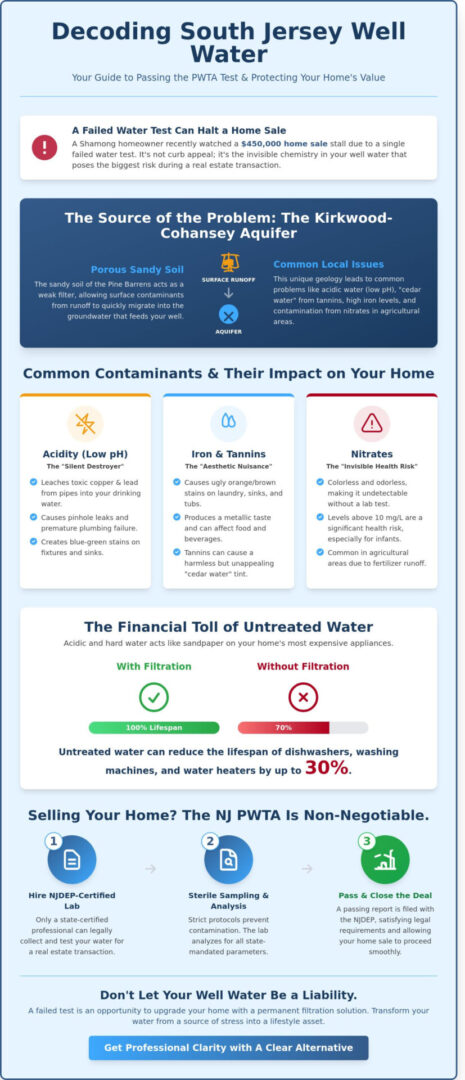
Last Tuesday, a Shamong homeowner watched a $450,000 home sale stall because of a single failed south jersey water test. It wasn’t a lack of curb appeal or a leaky roof that killed the deal. It was the invisible chemistry of the Pinelands soil. You likely know that living in Medford Lakes or Tabernacle means dealing with unique environmental factors that city dwellers never face. You’ve probably felt that nagging worry when staring at a complex 15 page NJDEP lab report that looks like it belongs in a chemistry textbook.
This guide will show you how to decode those confusing results, navigate the latest 2026 NJ water regulations, and protect your home from the acidic water that ruins high end appliances. Your water should be a source of comfort, not a source of stress. We’ll break down the exact steps to pass your PWTA test and implement a permanent filtration plan that turns your well water into a lifestyle asset rather than a liability. It’s time to stop guessing and start enjoying the peace of mind that comes with professional clarity.
Key Takeaways
- Understand why a professional south jersey water test is the essential, non-negotiable step for a smooth home sale and total peace of mind.
- Discover how the unique geology of the Pine Barrens impacts your well water and learn to distinguish between aesthetic staining and real health risks.
- Get a clear look at modern sampling protocols that ensure your results are precise, sterile, and ready for regulatory approval.
- Learn how to decode complex lab reports to make confident, tech-backed decisions about your home’s most vital resource.
- Transform a failed test into an opportunity to upgrade your home with a personalized filtration solution tailored to your specific local profile.
Beyond the Tap: Why South Jersey Water Testing Is Critical in 2026
A south jersey water test is your home’s most vital health diagnostic tool in 2026. It’s a deep analysis of both chemical and bacteriological markers that ensures your family’s safety. Many homeowners in Burlington and Ocean counties believe that if their water looks clear, it’s safe to drink. That’s a dangerous myth. Colorless and odorless contaminants like nitrates or volatile organic compounds often hide in perfectly transparent water. Understanding water testing procedures helps you realize that the EPA doesn’t regulate private wells; you’re essentially the manager of your own water utility.
Our family-owned team at A Clear Alternative uses decades of regional data to help you decode these complex results. We don’t just hand you a spreadsheet of numbers. We provide a roadmap for your home’s health. Ordering a south jersey water test is the first step toward a lifestyle of confidence and security, moving you away from guesswork and toward scientific certainty.
The Unique Chemistry of the Kirkwood-Cohansey Aquifer
The Kirkwood-Cohansey aquifer system is the primary water source for approximately 1 million South Jersey residents. Because this aquifer sits beneath porous, sandy soil, it’s highly susceptible to surface contamination. This sand acts as a very weak filter, allowing pollutants to migrate into the groundwater much faster than they would in clay-heavy regions.
In towns like Tabernacle and Medford Lakes, residents often encounter “cedar water” characteristics. This tea-colored tint is caused by natural organic tannins from the Pine Barrens. While it’s a signature of our local geography, it also signals a highly acidic environment. This acidity requires a sophisticated approach to filtration that respects the delicate balance of our local ecosystem while protecting your home’s potability.
Health and Infrastructure Risks of Untested Wells
Untested wells in Shamong and surrounding agricultural belts face specific chemical threats. Runoff from local farms can push nitrate levels above the 10 mg/L safety limit, which poses significant risks to infants and vulnerable adults. Low pH levels are also common across the region. When your water is too acidic, it becomes aggressive, leaching copper and lead from your home’s internal plumbing lines directly into your glass.
- Internal Leaching: Acidic water dissolves metal pipes, leading to pinhole leaks and heavy metal ingestion.
- Appliance Longevity: High iron and sulfur levels act like sandpaper on your internal components.
- Economic Impact: A 2025 industry report confirmed that untreated South Jersey well water can reduce the lifespan of high-end dishwashers and tankless water heaters by up to 30 percent.
Investing in a professional analysis today prevents the silent erosion of your home’s infrastructure. It’s about more than just plumbing; it’s about the peace of mind that comes from knowing every drop in your house is pure.
NJ Private Well Testing Act (PWTA): Compliance for Tabernacle and Shamong Sellers
Selling a home in Tabernacle or Shamong requires more than just a fresh coat of paint. Since 2002, the New Jersey Private Well Testing Act has made water quality a mandatory part of the real estate process. You won’t reach the closing table without a passing report. This isn’t a suggestion; it’s a legal requirement for every real estate transfer involving a private well in the state. If the water doesn’t meet state standards, the deal won’t move forward until the issues are fixed.
You need an NJDEP-certified lab to handle everything from collection to analysis. These professionals don’t just drop off bottles for you to fill. They follow strict protocols to ensure the sample isn’t contaminated by the faucet or the environment during the process. Once the lab finishes the analysis, they upload the results directly to the New Jersey Department of Environmental Protection through a secure digital portal. You’ll receive a copy for your records, but the state keeps the data to monitor groundwater health across the region. While the lab report gives you the raw data, Interpreting Drinking Water Quality Analysis helps you understand the health implications and technical thresholds of each finding.
Mandatory Parameters for a Passing PWTA Report
A standard south jersey water test for a real estate sale covers a specific battery of contaminants. You can’t pick and choose what to test; the law dictates the list. The core parameters include:
- Bacteria: Testing for Total Coliform and E. coli.
- Nitrates: Crucial in agricultural areas like Shamong.
- Lead: Sampling must follow specific “first draw” protocols.
- Volatile Organic Compounds (VOCs): A screen for 26 different industrial chemicals.
- Gross Alpha: This radiological test is mandatory for 100% of homes in Burlington and Ocean counties due to the Kirkwood-Cohansey aquifer’s natural composition.
- pH Levels: Technicians must test this at the kitchen tap within 15 minutes of collection to ensure an accurate reading before the water chemistry shifts.
Timing and Validity of Your Test Results
A PWTA report remains valid for 12 months from the date of collection. If your closing date pushes past that 365-day mark, you’ll need a fresh south jersey water test to stay compliant. Smart sellers in Tabernacle schedule their testing 45 days before listing the property. This buffer is vital because 18% of private wells in the region fail at least one parameter on the first try. Early testing allows you to install treatment systems without delaying your move. If you’re already under contract and facing a tight deadline, A Clear Alternative provides 24/7 emergency support to handle urgent sampling and remediation. You can book a priority compliance test to keep your real estate transaction on schedule.
Decoding Contaminants: Iron, Acid, and Nitrates in Medford Lakes
When you review your south jersey water test results, three specific issues frequently appear for Medford Lakes and Shamong homeowners. We call these the “Big Three.” They include high iron content, low pH (acidity), and nitrates. Understanding the difference between these is vital for your home maintenance and your family’s well-being. Some contaminants are purely aesthetic, meaning they ruin your white towels or leave orange streaks in the shower. Others are health-based risks that require immediate filtration to ensure your kitchen tap is safe for everyone.
The local landscape plays a massive role in your water quality. Because our region has a rich agricultural history, the soil often contains remnants of past fertilizers and pesticides. These chemicals can migrate into the shallow aquifers that feed local wells. The New Jersey Private Well Testing Act mandates testing for these substances during real estate transactions because they are invisible, tasteless, and potentially harmful. While the Pine Barrens offer beautiful scenery, the sandy soil doesn’t filter out these agricultural byproducts effectively.
The Acidic Water Crisis: Low pH in the Pinelands
The soil in Tabernacle and Shamong is naturally aggressive. It is common to see pH levels as low as 4.5 on a south jersey water test, which is significantly more acidic than the neutral 7.0 standard. Your home has a way of telling you when the pH is too low. Look for the “Blue-Green Stain” indicator on your porcelain sinks or tile grout. This color is actually copper from your plumbing being dissolved by the water. These Signs of Acidic Water in Your Home are warnings of impending pipe failure. Modern acid neutralizers use natural crushed calcite to restore balance, protecting your pipes and stopping those stubborn stains.
Iron and Sulfur: The “Rotten Egg” and Rust Problem
Iron shows up in two distinct ways in Medford Lakes. Ferrous iron is “clear water iron” that looks fine coming out of the tap but turns red once it hits the air. Ferric iron is already oxidized, appearing as orange or brown particles in your water. In Medford Lakes, iron levels often exceed 0.3 mg/L, the specific threshold where staining and metallic tastes become unavoidable.
Sulfur gas is the culprit behind that familiar rotten egg smell. It is more than just an embarrassing odor when guests visit. Sulfur is a highly corrosive agent that can damage the internal components of your water heater and dishwasher over time. Removing these elements isn’t just about better-tasting water. It’s a lifestyle upgrade that preserves your appliances and gives you back the confidence to use your water for everything from cooking to laundry.
Professional Sampling Protocols: What to Expect During Your Appointment
Getting a south jersey water test shouldn’t feel like a cold, clinical procedure. We’ve designed our process to be as transparent and tech-forward as the modern home it protects. When our technician arrives, they follow a rigorous 5-step protocol to ensure your results are 100% accurate and compliant with state regulations.
- Step 1: Port Identification. We locate the most reliable sampling point. This is typically your kitchen tap or the pressure tank itself to get a raw look at your well’s health.
- Step 2: Sanitization. We sanitize the faucet using a targeted heat or chemical method. This prevents surface bacteria from contaminating the sample and giving a “false positive” result.
- Step 3: GPS Compliance. As required by the NJDEP for Private Well Testing Act (PWTA) compliance, we record the exact GPS coordinates of your well head. This ensures your data is locked to your specific property.
- Step 4: Chain of Custody. Your samples are placed in secure, temperature-controlled transport. We use a strict Chain of Custody protocol, meaning every hand that touches your sample is logged and tracked.
- Step 5: Digital Review. Once the lab finishes, you’ll receive a digital report. An A Clear Alternative expert will then schedule a brief call to translate the data into an actionable plan.
Preparation Tips for Homeowners
You can help us get the most accurate snapshot of your water by following a few simple steps. First, ensure our technician has clear access to the well head and the pressure tank. If we’re testing for lead and copper, don’t use any water for at least 6 hours before your appointment. This includes flushing toilets or running the dishwasher. This “stagnant” sample is the only way to see if your plumbing is leaching metals into your drinking supply. If you’ve noticed a sudden change in smell, your well might need a “shock” treatment before we perform a formal test.
Understanding the Lab Report Layout
Your NJDEP report can be 10 or 15 pages long, but don’t let the volume overwhelm you. Focus on the Maximum Contaminant Level (MCL). This is the safety threshold set by the state. If your “Result” is higher than the MCL, it’s an immediate red flag. You’ll likely see “ND” on several rows. This means “Not Detected.” Modern lab equipment is incredibly sensitive, often detecting 1 part per billion. If it says ND, your water is remarkably clean for that specific parameter. We’ll help you spot any exceedances that require immediate filtration upgrades.
Don’t leave your family’s health to chance. Book your professional south jersey water test with our expert team and enjoy the confidence of total water clarity.
Turning Test Results into Clean Water Solutions
Seeing a “failed” status on your south jersey water test might feel stressful at first. Don’t view it as a setback. It’s actually a clear signal to upgrade your home’s health and your family’s daily experience. In areas like Tabernacle or Shamong, the local soil composition often leads to specific issues like high acidity or heavy iron deposits. A generic, one-size-fits-all filter won’t solve these regional challenges. You need a system designed for the unique Pine Barrens geography to ensure your water is as pure as it looks.
Standard carbon filters often miss microscopic contaminants that a south jersey water test can uncover. Reverse Osmosis (RO) stands as the gold standard for achieving bottled-quality water directly from your tap. It removes up to 99% of dissolved solids, including nitrates and lead, which basic pitchers simply ignore. If you want total peace of mind for every faucet in the house, explore A Guide to Whole House Water Filtration Systems to see how we scale these high-tech solutions for your entire property.
Tailored Treatment: From Acid Neutralizers to UV Sterilizers
Medford Lakes homes frequently battle “rotten egg” odors or orange staining on porcelain. If your iron levels exceed 0.3 mg/L, an iron filter is your best friend. If you only deal with white scale buildup on fixtures, a water softener is the right tool for the job. When a test shows coliform bacteria, a UV sterilizer becomes mandatory. It kills 99.99% of pathogens without using harsh chemicals. You should plan for professional maintenance every 12 months to ensure your sensors and bulbs stay effective.
The A Clear Alternative Advantage
We bring 35 years of local expertise to your doorstep. We’ve serviced over 10,000 systems across the Tri-State area and understand the specific mineral challenges of South Jersey better than anyone. Our team provides 24/7 emergency support because well pumps don’t wait for business hours to break. You deserve water that matches your lifestyle and boosts your confidence in your home. Schedule your comprehensive South Jersey water test today and take the first step toward total clarity.
Take Control of Your Home’s Water Quality Today
Your home in Tabernacle, Shamong, or Medford Lakes deserves water that’s as clear as your vision for the future. Navigating the NJ Private Well Testing Act doesn’t have to be a headache. Whether you’re managing Medford Lakes’ common iron issues or meeting 2026 compliance standards for a home sale, the right data is your best tool. Since 1991, we’ve helped local residents transform confusing lab results into reliable, clean water solutions that fit a modern lifestyle. Our NJDEP Certified Sampling Technicians use precise protocols to ensure every south jersey water test we conduct meets the highest professional standards.
We don’t just hand you a report and walk away. We provide 24/7 emergency water and well support to ensure your family never has to wait for help when it matters most. It’s about more than just passing a test; it’s about the confidence that comes from knowing your tap provides nothing but pure, safe water. You’ve worked hard for your home, so don’t let hidden contaminants like nitrates or acid compromise your quality of life. For comprehensive guidance on maintaining your water quality, our well water testing in Tabernacle, Shamong, and Medford Lakes essential guide for homeowners provides detailed information on testing procedures and local resources. Take the first step toward a healthier, worry free home today.
Get Your Certified South Jersey Water Test Scheduled Now
Frequently Asked Questions
How much does a South Jersey water test cost in 2026?
A comprehensive South Jersey water test in 2026 typically costs between $600 and $850 depending on your specific county requirements. This price covers the certified laboratory fees for all 32 mandated parameters like gross alpha, mercury, and arsenic. You’re investing in a clear, digital report that ensures your home’s safety and legal compliance. It’s a small price for total peace of mind regarding your family’s daily health.
Is a water test required by law when selling a home in New Jersey?
Yes, the New Jersey Private Well Testing Act (PWTA) mandates a water test for every real estate contract signed after September 16, 2002. Both the buyer and seller must certify in writing that they’ve reviewed the laboratory results before the closing can legally proceed. This law ensures every resident knows exactly what’s in their glass. It’s a non-negotiable step that protects your investment and your health during the transition.
How long does it take to get water test results back for a NJ real estate closing?
You should expect your results within 10 to 14 business days from the date of professional collection. While basic bacteria tests only take 48 hours, the NJDEP requires extensive analysis for radiologicals like gross alpha, which takes significantly longer in the lab. Plan your closing date carefully to avoid last-minute delays. We recommend scheduling your South Jersey water test at least 21 days before your target move-in date.
Can I test my own well water with a store-bought kit for PWTA compliance?
No, you can’t use a store-bought kit for PWTA compliance because the law requires a certified third-party laboratory to collect the samples. NJDEP regulations state that only an authorized professional can pull the water to ensure no tampering occurs during the process. These DIY kits are great for personal monitoring between official checks. However, they won’t hold up in a legal real estate closing or meet the state’s strict 2026 certification standards.
What happens if my well water fails the NJ Private Well Testing Act?
If your well fails, you must install a water treatment system to bring the levels back within NJDEP safe drinking water standards. For example, if your test shows arsenic above 5 micrograms per liter, an ion exchange or reverse osmosis system is necessary. The seller usually pays for this installation, though the law doesn’t strictly dictate who covers the cost. Once the system is in, a re-test confirms your water is pure.
How often should I test my well water if I am not selling my home?
You should test for coliform bacteria and nitrates every 12 months to maintain a healthy and safe home environment. Every 3 to 5 years, it’s smart to run a full panel including lead, arsenic, and volatile organic compounds. Regular check-ups prevent small issues from becoming expensive problems later. Think of it as a digital health scan for your home’s most vital resource. It keeps your water crystal clear.
What are the most common contaminants found in Shamong and Tabernacle wells?
Wells in Shamong and Tabernacle frequently show elevated levels of mercury and gross alpha radiation due to the unique geology of the Kirkwood-Cohansey aquifer. Data from the NJDEP shows that nearly 15 percent of wells in this Pine Barrens region require treatment for naturally occurring contaminants. You’ll also likely find acidic water with a pH below 6.5. This acidity can corrode your pipes if it isn’t neutralized with a calcite system.
Does a standard water softener remove lead and nitrates from my water?
No, a standard water softener doesn’t remove lead or nitrates from your drinking water. Softeners use ion exchange specifically to swap calcium and magnesium for sodium, which only addresses water hardness issues. To tackle lead or nitrates, you need specialized equipment like a reverse osmosis system or a dedicated anion exchange unit. Don’t rely on basic softening technology for chemical safety; always choose the right tool for the specific contaminant found.