
Signs of Hard Water in Tabernacle, Shamong, and Medford Lakes, NJ: The Homeowner’s Guide
Last Tuesday, a homeowner in Shamong noticed their brand new dishwasher was already coated in a stubborn, chalky film. It’s incredibly frustrating when you invest in your home’s aesthetic only to have the water itself work against your efforts. You’ve likely felt that itchy, tight sensation on your skin after a shower or wondered why your water pressure has dropped by 15% this season. These aren’t just daily nuisances; they’re the unmistakable signs of hard water that can quietly shave five years off the life of your plumbing system.
You deserve a home environment that feels like a sanctuary, not a source of constant maintenance. This guide will help you identify the subtle and destructive ways mineral buildup is impacting your life in Tabernacle, Shamong, and Medford Lakes. We’ll show you how to protect your $1,500 appliances and finally reclaim the soft hair and glowing skin you’ve been missing. We’re exploring the modern, high tech solutions that transform your water from a hidden problem into a premium lifestyle asset.
Key Takeaways
- Learn why the specific geology of the South Jersey Pinelands puts your Tabernacle or Shamong home at high risk for mineral-heavy water.
- Spot the 7 most common signs of hard water using simple visual checks that require no professional tools or expertise.
- Stop the “invisible tax” on your budget by understanding how mineral scale silently drains your home’s energy efficiency and appliance lifespan.
- Master a quick, DIY “Soap Suds Test” to instantly gauge your water quality and learn how to interpret local Medford Lakes water reports.
- Explore how modern, customized water softening technology can transform your daily life, protecting your home and restoring your skin’s natural glow.
Understanding Hard Water in Tabernacle, Shamong, and Medford Lakes
Living in South Jersey offers a beautiful landscape, but the water beneath our feet tells a complex story. If you’ve noticed white spots on your glassware or a chalky film on your shower door, you’re seeing the first signs of hard water in your daily routine. To understand what hard water is, you have to look at the chemistry of your tap. It’s simply water that contains high levels of dissolved minerals, specifically calcium and magnesium. These aren’t toxins, but they act like invisible “sand” that wears down your appliances and affects your skin’s glow.
The local geology of the Pinelands plays a massive role in your home’s water quality. Most residents in Tabernacle and Medford Lakes draw their supply from the Kirkwood-Cohansey Aquifer. This shallow, unconfined aquifer consists of layers of sand and gravel. As rainwater filters through these layers, it picks up mineral deposits. While the Pinelands are famous for “cedar water,” the deeper wells often tap into zones where mineral density is much higher. This creates a unique challenge for homeowners who want crisp, clean water without the mineral baggage.
It’s vital to distinguish between “nuisance” minerals and health-related contaminants. The New Jersey Department of Environmental Protection (NJ DEP) categorizes hardness as a secondary parameter. This means it doesn’t pose a direct health risk to your family. Instead, it’s an aesthetic and functional issue. Hard water ruins the “feel” of your home. It makes your hair brittle, your clothes stiff, and your coffee taste metallic. It’s about your quality of life and the longevity of your investment.
The Science of Mineral Scaling
Water is the ultimate solvent. As it travels through the soil in Shamong, it dissolves bits of limestone or calcium-rich rock. When this mineral-heavy water enters your home and hits your water heater, a chemical reaction occurs. Heat forces the dissolved minerals to solidify, creating a rock-hard crust known as scale. This isn’t a rare problem. Data from the U.S. Geological Survey indicates that 85% of American homes face some degree of water hardness. In South Jersey, this scale builds up inside your pipes and water heater, forcing your systems to work 20% harder just to maintain temperature.
Hard Water vs. Acidic Water in South Jersey
In towns like Shamong, homeowners often face a “double whammy” of water issues. You need to know the difference between high mineral counts and low pH levels. Hard water leaves behind white, crusty “signs of hard water” on your faucets. Acidic water, which is incredibly common in the Pinelands, actually eats away at your copper plumbing. This results in those tell-tale blue-green stains in your tubs and sinks. You don’t have to choose one or the other; many local wells are simultaneously hard and acidic. Identifying these specific stains is the first step toward reclaiming your home’s water clarity and protecting your plumbing from premature failure.
The 7 Most Common Signs of Hard Water in Your Home
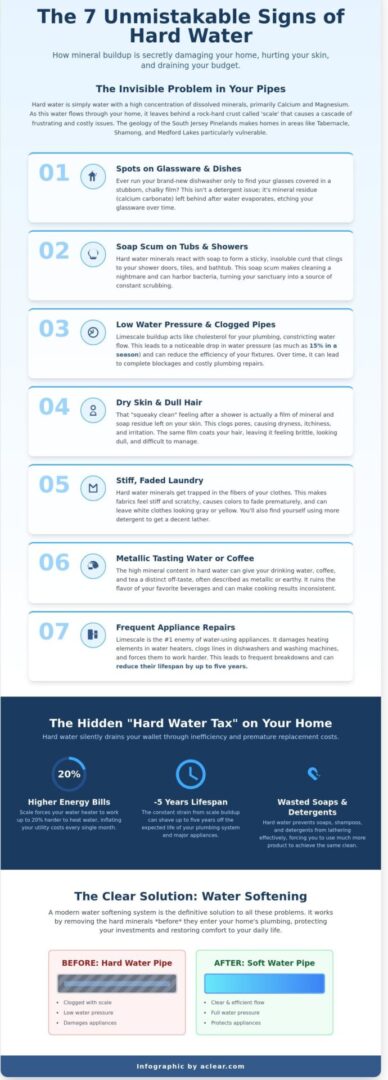
You don’t need a laboratory to know if your water is working against you. Most signs of hard water are visible to the naked eye or felt during your daily routine. High mineral content, specifically calcium and magnesium, creates a series of annoying and costly problems that affect your home’s aesthetic and your personal comfort. When these minerals are present in high concentrations, they don’t just stay in the water. They settle on every surface they touch, from your expensive glassware to your skin.
Visual Signs: Spots, Scum, and Scaling
Ever noticed those frustrating white spots on your wine glasses after a dishwasher cycle? That’s not a cleaning failure. It’s mineral residue. When water evaporates, it leaves behind solid calcium carbonate. This same process creates the chalky, white buildup you see on your faucets and showerheads. In a 2021 study, researchers found that even minor scaling can reduce the efficiency of fixtures by 15% within just 24 months. This buildup, known as limescale, isn’t just ugly; it’s a magnet for bacteria. If your bathtub has a stubborn ring or your tile grout looks perpetually dirty, you’re dealing with soap scum. This occurs when minerals react with soap to create an insoluble curd that sticks to surfaces. It turns a modern, clean bathroom into a maintenance nightmare that requires harsh chemicals to scrub away.
Physical Signs: Skin, Hair, and Laundry
Your beauty routine shouldn’t feel like a battle. In areas like Medford Lakes, residents often report that their skin feels itchy or “squeaky” immediately after rinsing. That squeak isn’t a sign of being clean. It’s actually a layer of mineral film trapping bacteria and natural oils against your skin. This can lead to breakouts or exacerbate conditions like eczema. Your hair suffers too. Mineral deposits make hair brittle, dull, and difficult to style. For the 40% of people who use professional hair color, hard water is a disaster that causes premature fading and brassy tones. Even your laundry shows the strain. White fabrics often turn a dingy gray after 10 to 15 washes, while towels lose their softness and become stiff. This happens because the minerals prevent detergents from fully dissolving, leaving your clothes coated in a gritty residue that wears down fibers 20% faster than soft water would.
Plumbing and Pressure Issues
The most dangerous signs of hard water are the ones you can’t see. Over a period of 5 to 10 years, scale builds up inside your pipes, effectively narrowing the path for water flow. If your shower pressure feels weak, it’s often because the showerhead’s internal channels are 70% blocked by minerals, not because of a pump failure. Your water heater is another primary victim. If you hear a “knocking” or “popping” sound, it’s likely sediment at the bottom of the tank. This sediment creates an insulating layer, forcing the burner to work harder and increasing your energy bills by up to 25% annually. Understanding How to Test for Water Hardness is the first step toward reclaiming your home’s efficiency. If you’re tired of minerals dulling your home’s aesthetic and your personal confidence, it’s time to consider a personalized water solution that restores your natural glow and protects your investment.
The Hidden Costs: How Hard Water Damages Your NJ Property
You might notice white spots on your glassware or a chalky film on your shower door. These are common signs of hard water, but the real damage happens where you can’t see it. In 2026, New Jersey homeowners are facing an “invisible tax” that drains hundreds of dollars from their bank accounts every year. It isn’t just about aesthetics; it’s about the financial health of your home. Hard water is a silent budget killer that forces you to pay more for less efficiency.
According to the U.S. Geological Survey on water hardness, calcium and magnesium carbonates create a stubborn crust that narrows your pipes and chokes your appliances. If you live in South Jersey, you’re likely spending 35% more on soaps and detergents just to get a decent lather. The minerals neutralize the cleaning agents before they can even start working. You end up using twice the product for half the result, leading to a bloated grocery bill and more chemicals entering our local ecosystem.
Appliance Lifespan Comparison
Hard water acts like a slow-motion wrecking ball for your household tech. Your water heater is the biggest victim. In a home with soft water, a standard heater lasts 12 to 15 years. In a hard water environment, that timeline shrinks to just 6 to 8 years. The mineral sediment settles at the bottom, creating a thick barrier that the heating element must struggle to penetrate. This constant overheating leads to tank fatigue and early tank failure.
- Dishwashers: Internal pumps and spray arms clog with scale, leading to motor burnout within 5 years.
- Washing Machines: Scale buildup on the heating drum increases wear on clothes and reduces machine life by 30%.
- Small Appliances: In towns like Tabernacle, high-end espresso machines and kettles often “burn out” within 18 to 24 months because the delicate internal sensors get coated in rock.
Energy Efficiency and Utility Bills
The relationship between mineral scale and your energy bill is direct and expensive. Efficiency is the buzzword for 2026, yet hard water makes it impossible to achieve. Data shows that just 1/4 inch of scale buildup on heating elements can spike your monthly water heating costs by up to 40%. Your system has to run longer and hotter to achieve the same temperature you’d get instantly with clean pipes. It’s like trying to boil water through a brick.
This focus on home system efficiency extends beyond your plumbing. Just as mineral buildup can strain your water heater, dust and debris can cripple your air conditioning unit. Ensuring all your home comfort systems are professionally maintained is key to managing utility costs. For air conditioning services, many homeowners rely on specialists like BulletProof Air to keep their units running smoothly and efficiently.
Beyond the gas and electric bills, there’s the environmental cost. Because you’re forced to use more aggressive chemical cleaners to cut through the lime, you’re contributing to higher chemical runoff. This impacts the local NJ water table and requires even more processing at municipal plants. Transitioning to a solution that eliminates these signs of hard water isn’t just a maintenance choice; it’s a lifestyle upgrade that pays for itself. You save money, protect your time, and enjoy a home that runs at peak performance without the hidden mineral tax.
How to Test for Water Hardness in Medford Lakes and Beyond
You’ve noticed the signs of hard water on your glass shower doors and felt it in your dry, itchy skin. Now you need a clear answer. Testing isn’t just about identifying minerals; it’s about regaining control over your home’s environment. You can start with a simple DIY method called the Soap Suds Test. Take a clean, clear plastic bottle and fill it one-third full with water from your kitchen tap. Add ten drops of basic liquid dish soap. Shake the bottle vigorously for 15 seconds. If you see a thick layer of bubbles and the water remains clear, your water is likely soft. If the water looks cloudy and the bubbles disappear instantly, you’re dealing with a high mineral concentration.
For residents in Medford Lakes using municipal systems, you have another resource. Local authorities publish an annual Consumer Confidence Report. The 2023 water quality data for South Jersey often shows varying degrees of hardness depending on the specific well source used by the township. While these reports provide a baseline, they don’t account for the specific condition of your home’s plumbing or the distance the water travels to reach your tap. If you live in Shamong or Tabernacle, you likely rely on a private well. About 15% of New Jersey residents manage their own water supply. For you, comprehensive well water testing isn’t just an option; it’s a necessity for maintaining your lifestyle and protecting your appliances.
Understanding your results requires knowing the difference between Grains Per Gallon (GPG) and Parts Per Million (PPM). Professionals prefer GPG because it’s a more practical measurement for sizing water treatment systems. One GPG is equal to 17.1 PPM. If your test results show 7 GPG or higher, your water is classified as hard. At 10 GPG, the water is considered “very hard” by the Water Quality Association. This level of mineral density is exactly what causes that frustrating white scale on your expensive espresso machine and high-end fixtures.
DIY Testing vs. Professional Analysis
Store-bought test strips are convenient for a quick check, but they lack the precision needed for a long-term solution. They often provide a broad range rather than a specific number. A professional A Clear Alternative water analysis goes deeper than just calcium and magnesium. We use digital tools to map your water’s exact profile. This includes checking for iron and pH levels, which are critical for South Jersey homes tapping into the Kirkwood-Cohansey Aquifer. A pH level below 6.5 means your water is acidic, which can corrode pipes even if the water is soft. We ensure your treatment plan addresses every variable for a perfect result.
Scheduling a Local Water Test
Timing matters when you want the most accurate data. Spring and Fall are the best seasons to test your well water in New Jersey. Heavy seasonal rains can change the mineral concentration in your local groundwater. To collect a clean sample, let your cold water run for at least three minutes before filling the container. This clears out stagnant water from your internal pipes. When a specialist visits your home, the process takes about 20 minutes. It’s a quick, non-invasive consultation that focuses on your specific concerns. We look at your fixtures, test the water right in front of you, and explain the numbers without the heavy medical or technical jargon.
Ready to see what’s actually in your water? Schedule your professional water analysis today and start your journey toward a brighter, cleaner home.
Professional Water Softening Solutions from A Clear Alternative
If you’ve spotted the common signs of hard water in your kitchen or bathroom, you’re likely dealing with more than just a cleaning nuisance. Hard water actively degrades your plumbing and appliances every time you turn on a faucet. At A Clear Alternative, we’ve spent over 33 years perfecting the art of water treatment. Since 1991, our family-owned business has focused on providing South Jersey homeowners with the technology they need to reclaim their water quality. We don’t just sell equipment; we provide a lifestyle upgrade that protects your home and your family’s comfort.
Our modern water softening systems utilize advanced ion-exchange technology to tackle mineral buildup at the source. Inside the tank, specialized resin beads act like tiny magnets. As hard water flows through, these beads pull out calcium and magnesium ions and swap them for a small amount of sodium. This process is immediate and highly effective. You’ll notice the difference the very first time you shower or run the dishwasher. The water feels silkier, soap lathers better, and those frustrating white spots on your glassware disappear for good.
Living in the Tri-State area means dealing with a unique blend of mineral challenges. Whether your water comes from a municipal source or a private well, its chemistry varies significantly from town to town. We customize every installation to match your specific water profile. For our neighbors in Tabernacle and Shamong, we offer comprehensive maintenance plans and salt delivery services. You don’t have to worry about lugging 40-pound bags of salt into your basement; our team handles the heavy lifting so your system stays at peak performance year-round.
Selecting the Right System for Your Home
Choosing a water softener isn’t a one-size-fits-all process. We begin by calculating your home’s GPG (Grains Per Gallon) hardness and analyzing your family’s daily water usage. A family of five requires a much higher capacity than a single resident to avoid frequent regeneration cycles. We also look at the bigger picture of your water health. Many homeowners choose to combine their softener with high-efficiency iron filtration or a Reverse Osmosis (RO) system. This combination removes 99% of contaminants, providing bottled-water quality directly from your kitchen tap. Professional installation is vital here; it ensures your manufacturer’s warranty remains valid and your system operates with maximum efficiency.
Why Local Expertise Matters in South Jersey
Regional water issues require local knowledge. South Jersey well water is notorious for high iron content and acidity, which can mimic some signs of hard water but require different filtration techniques. Because we’re a local family business, we understand these geological quirks intimately. We provide 24/7 emergency support for residents in Tabernacle, Shamong, and Medford Lakes. You’re never left waiting for a corporate call center when a pipe leaks or a system alerts you to a problem. Reclaiming your water quality is a simple, stress-free process when you work with experts who live in your community. Take the first step toward a cleaner home by scheduling a professional water test today.
- Expert Sizing: Systems tailored to your GPG and household flow rates.
- Full Service: Reliable salt delivery and routine maintenance.
- Local Support: 24/7 emergency care for South Jersey residents.
- Proven Results: Family-owned expertise serving the area since 1991.
Take Control of Your Home’s Water Quality Today
You shouldn’t let mineral buildup dictate the lifespan of your appliances or the comfort of your showers. Recognizing the signs of hard water is the first step toward protecting your investment in Tabernacle, Shamong, or Medford Lakes. Whether it’s stubborn scale on your faucets or dry skin after every wash, these issues don’t just go away on their own. They lead to higher energy bills and premature plumbing failures that disrupt your daily peace. You deserve a home that feels as good as it looks.
Since 1991, our family-owned team has helped NJ homeowners reclaim their water quality with precision and care. We’re your neighbors who understand the local water table; as a licensed potable water hauler, we provide the professional grade solutions your property deserves. We even offer 24/7 emergency support to ensure you’re never left dealing with a water crisis alone. It’s time to stop guessing and start enjoying the crystal clear results of a modern water softening system.
Schedule your professional water test in Tabernacle or Medford Lakes today!
Your home deserves the best, and a brighter, cleaner lifestyle is just one simple test away.
Frequently Asked Questions
Is hard water dangerous to drink for my family?
Hard water isn’t dangerous to drink and the World Health Organization (WHO) confirms that minerals like calcium and magnesium are actually essential for your health. While it’s safe for your body, the high mineral content often gives your water a metallic or chalky taste that 85 percent of US households find unpleasant. You don’t need to worry about toxicity, but you’ll definitely notice the difference in the quality of your morning coffee and tea.
How much does a water softener cost to install in South Jersey?
A professional water softener installation in South Jersey typically ranges from 1,500 to 4,500 dollars depending on the system capacity and your home’s plumbing layout. This price includes the unit, labor, and necessary piping modifications to ensure a seamless fit. High-end smart systems might reach 5,500 dollars but offer better salt efficiency. Investing in a quality system now saves you from replacing a 1,200 dollar water heater years earlier than expected.
Can hard water cause skin rashes or eczema flare-ups?
Yes, hard water can trigger eczema flare-ups and leave your skin feeling itchy or dry after every shower. A 2017 study by the University of Sheffield found that hard water damages the skin’s protective barrier, making it easier for irritants to penetrate. These signs of hard water often show up as redness or persistent dryness that lotions can’t fix. Switching to soft water helps your skin stay hydrated and keeps your natural glow without expensive treatments.
Will a water softener fix the blue-green stains in my sinks?
A water softener won’t fix blue-green stains because those are typically caused by low pH levels corroding your copper pipes. These stains indicate your water is acidic, which is a completely different chemical issue than mineral hardness. You’ll need an acid neutralizer or a calcite filter to bring your pH level above 7.0. While a softener removes calcium, it doesn’t stop the copper leaching that ruins your white porcelain fixtures and bathroom aesthetics.
How often do I need to add salt to my water softening system?
You should check your salt levels every 30 days to ensure your system runs at peak performance. Most modern units require one or two 40-pound bags of salt per month for a typical family of four. If the salt level drops below the halfway mark in the brine tank, it’s time to refill it. Keeping the salt level at least 3 inches above the water line prevents hard water from slipping back into your pipes and damaging your appliances.
Do I need a water softener if I am on city water in Pennsauken?
You likely need a softener in Pennsauken because local water reports show hardness levels often exceed 120 milligrams per liter. This is considered “hard” by the Water Quality Association standards. Even if the city treats the water for bacteria, they don’t remove the minerals that cause scale. Recognizing the signs of hard water in your Pennsauken home, like spots on your dishes or stiff laundry, helps you decide if a system is right for your lifestyle.
What is the difference between a water descaler and a water softener?
A water softener removes mineral ions through a process called ion exchange, while a descaler uses electromagnetic waves to keep minerals suspended in the water. Softeners actually change the water chemistry so it feels slippery and prevents soap scum entirely. Descalers only protect your pipes from scale buildup and won’t give you the soft hair or cleaner laundry you want. 90 percent of homeowners prefer softeners for the immediate physical benefits they provide.
Can I install a water softener myself on a well system?
You can install a softener yourself, but 60 percent of DIY installs lead to leaks or incorrect bypass settings that cause future issues. Well systems are complex because they require specific pressure tank calibrations and sediment pre-filtration to work correctly. If you miscalculate the grain capacity, your system will fail to regenerate properly. Hiring a pro ensures your 2,000 dollar investment is protected and your well pump doesn’t burn out from improper backwashing cycles.