
Professional Well Water Testing Cost in South Jersey: 2026 Guide
What if those stubborn blue-green stains on your bathroom tile aren’t just a cleaning chore, but a warning sign that your South Jersey home is fighting a silent battle against acidic water? Living in the Pinelands means enjoying a unique lifestyle, but it also means dealing with specific water chemistry that can eat away at your pipes and your peace of mind. Understanding the professional well water testing cost is the first step toward reclaiming your home’s health and ensuring your family’s safety.
It’s completely normal to feel a bit of anxiety when faced with rotten egg odors or the complex requirements of the NJ Private Well Testing Act. You want clear answers, not a confusing lab report that looks like a chemistry textbook. This guide is designed to give you exactly that. We’ll explore the real-world costs for testing in Tabernacle, Shamong, and Medford Lakes, including the $972 flat rate for real estate transactions in Southern New Jersey counties like Burlington and Atlantic.
You’ll learn about the latest 2026 updates regarding PFAS “forever chemicals” and why mercury testing is mandatory for our specific region. We’ll also show you how professional analysis transforms scary statistics into a simple plan for a maintenance-free, high-quality life. Let’s dive into the details so you can stop worrying about your water and start enjoying the home you love.
Key Takeaways
- Get a clear breakdown of the professional well water testing cost for 2026, including the specific flat rates required for South Jersey home sales.
- Learn how the unique Pinelands soil affects your water’s pH and why professional collection is more accurate than DIY mail-in kits.
- Identify the essential contaminants your 2026 test must cover, from newly updated PFAS requirements to standard bacteria and nitrate panels.
- Understand your legal responsibilities under the NJ Private Well Testing Act and why annual testing is the key to protecting your home’s value.
- Discover how to turn technical lab results into a simple plan for better water, ensuring the longevity of your plumbing and appliances.
Why Well Water Testing is Essential for South Jersey Homeowners
Many homeowners think a “dip-strip” from a hardware store is enough to clear their water for daily use. It’s not. Professional analysis is essential for South Jersey homeowners because our groundwater has a personality of its own. In the Pinelands, our sandy soil naturally filters water but also leaves it highly acidic. This low pH doesn’t just taste sharp; it’s a silent predator for your plumbing. Unlike public water systems that are treated at a central plant, your private well is an unregulated resource. You are the manager of your own mini-utility company.
When you weigh the professional well water testing cost, think of it as a diagnostic tool for your home’s circulatory system. Acidic water acts like a slow solvent, eating away at copper pipes and expensive water heaters from the inside out. You might see blue-green stains in your sink, but the real damage is happening behind your walls. A pro test reveals the exact chemistry, allowing you to fix the problem before a pipe bursts. It’s a small investment that prevents thousands of dollars in emergency plumbing repairs.
The Local Impact: Tabernacle, Shamong, and Medford Lakes
The soil composition in Tabernacle and Shamong is unique. Because we’re so close to the Pinelands, the groundwater is often soft and acidic. While soft water feels great on your skin, that lack of mineral balance makes the water “hungry” for metal. This is why acid neutralizer systems are a standard fixture in modern South Jersey homes. Additionally, our region’s rich agricultural history means nitrates from fertilizers can occasionally seep into deeper aquifers. You can’t see or smell nitrates, but a lab-grade test will find them instantly.
Health vs. Aesthetics: What Your Test Reveals
It’s easy to focus on “nuisance” issues. Orange stains from iron or the “rotten egg” smell of sulfur are annoying, but they usually aren’t dangerous. The real concern lies in what you can’t see. Bacteria like E. coli or chemical contaminants like PFAS don’t leave a trail. A baseline test in 2026 is your insurance policy. It gives you a clear data point to compare against in future years. Investing in the professional well water testing cost today buys you the psychological freedom of knowing every glass of water you pour is 100% safe. It’s about more than compliance; it’s about the confidence that comes with total transparency.
Professional Well Water Testing Cost: 2026 Industry Expectations
Budgeting for home maintenance in South Jersey requires looking beyond surface level repairs. When you consider the professional well water testing cost, you’re investing in a certified snapshot of your home’s environmental health. For 2026, the industry has shifted toward more comprehensive panels that include emerging contaminants like PFAS, which naturally affects the bottom line. While a basic bacteria check remains affordable, most homeowners find that a tiered approach offers the best balance of safety and value.
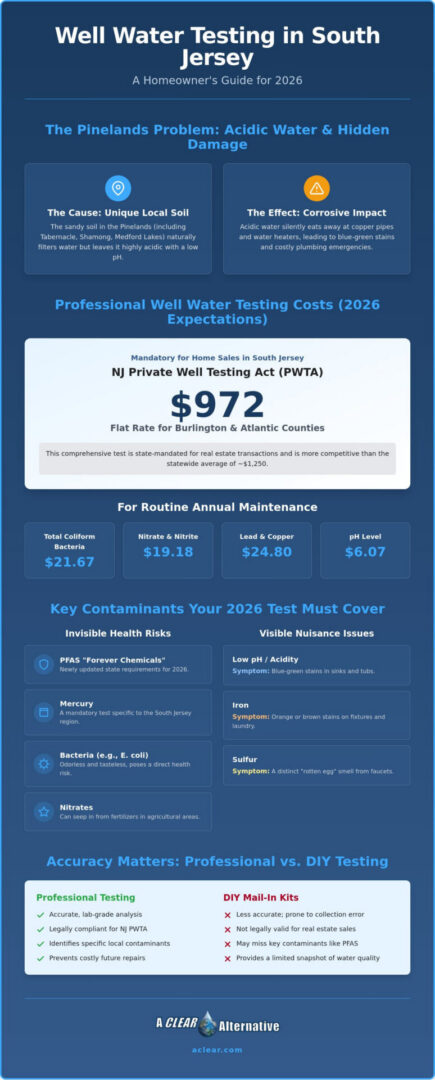
If you’re selling a home in Burlington or Atlantic County, the New Jersey Private Well Testing Act (PWTA) sets a clear benchmark. For these Southern New Jersey counties, the current flat rate for a PWTA test is $972. This comprehensive package is non-negotiable for real estate transactions. It covers every state-mandated parameter, including the recently expanded PFAS list and mercury, which is a specific requirement for our region. Statewide, the average cost for this level of detail often reaches $1,250, making our local rates relatively competitive for the depth of data provided.
For routine annual maintenance, you don’t always need the full PWTA suite. Individual tests through local authorities like the ACUA offer a more modular approach. You can expect to pay approximately $21.67 for a total coliform bacteria test, $19.18 for nitrate and nitrite levels, and $24.80 for lead and copper analysis. Adding a pH test usually costs around $6.07. These smaller investments allow you to monitor your comprehensive water testing needs without the full price tag of a real estate transfer panel.
Factors That Influence Professional Testing Fees
Not all lab reports are created equal. The level of laboratory certification is a primary driver of cost. State-certified labs must adhere to rigorous quality control standards that DIY kits simply can’t match. On-site collection fees also play a role. Having a professional visit your home in Shamong or Medford Lakes ensures the sample isn’t contaminated during the process, which protects the integrity of the results. Finally, keep an eye on turnaround times. Standard reporting usually takes 5 to 10 business days; requesting a “rush” status for a pending home closing can significantly increase your final invoice.
The Cost of Accuracy: Professional Lab vs. DIY Kits
It’s tempting to grab a $20 “all-in-one” kit from a hardware store. These strips are fine for a quick pulse check, but they often provide a false sense of security by missing trace amounts of lead or complex chemicals. Similarly, be cautious of companies offering “free” water tests. These are frequently sales tools designed to highlight specific problems rather than provide an unbiased health report. Only a certified laboratory analysis provides the legally defensible data required to ensure PWTA compliance. Choosing professional collection means you’re paying for accuracy, not just a piece of paper.
Key Contaminants Your 2026 Water Test Should Cover
While knowing the professional well water testing cost is vital for your home maintenance budget, the real value lies in the specific data points your report reveals. In South Jersey, we aren’t just looking for generic impurities. We’re hunting for the specific chemical signatures of the Pinelands and our local agricultural history. A comprehensive 2026 test acts as a high-tech health screening for your home. It moves you away from guesswork and toward a lifestyle of total water confidence and transparency.
Understanding South Jersey’s “Big Three”
Bacteria is the non-negotiable starting point for any safety panel. Heavy South Jersey rains can wash surface contaminants into shallow wells, making Total Coliform and E. coli testing a seasonal necessity rather than a one-time event. If you live in Shamong, being near agricultural zones makes this even more critical, as runoff can impact local aquifers. You can’t see these biological threats, but a lab-grade sample will find them instantly.
Acidity is the second major hurdle for our region. If you live in Tabernacle, a pH level below 6.5 is a significant red flag. This “aggressive” water is hungry for minerals, and it will happily eat the copper out of your pipes to satisfy that hunger. This lead to pinhole leaks and blue-green staining that ruins your fixtures. Testing the pH is the only way to know if your home’s “circulatory system” is at risk of premature failure.
Finally, we have the aesthetic villains: iron and sulfur. These are responsible for the orange stains on your laundry and that distinct “rotten egg” smell that greets you in the shower. While they aren’t always health risks, they drastically lower your quality of life. This is why iron and sulfur filtration systems have become a top upgrade for Medford Lakes residents who value a pristine, maintenance-free home environment.
PFAS and VOCs: The 2026 Update
The 2026 landscape has brought PFAS, often called “forever chemicals,” to the forefront of residential safety. These synthetic compounds are now a primary focus of the New Jersey Private Well Testing Act (PWTA). PFAS are a group of man-made chemicals including PFOA and PFOS that are now strictly regulated under NJ state standards due to their persistence in the environment and potential health impacts. Your 2026 test should also include Volatile Organic Compounds (VOCs), which can originate from industrial runoff or old underground fuel tanks.
Even if your well head looks modern, lead testing remains a critical step. Lead often leaches from older solder or brass fixtures inside the home rather than the well itself. The only way to be sure of your water’s safety is through a certified lab sample. Balancing the professional well water testing cost against these invisible risks ensures you aren’t just checking a box, but truly protecting your family’s long-term health.
Timing Your Test: When Is It Critical to Check Your Well?
Timing is everything when it comes to maintaining a healthy home environment. While many homeowners view water analysis as a one-time event, your groundwater is actually a dynamic resource. It shifts with the seasons, reacts to environmental changes, and can be influenced by nearby activity. Waiting for a problem to become visible often means the damage is already done. Instead, proactive scheduling ensures your home’s water remains a source of comfort rather than a cause for concern.
The annual standard is your most important baseline. Every spring, as the ground thaws and South Jersey rains increase, you should check for bacteria, nitrates, and pH levels. This routine checkup allows you to catch subtle shifts in chemistry before they result in blue-green stains or plumbing leaks. When you factor the professional well water testing cost into your yearly home maintenance budget, you’re essentially buying an insurance policy for your pipes and your family’s health.
The New Jersey Private Well Testing Act (PWTA) represents the most critical timing for many residents. If you’re selling a property, this testing is a legal mandate. As of 2026, these requirements have become even more comprehensive. Since the update on May 19, 2025, the state now requires testing for additional PFAS compounds like GenX, PFHxS, and PFBS. These “forever chemicals” are now a standard part of the $972 flat rate for real estate testing in our Southern New Jersey counties, ensuring every new homeowner starts with a clean slate.
The NJ Real Estate Process: Medford Lakes and Beyond
For sellers in Medford Lakes or Tabernacle, a certified water report is more than just a closing document. It’s a premium feature that adds “trendy” appeal and value to your listing. Modern buyers are highly health-conscious and value the transparency of a professionally managed well. Working with expert water treatment companies near me for pre-sale prep allows you to resolve any issues before they appear on a buyer’s mandatory report, keeping your closing on track and your reputation as a homeowner intact.
Immediate Warning Signs to Watch For
Sometimes, your well doesn’t wait for the calendar. You should schedule an immediate test if you notice any of the following triggers:
- Sudden changes in taste, clarity, or the onset of “rotten egg” odors.
- New blue-green staining on fixtures or the discovery of pinhole leaks in copper plumbing.
- Increased turbidity or cloudiness following heavy South Jersey rainstorms or flooding.
- Completion of a well pump or pressure tank replacement, which opens the system to potential bacterial contamination.
Nearby construction or land clearing can also impact the local aquifer by changing how water flows underground. If you notice a shift in your water’s personality, it’s time to act. Don’t leave your water quality to chance. Schedule your professional water analysis today and take the first step toward a maintenance-free, high-quality lifestyle.
From Results to Resolution: Restoring Your Water Quality
Receiving a laboratory report can feel like looking at a foreign language. Those technical rows of data are more than just numbers; they represent the blueprint for your home’s future comfort. We turn these results into a clear, actionable home improvement plan. The goal isn’t just to meet legal standards. It’s about elevating your daily living experience. When you invest in the professional well water testing cost, you’re buying the data needed to move from a place of uncertainty to a lifestyle of total confidence.
Neutralizing acidity is often the first and most rewarding step for South Jersey residents. It’s a dual-purpose win. By balancing your pH, you stop the silent erosion of your plumbing while making your water significantly gentler on your skin and hair. For those dealing with the “nuisance” side of well water, advanced filtration systems can now address iron, sulfur, and hardness in one streamlined unit. This eliminates orange stains and odors in a single stroke, restoring the aesthetic beauty of your home’s fixtures.
For the ultimate lifestyle upgrade, Reverse Osmosis remains the gold standard for drinking water. This technology provides bottled-water quality right from your kitchen tap, removing trace impurities that standard filters might miss. It’s the final touch for a modern, health-conscious home, ensuring that your water is as pure as it is refreshing. Balancing the initial professional well water testing cost against these long-term upgrades ensures you are spending your budget where it matters most.
Customized Treatment Solutions for South Jersey
Every well in Tabernacle, Shamong, and Medford Lakes has a unique fingerprint. One-size-fits-all filters found in big-box stores often fail because they aren’t designed for the specific chemistry of the Pinelands. A whole house water filtration system provides comprehensive protection by tailoring the media to your specific test results. We also recommend UV sterilizers as a final, chemical-free barrier. These systems provide 24/7 protection against biological contaminants, giving you a maintenance-free safety net that works silently in the background.
Partnering with A Clear Alternative
Since 1991, A Clear Alternative has been the local authority on South Jersey water chemistry. We understand the specific challenges of our regional aquifers because we live and work here too. Our family-owned approach means we don’t just install equipment; we build relationships. Our modern maintenance programs are designed so you never have to worry about your water again. We handle the salt, the filters, and the technical checks while you enjoy the results. Stop guessing about your water quality. Schedule your professional analysis today for total peace of mind and a renewed sense of confidence in your home.
Secure Your Home’s Future with Crystal Clear Confidence
Investing in your home’s water quality is the ultimate commitment to your family’s health and your property’s longevity. By understanding the professional well water testing cost and the specific challenges of the South Jersey Pinelands, you’ve already taken the most important step toward a maintenance-free lifestyle. Whether you’re navigating the complexities of the NJ Private Well Testing Act or simply want to stop the silent erosion of your plumbing, clear data is your best tool. You deserve to pour every glass with total transparency and peace of mind.
At A Clear Alternative, we’ve been your neighbors since 1991. As a family-owned and operated team, we bring a personal touch to modern water technology. We’re a licensed potable water hauler and provide 24/7 emergency support for South Jersey, ensuring you’re never left in the dark. It’s time to stop guessing and start enjoying the premium water experience your home was meant to provide. Schedule Your Professional Well Water Analysis with A Clear Alternative today. Let’s create a future where your water is as pure and refreshing as the lifestyle you’ve built.
Frequently Asked Questions
How much does a professional well water test cost in Tabernacle, NJ?
In Tabernacle, the professional well water testing cost usually follows a tiered structure based on your specific needs. While a full NJ Private Well Testing Act panel for a home sale is a flat $972, routine annual checkups for bacteria and nitrates are much more accessible. It’s about choosing the right level of detail to ensure your home’s water is safe and your plumbing is protected from Pinelands acidity.
How often should I realistically test my well water in South Jersey?
You should realistically test your well once a year for total coliform and nitrates. Because South Jersey soil is so sandy, surface contaminants can reach shallow aquifers faster than in other regions. Every five years, it’s smart to expand your panel to include lead, VOCs, and arsenic. This consistent schedule helps you catch subtle shifts before they become expensive repairs.
What is the NJ Private Well Testing Act and does it apply to me?
The NJ Private Well Testing Act is a mandatory law that applies to any property sale or lease involving a private well. It ensures that both buyers and tenants have a certified report on the water quality before a transaction closes. Even if you aren’t selling, these standards are the best benchmark for maintaining a high-quality, modern home environment.
Can I test my own well water with a kit from a hardware store?
Hardware store kits are fine for a quick pulse check on pH, but they lack the precision needed for a truly professional well water testing cost evaluation. They won’t detect trace amounts of heavy metals or the complex PFAS compounds required by state law. Laboratory analysis is the only way to get legally defensible results and total peace of mind for your family.
Why does my well water smell like rotten eggs and is it dangerous?
That distinct rotten egg smell is usually caused by hydrogen sulfide gas, which is common in our local groundwater. While it isn’t typically dangerous to your health, it drastically lowers your quality of life and can be embarrassing when guests visit. Modern iron and sulfur filtration systems are designed to strip these odors away instantly, restoring a fresh feel to your home.
What should I do if my water test comes back positive for bacteria?
If your test is positive for bacteria, stop drinking the water and switch to bottled supplies immediately. You’ll likely need to perform a shock chlorination or install a UV sterilizer to provide a permanent barrier. Professional guidance ensures the root cause is addressed so the issue doesn’t return after the initial treatment.
Will a water softener fix all the issues found in my water test?
Water softeners are fantastic for mineral buildup, but they won’t fix acidity, bacteria, or chemical runoff. You might need an acid neutralizer for low pH or a reverse osmosis system for total chemical purity. A customized treatment plan is always based on your specific lab results to ensure you aren’t wasting money on unnecessary equipment.
Is it safe to drink well water if it has a low pH level?
Drinking low pH water isn’t a direct health threat, but the secondary effects can be serious. Acidic water leaches metals like copper and lead from your pipes, which then enter your diet. Neutralizing the acidity protects your health and your home’s infrastructure simultaneously. It’s a simple fix that preserves your pipes and improves the taste of every glass.