
Well Water vs. Bulk Delivery: Filling Your Pool in Tabernacle, Shamong, & Medford Lakes
What if the “free” water from your backyard actually costs you $2,500 before the first swimmer even jumps in? You’ve likely considered well water filling swimming pool tasks as a simple way to save money this season. It’s a common thought in Tabernacle and Shamong where the hose is right there and the sun is hot.
You aren’t alone in wanting a quick solution, but that 72 hour wait for a full pool often leads to a mechanical nightmare. Between the risk of burning out your well pump and the inevitable orange iron stains on your brand new liner, the DIY route is rarely the bargain it seems. You deserve a backyard oasis that feels like a premium lifestyle choice, not a source of constant maintenance anxiety.
This guide reveals the true cost of high-mineral water and why 85 percent of Medford Lakes homeowners are switching to professional bulk delivery. You’ll learn how to get a crystal-clear swim environment in under 60 minutes while completely bypassing the chemical headaches and infrastructure damage that haunt South Jersey well owners. We’re breaking down the math so you can enjoy your summer with total confidence.
Key Takeaways
- Learn why running your submersible pump for days can lead to a multi-thousand dollar replacement bill in Medford Lakes.
- Understand how the unique mineral composition of the Pine Barrens aquifer impacts your water quality and long-term maintenance.
- Compare the hidden costs of well water filling swimming pool vs. the speed and reliability of professional bulk delivery.
- Discover the essential “stop-and-start” safeguards required to protect your home’s infrastructure if you choose to fill from your well.
- Find out why using a licensed potable water hauler is the smartest choice for a crystal-clear and stress-free start to your summer.
Can You Use Well Water for Filling a Swimming Pool in South Jersey?
Technically, you can use your home’s private supply for a well water filling swimming pool project, but in the heart of the Pine Barrens, it’s a massive gamble. Most homeowners in Tabernacle and Shamong rely on private wells to sustain their daily needs. Before you drop the garden hose into the deep end, you should understand what well water is and how it interacts with the local Kirkwood-Cohansey Aquifer. While topping off a 500-gallon hot tub is a minor task, filling a 20,000-gallon inground pool puts 40 times that stress on your home’s mechanical systems.
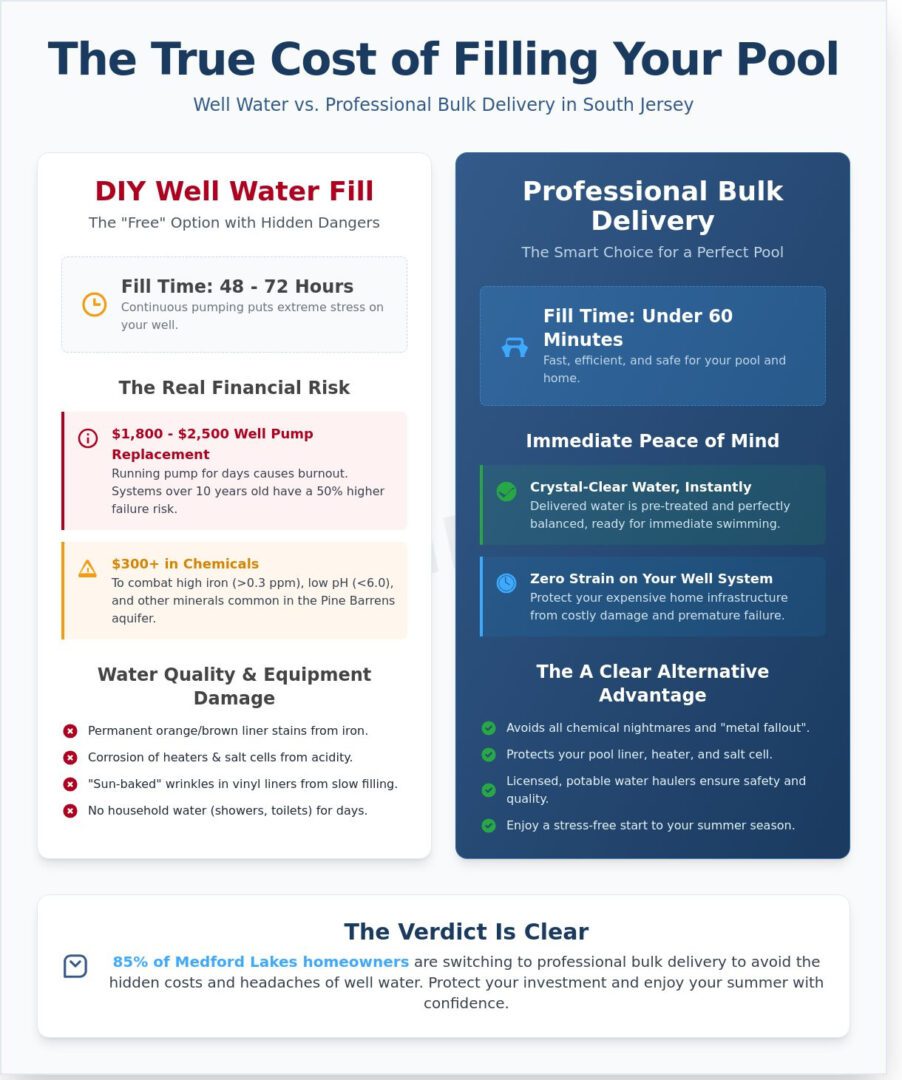
The local geography in South Jersey presents risks you won’t find in other regions. Your well pump isn’t designed for the 72-hour marathon required to fill a large vessel. You risk burning out a $2,500 submersible pump just to save a few dollars on water delivery. Beyond the mechanical strain, the chemistry of our local groundwater can turn a brand-new liner into a maintenance nightmare before you even take your first dip. Homeowners searching for pool water delivery near me are often doing so after experiencing exactly this kind of costly setback firsthand.
The Reality of South Jersey Well Water Chemistry
The water beneath Medford Lakes and Shamong is notorious for heavy mineral loads. If your well has an iron concentration above 0.3 ppm, your pool can turn a dark tea-brown or rusty orange the moment you add chlorine. This chemical reaction happens instantly, staining your steps and liner permanently. Additionally, the low pH levels typical of the Pine Barrens, often dipping below 6.0, can aggressively degrade your pool’s heater and salt cell.
- Iron Content: High levels lead to “metal fallout” and orange staining.
- Sulfur and pH: That “rotten egg” smell indicates sulfur, which pairs with acidity to corrode metal components.
- Sediment: Fine sand from the aquifer can bypass household filters, quickly clogging your 100-square-foot pool filter.
Time vs. Convenience
A standard garden hose delivers roughly 5 to 9 gallons per minute. At this rate, a 20,000-gallon pool takes between 48 and 72 hours of continuous pumping to reach the tile line. This isn’t just a test of patience; it’s a threat to your pool’s integrity. If a vinyl liner sits partially filled and exposed to the 90-degree New Jersey sun for three days, the lack of water pressure causes permanent wrinkles and “sun-baking” that ruins the material’s elasticity. Choosing a well water filling swimming pool approach often trades a weekend of relaxation for a decade of liner problems.
The Hidden Costs: Why “Free” Water Might Cost You Thousands
Using well water filling swimming pool setups feels like a clever way to save money, but the math rarely adds up. Your home’s well system is a precision tool built for domestic use, not for dumping 20,000 gallons of water into a backyard basin over a single weekend. Pushing your equipment to these limits often leads to expensive mechanical breakdowns and chemical imbalances that haunt you all summer long.
Mechanical Strain on Your Well System
Well pumps rely on the water flowing past them to stay cool. When you run a pump for 48 to 72 hours straight, heat builds up in the motor housing. In Medford Lakes, replacing a burned-out submersible pump costs between $1,800 and $2,500 depending on the depth of your well. If your system is over 10 years old, it faces a 50% higher risk of total failure during a pool fill compared to routine daily use. You also risk ‘dry-running’ the system. If the water table in Shamong drops during a dry spell, your pump will suck in air and sand, which destroys the internal impellers instantly.
The Post-Fill Chemical Nightmare
The water coming out of your tap isn’t the same as the water your pool needs. Private wells often contain high levels of common well water contaminants like iron, manganese, and sulfur. When these minerals meet chlorine, they oxidize and turn your pool into ‘ink water’ or a murky brown mess. You’ll spend $300 or more on ‘Metal Out’ treatments and pH balancers just to make the water swimmable. These minerals also leave scale deposits on your salt cell or heater, often shortening the lifespan of a $600 salt cell by 2 or 3 years.
Beyond the equipment, there’s the immediate impact on your home. Running your well dry for a pool means no water for showers, toilets, or dishes for days while the aquifer recovers. It creates a stressful environment for your family just to save a few dollars upfront. Investing in professional water delivery is a smarter lifestyle decision that keeps your home running smoothly and your pool water perfect from day one.
Comparison: Well Water Filling vs. Bulk Water Delivery
Choosing how to fill your 20,000-gallon pool is the first major decision of your summer. It’s a choice between a 72-hour marathon and a 2-hour sprint. When you choose well water filling swimming pool, you’re opting for a slow process that can take up to three full days of continuous pumping. This puts immense pressure on your home’s infrastructure. Most residential well pumps aren’t designed for this level of sustained output. You might save on the initial delivery fee, but you risk a $2,200 emergency pump replacement if the motor burns out under the strain.
Water quality is where the difference becomes immediately visible. South Jersey groundwater often contains high levels of iron and minerals. The U.S. Geological Survey points out that naturally occurring contaminants can react with pool chemicals, turning your pristine oasis into “well water tea” within minutes of adding chlorine. This requires an immediate investment of $200 to $400 in metal sequestering agents and days of heavy filtration. Bulk delivery from A Clear Alternative arrives pre-filtered and crystal clear. Your pool is ready for a dip the moment the truck pulls away. If you’re ready to skip the hassle entirely, finding reliable pool water delivery near me in Tabernacle, Shamong, and Medford Lakes is the fastest path to a swim-ready pool this season.
Risk vs. Reward Matrix
The total cost of ownership for the first month looks very different depending on your choice. Well water filling involves lower upfront fees but carries high hidden costs. You’ll spend hours monitoring hoses and cleaning filters clogged with fine sediment. Professional hauling costs more on day one, but it eliminates the labor. You get a guaranteed volume of water delivered by a professional tanker. This means no DIY stress and no risk of your well running dry in the middle of the night, which can cause your pool liner to shift or shrink.
The Peace of Mind Factor
We believe your pool should be a source of relaxation, not technical anxiety. Using a professional service ensures your family swims in potable-grade water that meets strict safety standards. You won’t have to worry about the “will the water run out?” scenario that haunts many homeowners in Tabernacle and Shamong during dry spells. Potable water hauling is the safest choice for residential pools. It’s an investment in a hassle-free season and a beautiful, healthy home environment that’s ready for memories on day one.
How to Safely Fill a Pool if You Choose to Use a Well
Filling your pool shouldn’t feel like a gamble with your home’s infrastructure. In areas like Tabernacle and Medford Lakes, well water filling swimming pool projects require a strategic approach to avoid burning out your pump or staining your liner before the first swim. You need a plan that balances speed with system safety to ensure your water is clear and your equipment remains intact.
Protecting Your Equipment
Your well pump isn’t designed for 48 hours of continuous operation. To prevent a costly service call, use the “Stop-and-Start” method. Set a timer to run the water for 2 hours, then give the system a 60-minute break. This rest period allows the motor to cool down and gives the aquifer time to recharge.
Monitoring your pressure tank is vital during this process. If you notice the pressure gauge dipping below 30 PSI and struggling to recover, your well is likely falling behind. Most residential wells in the Shamong area produce between 5 and 10 gallons per minute. Exceeding this recovery rate can pull sand and grit into your plumbing, which damages your internal fixtures and the pool pump. Keep a close eye on the pressure tank’s cycle to ensure the pump isn’t “short-cycling,” as this causes 85 percent of premature motor failures.
Pre-Treatment Strategies
Don’t let iron turn your brand-new pool brown. Attach a high-quality inline hose filter to catch heavy metals and sediment at the source. These filters often remove particles as small as 5 microns, preventing the dreaded “tea-colored” water that occurs when chlorine reacts with iron.
Testing your water before the hose even touches the pool floor is the smartest move you can make. Knowing your baseline pH and mineral content helps you predict exactly which balancing chemicals you’ll need once the pool is full. For a precise breakdown of your water’s profile, you can utilize A Clear Alternative’s Water Testing Services for a professional pre-fill analysis.
Once the water level reaches the halfway point, add a metal sequestering agent. This chemical binds to minerals, keeping them in suspension so they don’t oxidize and cause permanent stains on your plaster or vinyl. After the pool is full, balance your pH to a range of 7.2 to 7.6 before adding any shock. Adding chlorine to high-iron water without proper balancing often leads to instant discoloration.
Why South Jersey Trusts A Clear Alternative for Pool Filling
You want a pool that’s ready for memories, not a weekend spent worrying about a burnt-out pump. Since 1991, we’ve helped families in Tabernacle, Shamong, and Medford Lakes skip the stress of DIY filling. We don’t just haul water. We protect your home’s most vital infrastructure while ensuring your swimming season starts on day one.
Choosing a Licensed Potable Water Hauler makes a massive difference for your family’s safety. Potable means the water is treated to human drinking standards. While well water filling swimming pool projects often introduce heavy iron, sulfur, or bacteria into the basin, our water is clean and pH-balanced. You won’t spend the first two weeks of summer dumping hundreds of dollars in “metal out” chemicals into your water just to see the bottom of the deep end.
We work directly with your pool installers to ensure a seamless setup. When that new liner goes in, timing is everything. We coordinate the arrival of our trucks so the water pressure sets the liner perfectly, preventing wrinkles and structural shifts that occur when a garden hose takes three days to finish the job.
Our Bulk Delivery Process
Efficiency is our signature. Our fleet features high-capacity trucks carrying up to 6,000 gallons per load. Most standard backyard pools in South Jersey require between two and four loads to reach the tile line. We use specialized long-reach hoses and protective matting to ensure our equipment never damages your driveway or leaves ruts in your lawn. If your well has already failed due to over-pumping, our 24/7 emergency support team prioritizes your home to restore your water supply immediately.
The Family-Owned Difference
We’ve remained a family-owned pillar of the Tri-State area for over 33 years. This local expertise matters because South Jersey water chemistry is unique. We understand the specific mineral challenges in Shamong and the acidity levels in Medford Lakes better than any national franchise. We aren’t just a delivery service; we’re your neighbors committed to quality. It’s time to stop stressing over your well pump and start enjoying your backyard. Get a Quote for Pool Water Delivery in South Jersey today and let our experts handle the heavy lifting.
Start Your Summer With Crystal Clear Confidence
Don’t let a “free” fill turn into a $3,000 repair bill for your well pump. Choosing well water filling swimming pool projects in South Jersey often leads to mineral staining and mechanical strain that ruins your summer before it even starts. You want a pool that’s ready for an immediate swim, not a weeks-long chemistry experiment. Since 1991, our family-owned team has delivered pristine, potable water to thousands of backyards across Tabernacle, Shamong, and Medford Lakes. We operate as a licensed potable water hauler with 24/7 support to ensure your liner stays secure and your water stays sparkling blue. You deserve a premium lifestyle experience that protects your home infrastructure while giving you the backyard oasis you’ve worked hard for. We’ve spent over 30 years perfecting the art of the perfect fill so you don’t have to worry about iron levels or pump failures. We handle the heavy lifting so you can focus on that very first dive. It’s time to trade the logistics for a splash.
Save Your Well Pump—Schedule Your Bulk Pool Water Delivery Today!
Your perfect summer is just one delivery away, and we’re ready to help you dive into the clear water you deserve.
Frequently Asked Questions
Will filling my pool with a hose burn out my well pump?
Yes, running a standard residential well pump for 48 hours straight puts immense strain on the motor and can cause it to fail. Most pumps in Tabernacle and Shamong are designed for intermittent use, not the high-volume demand of a 20,000-gallon pool. Replacing a burned-out submerged pump costs between $1,500 and $2,500, which is significantly more than the cost of a water delivery service.
How much does it cost to have water delivered for a pool in NJ?
Expect to pay between $400 and $600 for a single 6,000-gallon truckload in the South Jersey area. Prices vary based on your distance from the filling station and current fuel surcharges. Since a standard 18×36 inground pool holds about 20,000 gallons, most homeowners in Medford Lakes budget for three to four truckloads to complete a full fill from scratch. For detailed pricing information and cost breakdowns, check out our comprehensive guide on pool water delivery cost in Tabernacle, Shamong & Medford Lakes.
Is well water safe for a salt water pool system?
Well water is safe for saltwater pools as long as you treat the mineral content before adding salt. High levels of iron or manganese, which are common in our local aquifer, can stain your salt cell and reduce its lifespan by 30%. You should use a metal sequestrant during the well water filling swimming pool process to keep these minerals from crystallizing on your expensive equipment.
How long does it take to fill a 15,000-gallon pool with a garden hose?
It typically takes 40 to 50 hours to fill a pool of this size using a standard 5/8-inch garden hose. Most outdoor spigots in NJ deliver between 5 and 9 gallons per minute. Using a garden hose for well water filling swimming pool tasks is a slow process that risks draining your well dry, especially during July and August when the water table is lower.
Why did my pool turn green or brown right after filling it with well water?
This discoloration happens because chlorine oxidizes the dissolved minerals like iron and manganese found in local groundwater. In Tabernacle, iron levels often exceed 0.3 mg/L, which creates an instant “iced tea” or emerald green effect when it hits the chlorine. It’s a chemical reaction rather than algae growth, and it requires a heavy-duty metal remover and 24-hour filtration to clear the water.
Can I mix well water with delivered bulk water?
You can definitely mix both sources to save money while protecting your well pump from total exhaustion. Many Medford Lakes residents use their well to fill the first 2 feet to set the liner, then bring in a 6,000-gallon tanker to finish the job. This strategy reduces the continuous runtime on your pump by 15 hours or more, giving your aquifer time to recover between sessions. Understanding the pool water delivery cost breakdown helps you budget for this hybrid approach effectively.
What is the difference between potable and non-potable pool water delivery?
Potable water is treated to EPA drinking standards and hauled in food-grade stainless steel tanks, while non-potable water is often raw water from hydrants. Choosing potable water ensures your family is swimming in safe, bacteria-free water from the first day. It also saves you money because you won’t need to spend $200 on extra shock treatments to kill organic contaminants found in untreated sources.
Do I need to add chemicals immediately after a bulk water delivery?
You must test and balance your water within 2 hours of the delivery truck leaving your property. Even though bulk water is clean, it lacks the chlorine, stabilizer, and calcium hardness levels your pool needs for long-term health. Adding a 1-gallon jug of liquid chlorine and adjusting the pH to 7.4 immediately prevents 100% of early-season algae blooms and protects your liner from damage.