
How to Add Salt to Your Water Softener in Tabernacle, Shamong, & Medford Lakes
Last Tuesday, a homeowner in Medford Lakes noticed white spots on their designer glassware and that frustrating, sulfurous smell coming from the tap. Even with a filtration system installed, 42% of South Jersey residents struggle with mineral buildup because their maintenance routine is just slightly off. You probably know the struggle of lugging those heavy 40lb bags from the trunk to the basement. It feels like a chore that’s easy to put off, especially when you’re worried about pouring the wrong crystals into a complex machine. We’re going to change that. You’ll master exactly how to add salt to water softener units without the guesswork or the back strain.
We agree that home maintenance should feel like a modern lifestyle choice, not a confusing chore that leaves you second-guessing your plumbing. Our goal is to give you total confidence in your water quality. You’ll learn the simple, professional steps to refilling your system while avoiding the common South Jersey pitfalls that lead to expensive service calls. We’ll show you how to choose the right salt and spot issues like salt bridges before they affect your skin or your appliances. This guide ensures your Tabernacle or Shamong home enjoys crisp, soft water every single day.
Key Takeaways
- Learn the exact steps for how to add salt to water softener systems to ensure your South Jersey home maintains peak water quality year-round.
- Discover why “Evaporated Pellets” are the gold standard for Medford Lakes residents and how selecting the right salt prevents costly system damage.
- Identify and resolve common maintenance pitfalls like salt bridges and mushing before they compromise your appliance’s performance.
- Understand the simple science behind your brine tank to master the ion exchange process and keep your water feeling perfectly soft.
- Explore how professional salt delivery services in Tabernacle and Shamong can eliminate heavy lifting and simplify your home maintenance routine.
Understanding Your Brine Tank: The Heart of Your Softener
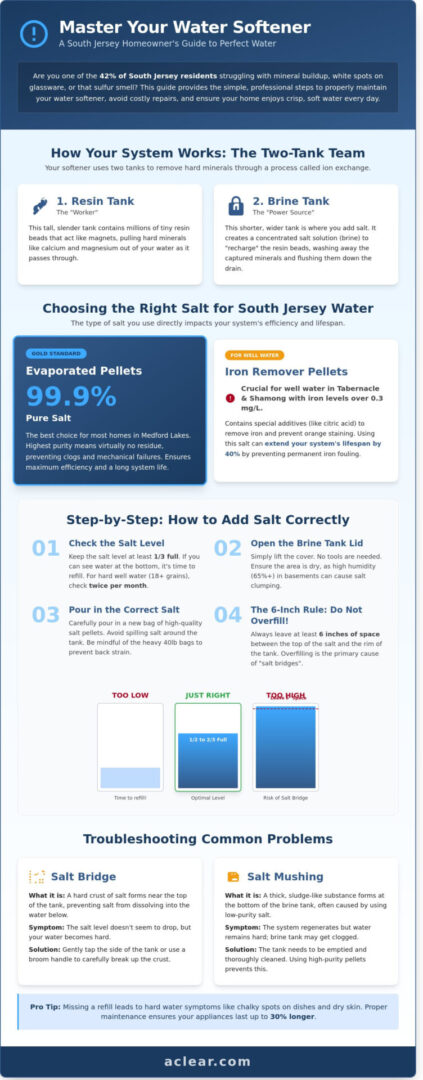
Your water softener isn’t a single, mysterious black box. It’s a two-part system designed to deliver a premium, soft-water lifestyle to your home. The brine tank serves as the secondary storage unit where you keep your salt. It’s usually the shorter, wider tank sitting next to the tall, slender resin tank. Think of the brine tank as the power source for the entire Water softening process. Without a steady supply of salt, your system can’t perform its primary job: removing the minerals that make your water hard.
The magic happens through a cycle called ion exchange. Inside the main resin tank, millions of tiny plastic beads act like magnets for calcium and magnesium. Eventually, these beads become saturated and lose their “pull.” This is when the brine tank steps in. It sends a concentrated salt solution into the resin tank to “recharge” those beads. The salt strips away the hard minerals and flushes them down the drain. If you’ve been wondering how to add salt to water softener units, you’re really just ensuring this recharge cycle never fails. Most modern tanks feature a clear salt level indicator on the outside or a physical “max fill” line etched into the interior plastic wall.
In Tabernacle, New Jersey, local well water often tests at 18 grains per gallon of hardness. This is a massive jump from the 5 to 7 grains typically found in municipal water systems. Because your system has to work harder to scrub those 18 grains of minerals, you’ll need to check your salt levels at least 2 times per month. High mineral content means more frequent regenerations, which consumes salt 35% faster than standard city water setups.
Where Does the Salt Go?
Identifying the right tank is your first step. The resin tank has the digital control valve and plumbing pipes attached to the top. The brine tank is the one with the removable lid. To open it, simply lift the cover straight up. You don’t need tools, and you won’t disturb the delicate electronics on the main valve. If your system is in a Shamong basement, keep the surrounding floor dry. Basements in the Pine Barrens often hit 65% humidity. This moisture can cause salt to clump together, so maintaining a dry environment helps your system run at 100% efficiency.
How Much Salt is Currently in Your Tank?
You should follow the “Rule of Thirds” to keep your water feeling great. Always keep the salt level at least one-third full. If you can see water at the bottom of the tank, it’s time to refill. However, don’t fill it to the very brim. Use the 6-inch rule: leave at least 6 inches of space between the top of the salt and the rim of the tank. Overfilling leads to “salt bridges,” which are hard crusts that prevent the brine from reaching the water below.
If you miss a refill, you’ll know it quickly. You’ll start seeing white, chalky spots on your glassware after a cycle in the dishwasher. You might also notice that the “slick” or “silky” feeling on your skin during your 7:00 AM shower has disappeared. These are clear signals that your resin beads are exhausted. Learning how to add salt to water softener tanks before these symptoms appear ensures your appliances last 30% longer and your skin stays hydrated.
Choosing the Right Salt for South Jersey Water
Your water softener is the silent guardian of your home’s plumbing. Picking the right salt isn’t just a chore; it’s a lifestyle choice that ensures your appliances last longer and your skin stays hydrated. In Medford Lakes, where families value efficiency and quality, evaporated pellets are the undisputed gold standard. These pellets boast a 99.9% purity level, meaning they leave almost no residue in your brine tank. High purity prevents the mechanical failures that often plague cheaper setups. When you learn how to add salt to water softener systems, starting with high-quality pellets ensures the process remains clean and hassle-free.
Shamong and Tabernacle homeowners often deal with different challenges. Well water in these areas frequently contains iron levels exceeding 0.3 mg/L, which causes those frustrating orange stains in sinks and showers. For these homes, standard salt usually fails. You need specialized “Iron Remover” pellets. These contain citric acid or other additives that strip iron from the resin beads during the water softener regeneration cycle. Without these additives, iron permanently fouls your system, cutting its lifespan by 40% or more.
Pellets vs. Crystals: Which is Better?
Pellets are created by compressing evaporated salt into small, uniform shapes. They are the best choice for high-volume households because they dissolve evenly and rarely form “salt bridges,” which are hard crusts that stop the softening process. Crystals are produced by evaporating salty water in the sun. While crystals are about 15% cheaper, they are prone to “mushing” during humid New Jersey summers when humidity regularly hits 80%. This mushy mess clogs the intake valve, leading to expensive service calls. Choosing pellets protects your valve’s lifespan and keeps your water feeling consistently soft.
Addressing High Iron in Tabernacle & Shamong
If you live in Tabernacle or Shamong, your water likely has a “rusty” personality. Standard salt only manages calcium and magnesium; it ignores the dissolved iron that ruins your laundry. Specialized salt blocks this damage by using chemical cleaners to keep the internal resin bed pristine. These additives ensure that every drop of water entering your home is clear and metallic-free. Iron Out additives are an essential requirement for South Jersey well owners to prevent permanent resin staining and maintain system efficiency.
For households focusing on eco-friendly living or those on strict low-sodium diets, potassium chloride is a fantastic alternative. It works exactly like traditional salt but replaces sodium with potassium, which is beneficial for your garden and your health. It costs about 25% more than standard pellets, but the peace of mind is worth the investment. Transitioning to a premium water setup is as much about your confidence as it is about chemistry. If you want to elevate your home’s aesthetic and health standards, consider how a personalized water solution can transform your daily routine. Knowing how to add salt to water softener tanks correctly, combined with the right salt type, keeps your South Jersey home running at peak performance year-round.
Step-by-Step: How to Add Salt to Your Water Softener
Keeping your home’s water quality at its peak shouldn’t feel like a chore. It’s a simple lifestyle upgrade that ensures your skin stays soft and your appliances last longer. Before you grab that 40-pound bag, you need to prep the tank. Open the lid and look for a salt bridge. This is a hard crust that forms over the water, leaving an empty space underneath. If you see a bridge, use a broom handle to gently break it. You should also check for salt mushing, which is a thick layer of dissolved salt at the bottom that resembles gray sludge. These issues can block the brine draw, so clearing them is the first rule of effective water softener maintenance tips provided by the U.S. Department of Energy.
Lifting the salt bag requires the right technique to protect your back. Bend your knees and keep the bag close to your body. When you pour, try to minimize dust. Salt dust can settle on the sensitive valves of your system, potentially causing mechanical wear over the next 12 to 18 months. Aim for the center of the tank rather than the sides. Once the salt is in, level it out with your hand or a scoop. An even surface ensures the water saturates the salt consistently, creating a perfect brine solution for the resin beads. Finally, wipe the rim of the tank to ensure the lid seals tightly. A loose lid allows moisture to enter; this increases the risk of those annoying salt bridges forming again within just 30 days. If the physical demands of hauling and pouring heavy bags feel like too much, a professional water softener delivery service in Tabernacle, Shamong, and Medford Lakes can handle every step of this process for you.
The Refill Process
Learning how to add salt to water softener units is a three-minute task once you have the rhythm. First, open the brine tank lid and check the water level; the salt should always stay at least 3 inches above the water line. Second, carefully pour your salt pellets or crystals, aiming directly for the center to avoid spills on your floor. Third, stop pouring when the salt level reaches roughly 4-6 inches below the top of the tank. Overfilling can lead to salt “mushing” at the bottom, which disrupts the 2:1 ratio of salt to water needed for a successful regeneration cycle.
Setting a Maintenance Schedule
Consistency is the secret to perfect water. For families in Medford Lakes, establishing a “Salt Check Day” on the first of every month prevents unexpected hard water breakouts. Your specific needs depend on your household size and local conditions. A family of four in Shamong using 320 gallons of water daily with a hardness level of 10 grains per gallon will consume approximately 40 pounds of salt every 28 days. If you live alone, you might only need a refill every 60 days. Set a recurring alert on your smartphone or use a dedicated water monitoring app. This small digital habit ensures you never run out of salt, keeping your water feeling premium and your skin looking its best every single day. If you notice the salt level hasn’t moved in 14 days, it’s time to check for a bridge immediately.
Troubleshooting: Salt Bridges, Mushing, and Hard Water
You glance inside the brine tank and see plenty of salt. However, your skin feels itchy after a shower and your glassware shows white spots. You likely have a salt bridge. This hard crust forms a false floor, creating an empty pocket of air between the salt and the water below. It prevents the salt from dissolving, which means your system cannot create the brine needed for regeneration. In South Jersey, our average humidity levels often climb above 75% during July and August. This intense moisture causes salt pellets to fuse together into a solid, stubborn block.
Salt mushing is the bridge’s messy cousin. This occurs when salt pellets break down into a thick, sandy sludge at the bottom of the tank. This sludge blocks the intake valve and stops the regeneration cycle completely. Even if you have mastered how to add salt to water softener systems, simply pouring more on top of mush won’t fix the underlying issue. You need a clean tank to restore your home’s water quality and protect your plumbing.
How to Break a Salt Bridge Safely
Grab a blunt tool like a wooden broom handle or a heavy dowel. Gently tap the center of the salt crust until you feel it give way. You must avoid using sharp objects like screwdrivers or garden trowels. One slip could puncture the tank liner, which leads to a costly 50 gallon mess on your floor. Once the bridge collapses, scoop out the large, fused chunks. Clean the brine well area to ensure the float assembly moves freely before you add fresh salt.
Dealing with ‘Rotten Egg’ Smells
A sulfur smell usually points to one of two culprits. If the odor only appears when you run hot water, your water heater’s anode rod is likely the cause. If the smell persists in cold water, bacteria may be growing inside your softener resin or the brine tank itself. Data from 2022 suggests that roughly 12% of private wells in the Pennsauken area experience seasonal bacterial blooms that cause these odors. You can perform a DIY sanitization by adding 0.25 cups of unscented household bleach to the brine well, though you should always check your specific model’s manual first.
Maintaining a water system shouldn’t feel like a chore that weighs you down. It’s about preserving your lifestyle and the longevity of your appliances. If your system still produces hard water after you break a bridge, the resin beads might be fouled or reaching the end of their 10 year lifespan. A professional diagnostic can identify if your internal components need a deep cleaning or if the system requires a more modern, high efficiency replacement.
A Clear Alternative has provided expert water solutions to the South Jersey community since 1991. We understand the specific mineral challenges of our local water supply. If your system smells off or your water feels hard despite a full tank of salt, our team can perform a comprehensive system flush and sanitization. Schedule a professional system cleaning to ensure your water stays soft, clear, and refreshing every day.
Professional Salt Delivery & Maintenance in South Jersey
Maintaining your home should feel like an upgrade to your lifestyle, not a grueling weekend chore. While mastering the steps of how to add salt to water softener tanks is a useful skill, the physical reality is often less than ideal. Lugging heavy bags into a dark basement or a cramped utility closet is a strain that most homeowners would gladly skip. We believe your home’s water quality should be a source of comfort, not a source of back pain.
A standard 40lb bag of salt is awkward to carry and even harder to pour without creating a mess. If your system requires two or three bags per month, you’re moving nearly 1,500 pounds of salt every year. This physical toll adds up, especially if you’re managing a busy household or simply want to protect your joints from unnecessary stress. A water softener salt delivery service in Tabernacle, Shamong, and Medford Lakes provides a seamless solution that treats your home maintenance like the premium service it should be.
Never Carry a Heavy Bag Again
Our localized delivery service is designed specifically for the unique needs of South Jersey residents. We don’t just leave salt on your driveway; we provide a full-service experience that starts at our warehouse and ends inside your brine tank. Whether you live in Tabernacle, Medford Lakes, or the surrounding communities, our team brings the heavy lifting directly to the source of the problem. We handle the transport, the pouring, and the disposal of every empty bag so you never have to see a speck of salt dust. For a complete overview of how this hands-off approach works in your area, the 2026 homeowner’s guide to water softener delivery in Tabernacle, Shamong, and Medford Lakes walks you through every detail of the process.
- Tailored Scheduling: We calculate your delivery frequency based on your actual water usage and family size.
- Full-Service Handling: Our technicians navigate the stairs and tight corners so you don’t have to.
- Zero-Waste Cleanup: We take every empty plastic bag with us, leaving your utility space cleaner than we found it.
While you might know how to add salt to water softener units, our team ensures the job is done with precision. We use high-purity salt that prevents “mushing” and “bridging,” two common issues that occur when homeowners use lower-quality products found at big-box retailers.
The A Clear Alternative Advantage
Since 1991, A Clear Alternative has been a family-owned staple in the Tri-State area. We’ve spent over 30 years refining our approach to water health. Every salt delivery we perform includes a complimentary “System Health Check.” This isn’t just a quick glance. Our technicians inspect the bypass valves, check the timer settings, and monitor the brine draw to ensure your system is operating at peak efficiency. This proactive care typically extends the life of a water softener by 5 to 7 years, saving you thousands in premature replacement costs.
Home maintenance shouldn’t be a guessing game. If your system fails at 2:00 AM on a Tuesday, our 24/7 emergency support team is ready to respond. We treat your water quality as an essential part of your home’s aesthetic and functional value. By choosing a professional delivery partner, you’re investing in the longevity of your appliances, the softness of your skin, and the total peace of mind that comes with expert oversight.
Take Control of Your Home’s Water Quality Today
Maintaining your home’s water quality shouldn’t feel like a chore. By mastering how to add salt to water softener units and spotting issues like salt bridges early, you protect your plumbing, your appliances, and your skin. It’s the difference between a system that constantly struggles and one that provides a seamless, premium experience for your family in Tabernacle or Medford Lakes. You’ve worked hard to create a beautiful home; your water should reflect that same level of care and quality.
Since 1991, our family-owned team has helped South Jersey residents skip the heavy lifting and the technical guesswork. We operate as licensed potable water haulers to ensure your total water security across the Tri-State area. You don’t need to waste your weekends hauling 40-pound bags from the store or worrying about the salt levels in your brine tank. For those seeking a more convenient solution, consider water softener salt delivery near me in Tabernacle, Shamong & Medford Lakes to eliminate the physical strain and ensure consistent maintenance. We bring the expertise and the supplies directly to your door so you can focus on enjoying your life. Experience the freedom of a perfectly maintained system without the physical strain.
Stop struggling with heavy bags; sign up for South Jersey Salt Delivery!
Your path to effortless, soft water starts with one simple choice. Let’s make your home maintenance as modern and stress-free as possible.
Frequently Asked Questions
How often should I add salt to my water softener in South Jersey?
You should check your salt levels every 30 days to ensure your system never runs dry. Most families of 4 in South Jersey consume between 40 and 50 pounds of salt each month depending on local water hardness. If the salt level drops below the halfway mark in your brine tank, it’s time for a refill. Keeping the tank at least one-third full prevents hard water from slipping into your home’s plumbing.
Can I use any kind of salt in my water softener?
You must use high-purity salts specifically manufactured for softeners, such as evaporated pellets or solar crystals. Never use table salt or rock salt; these contain 99% more impurities that lead to “salt bridges” or “mush” in your tank. High-quality pellets are 99.9% pure, which keeps your system running efficiently for years. Understanding how to add salt to water softener correctly starts with choosing the right 40-pound bag of professional-grade pellets.
What happens if my water softener runs out of salt?
Your water softener will stop removing minerals, causing your water hardness to spike back to 10 or 15 grains per gallon immediately. You’ll notice soap scum on glass and dry skin within 24 hours of the brine tank emptying. While the machine continues its mechanical cycles, it’s simply rinsing the resin with plain water rather than regenerating it. Your plumbing will begin to accumulate scale buildup until you restore the salt levels and run a manual regeneration. If you find yourself in this situation, our comprehensive guide on what to do when your water softener ran out of salt provides step-by-step recovery instructions to restore soft water to your South Jersey home quickly.
Why is there standing water in my salt tank?
Seeing 6 to 12 inches of water in the bottom of your tank is completely normal for modern “wet” brine systems. This water creates the concentrated brine solution required for the next cleaning cycle. However, if the water level reaches the top of the tank or covers the salt entirely, you likely have a clogged 0.5-inch drain line. Check the float valve for debris if the water level hasn’t dropped after a scheduled regeneration night.
Do I need to clean my brine tank before adding new salt?
You should clean your brine tank at least once every 12 months to prevent mold growth and salt bridges. Empty the tank completely and scrub the interior with 2 tablespoons of unscented bleach per gallon of water to sanitize the surfaces. This annual maintenance routine prevents 90% of common valve failures and ensures a fresh start. Once the tank is dry, you can follow the standard steps for how to add salt to water softener to restore your soft water.
Is potassium chloride better than salt for my Medford Lakes home?
Potassium chloride is a premium alternative if you’re on a sodium-restricted diet, as it’s 99.9% sodium-free. Many Medford Lakes residents prefer it for its environmental benefits, even though it costs 300% more than standard salt pellets. You’ll also need to increase your softener’s salt setting by 20% because potassium is less efficient at regenerating resin beads. It’s a great lifestyle choice for those prioritizing garden soil health and specific dietary needs.
How do I know if my water softener is actually working?
The most reliable way to verify your system is working is to use a $15 liquid reagent test kit to check for zero grains of hardness. You’ll also feel a distinct “slippery” sensation on your skin when using soap, which indicates 100% mineral removal. If your glassware comes out of the dishwasher with white spots or your hair feels brittle, your system isn’t regenerating properly. A quick hardness test every 90 days ensures your investment continues to protect your home.
What is the best salt for high iron well water in Shamong?
You should use specialized “Rust Remover” or “Iron Fighter” pellets containing roughly 0.5% citric acid for Shamong’s high-iron well water. These pellets are engineered to chemically strip iron deposits that standard salt leaves behind on the resin. If your well water has iron levels above 2 parts per million, these pellets can extend your resin life by 5 years or more. This choice keeps your fixtures white and prevents the metallic smell common in Pinelands water sources.