
Acid Neutralizer Systems for Tabernacle, Shamong, & Medford Lakes: The 2026 Homeowner’s Guide
Last Tuesday, a Shamong homeowner discovered a pinhole leak spraying water across their finished basement, a $4,200 disaster caused by nothing more than invisible acidity. You’ve likely seen the warning signs yourself: those stubborn blue-green stains in your Medford Lakes shower or the metallic tang in your morning coffee. It’s frustrating to watch your high-end fixtures lose their shine to corrosion while you worry about lead leaching from old solder into your drinking water. Installing a high-performance acid neutralizer stops this silent destruction immediately, ensuring your South Jersey home remains a sanctuary rather than a source of stress.
For particularly stubborn mineral scale or biological buildup that can occur over time, some homeowners also look into advanced cleaning techniques. While a standard re-bedding is often sufficient, you can also explore Dry Ice Blasting options to understand how this modern, non-abrasive method can restore tanks and components without using harsh chemicals or water.
You deserve water that’s as clear and healthy as it looks. This 2026 guide shows you how to achieve a perfect 7.0 pH balance while extending the life of your water heater by up to 50 percent. We’ll explore the latest digital filtration systems, compare local maintenance costs, and provide a clear roadmap to total water security for your family. It’s time to trade the constant scrubbing for the confidence of pure, protected plumbing.
Key Takeaways
- Protect your South Jersey home by identifying the “silent killer” in Pine Barrens well water that dissolves copper pipes from the inside out.
- Master the science of pH balancing with an acid neutralizer that uses natural minerals to restore your water’s health and clarity.
- Choose with confidence between backwashing and upflow systems based on your family’s unique water usage and sediment profile.
- Learn the simple reality of system maintenance and how to perfectly integrate pH balancing with your existing water softening needs.
- Experience the peace of mind that comes with a custom-sized installation designed specifically for the unique water chemistry of Tabernacle and Medford Lakes.
Why Your Tabernacle or Medford Lakes Well Water Needs an Acid Neutralizer
Your home in Tabernacle or Medford Lakes sits atop a geological wonder known as the Kirkwood-Cohansey aquifer. While this source provides an abundant supply of water, the ground beneath the 1.1 million acres of the Pine Barrens is naturally aggressive. You aren’t just dealing with standard well water; you’re dealing with a chemical imbalance that slowly destroys your plumbing. Living in South Jersey means accepting that your water chemistry is unique, and without the right intervention, it’s working against you every day.
The Science of the Pine Barrens Aquifer
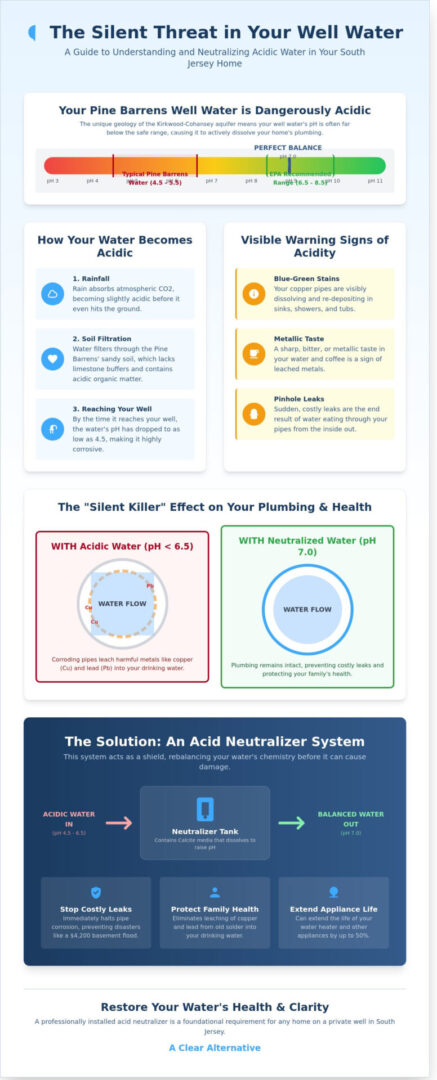
The sandy, porous soil of Shamong and Tabernacle lacks the natural limestone buffers found in other regions. When rain falls, it filters through decaying organic matter on the forest floor, picking up carbon dioxide and organic acids. By the time it reaches your well, the pH often ranges between 4.5 and 5.5. For context, the EPA recommends a domestic water pH range of 6.5 to 8.5. If a local lab test shows your water is at a 6.2, your pipes are already under constant chemical attack. Understanding modern water purification processes helps you realize that pH adjustment isn’t a luxury; it’s a foundational requirement for any home on a private well in this zip code.
Acidic water acts as a powerful solvent. It doesn’t just flow through your pipes; it dissolves them from the inside out. This “silent killer” effect targets copper lines and lead solder joints. Over time, the metal thins until it fails. This isn’t just about the cost of a plumber. When metals leach into your flow, they end up in your glass. High copper concentrations can cause gastrointestinal distress, while any level of lead is a known neurotoxin. Installing a high-performance acid neutralizer is the only way to stop this leaching process and protect your family’s health.
Visible Signs You Have an Acidity Problem
You don’t always need a laboratory to tell you there’s a problem. Look at your fixtures. If you see stubborn blue-green staining in your white porcelain bathtubs or sinks, that is actually your copper piping dissolving and redepositing on the surface. You might also notice a sharp, metallic, or bitter taste in your morning coffee. Since 2021, many Medford Lakes homeowners have reported “mystery” pinhole leaks in their basement or crawlspace lines. These aren’t accidents or bad pipe installs. They’re the direct result of low-pH water eating through the metal wall of the pipe until it breaks the surface. If you’ve had to patch a leak recently, your water is likely below the 6.5 pH safety threshold. Recognizing these signs of acidic water in Tabernacle, Shamong, and Medford Lakes early can save you thousands in emergency plumbing repairs.
Standard sediment filters or carbon blocks won’t fix this. Those tools are designed to catch physical particles or chlorine. Correcting low pH requires a chemical shift. A professional acid neutralizer uses a sacrificial media, typically crushed calcite or magnesium oxide, to balance the water. As the acidic water passes through the tank, it dissolves just enough of these minerals to raise the pH to a neutral 7.0. It’s a simple, elegant solution that turns aggressive groundwater into safe, balanced water that stays in your pipes where it belongs.
How Acid Neutralizers Protect Your Shamong Home’s Plumbing
Acidic water in Shamong isn’t just a minor technicality. It’s a slow-motion wrecking ball for your pipes. When your well water pH drops below the neutral 7.0 mark, the water becomes chemically “hungry.” It actively seeks out minerals to stabilize itself, often stripping them directly from your copper plumbing and brass fixtures. This process leads to the tell-tale blue-green stains in your sinks and, eventually, pinhole leaks that can flood a basement in hours. An acid neutralizer acts as a proactive shield, balancing your water chemistry before it ever touches your tap.
The system works through a process called sacrificial filtration. As acidic water passes through the tank, it dissolves a specialized crushed mineral media. This reaction raises the pH to a safe, neutral level. It’s a simple, elegant solution that mimics how nature filters water through limestone deep underground. Understanding how acid neutralizers work is the first step toward reclaiming your home’s infrastructure from the corrosive effects of South Jersey’s sandy, acidic soil.
Calcite vs. Corosex: Which Media is Right for You?
Most Shamong homes find success with Calcite, which is naturally occurring calcium carbonate. It’s the industry standard for water with a pH between 6.0 and 6.8. Calcite is particularly effective because it’s self-limiting. It only dissolves when the water is actually acidic. Once the water reaches a neutral pH of roughly 7.2 to 7.4, the Calcite stops reacting. This ensures you never “over-correct” your water or make it too alkaline, which can cause its own set of scaling issues.
However, some deep wells in South Jersey show much more aggressive acidity, sometimes dipping as low as 5.0 or 5.2. In these high-flow environments, Calcite alone can’t work fast enough. That’s where Corosex comes in. Corosex is a highly reactive magnesium oxide additive. It packs five times the neutralizing power of Calcite. Our technicians often create a custom “sweet spot” blend, typically using 80% Calcite and 20% Corosex. This hybrid approach provides the punch needed for heavy acidity while maintaining the stable, self-limiting benefits of a standard acid neutralizer setup.
Extending the Life of Your Water Heater and Appliances
The financial impact of acidic water hits hardest in your utility room. Your water heater is essentially a large metal pressurized tank; when filled with low-pH water, the internal heating elements corrode 40% faster than they would in neutral conditions. This leads to sediment buildup at the bottom of the tank, forcing the unit to work harder and increasing your monthly energy bills by as much as 15%. By the time you notice a drop in hot water duration, the internal damage is often irreversible.
Your dishwasher and washing machine face similar risks. Acidic water degrades rubber seals and eats away at the metallic components of the pump assemblies. Replacing a high-end dishwasher every 4 years instead of the expected 10 years is a massive drain on your budget. When you compare the $2,500 investment in a professional filtration system to the $15,000 cost of a whole-house repipe, the ROI is clear. Protecting your home is about more than just plumbing; it’s about the confidence that comes with a healthy home environment. Investing in a neutralizer today prevents the structural fatigue that leads to expensive emergency repairs tomorrow.
Choosing the Right System: Backwashing vs. Upflow Neutralizers
Your home deserves a water system that works as hard as you do. Selecting an acid neutralizer isn’t just about chemistry; it’s about matching technology to your South Jersey lifestyle. Most local wells tap into the Kirkwood-Cohansey aquifer, which often carries fine sediment and organic matter. This makes your choice between backwashing and upflow systems a critical decision for your plumbing’s longevity. You want a solution that fits your space while delivering consistent, high-quality results every time you turn on the tap.
The Backwashing Advantage for NJ Well Owners
Backwashing systems are the gold standard for high-performance homes in Gloucester and Atlantic counties. These units use a motorized control head to reverse the water flow every few days. This 15-minute cycle lifts the media bed, washing away trapped silt and preventing the calcite from hardening into a solid block. Without this movement, your water pressure can drop by 20 PSI within just 90 days. Modern electronic heads, like the high-efficiency models released in early 2024, allow for “set-it-and-forget-it” operation. They track your actual water usage to trigger cleaning cycles only when necessary, ensuring you never run out of treated water during peak morning hours.
Upflow Systems: Simplicity for Specific Needs
Upflow systems offer a streamlined profile for smaller households or tight spaces. They don’t require a floor drain or an electrical outlet, making them a fit for crawlspaces or remote utility sheds. Water enters at the bottom and swirls upward through the media. However, these systems lack a cleaning cycle. If your well has even 5 microns of sediment, you risk “channeling.” This occurs when water carves a single path through the media, bypassing the neutralization process entirely. Statistics from 2023 field tests show that upflow models perform best in 1-2 person households where the incoming water is already pre-filtered and clear.
Tech innovation is changing the game for 2026 with the Vortech tank design. Traditional tanks use a heavy gravel bed at the bottom, but Vortech replaces this with a high-flow distribution plate. This design creates a more aggressive backwash with 30% less water waste. It’s an eco-friendly choice that protects your septic system from unnecessary volume while ensuring every drop of water is perfectly balanced. For South Jersey residents, this means better pressure in the shower and a longer lifespan for the media inside your acid neutralizer.
Maintenance is the key to a beautiful, scale-free home. You’ll need to replenish the media inside your system roughly every 12 to 18 months, depending on your family’s water consumption. Most local families find that a quick annual check-up is all it takes to keep the pH at a perfect 7.0. It’s a small investment for the peace of mind that comes with clear, non-corrosive water. Keep these factors in mind as you choose your setup:
- Water Usage: Families of 4 or more should almost always choose backwashing.
- Drain Access: If you don’t have a floor drain or utility sink, upflow might be your only option.
- Sediment Levels: High-sediment wells require the cleaning power of a backwashing head.
- Efficiency Goals: Look for Vortech tanks to save 30% on your water bill.
Comparing the footprint of these two options is also vital. A standard backwashing unit stands about 60 inches tall and requires a 12-inch diameter space, plus room for the drain line. Upflow units are slightly shorter because they lack the electronic head, often saving you about 6 inches of vertical clearance. Whether you prioritize the tech-heavy performance of a backwashing system or the minimalist approach of an upflow unit, the goal remains a healthy, vibrant home environment.
Maintenance and Integration: What NJ Homeowners Need to Know
Owning a well in South Jersey means you’re the manager of your own private utility company. Your acid neutralizer isn’t a “set it and forget it” appliance. It’s a dynamic system that requires consistent attention to stay effective. You must add new media to the tank every 6 to 12 months. This isn’t a suggestion; it’s a mechanical necessity. As the calcite or magnesium oxide dissolves to balance your pH, the physical volume of the material inside the tank decreases. If the media level drops below 50% of the tank’s total capacity, your water’s acidity will spike, and your copper pipes will begin to thin once again.
Monitoring your system’s performance is simple but vital. You can track your pH levels with a basic $15 at-home test kit. While these strips provide a quick snapshot, South Jersey residents should opt for a professional lab analysis every 24 months. A lab report provides the exact mineral count, which allows you to calibrate your system settings with digital precision. Watch your water pressure closely. A 15% drop in flow often signals that the media has “bridged” or solidified into a hard block. This usually happens when the backwash cycle isn’t frequent enough to stir the bed. If you notice a sudden dip in pressure, it’s time for a service call.
The Total System: Neutralizers and Softeners
Your acid neutralizer is the first line of defense, but it creates a specific trade-off. Because neutralizers work by adding calcium and magnesium to your water, they naturally increase water hardness by 3 to 5 grains per gallon. To maintain that silky, “luxury water” feel, you need an integrated approach. The ideal sequence involves placing the neutralizer before the water softener. This setup allows the softener to strip away the hardness minerals that the neutralizer just added. This combination protects your plumbing from pinhole leaks while ensuring your skin and hair feel incredible after every shower. For homeowners who want the convenience of professional maintenance, water softener salt delivery service in Tabernacle, Shamong & Medford Lakes ensures your system always has the right type and amount of salt without the hassle of heavy lifting or forgetting refills.
Service Checklists for Medford Lakes Residents
Living in areas like Medford Lakes requires a proactive maintenance schedule due to the specific mineral profiles found in local aquifers. Use this checklist to keep your system running at peak performance:
- Monthly Visual Check: Shine a high-lumen flashlight behind your translucent tank to verify the media line.
- Dome Hole Inspection: If you have an opaque tank, unscrew the dome hole plug twice a year to check for clumping or low levels.
- Control Valve Service: Listen for the motor during the backwash cycle. Grinding noises mean the internal seals need replacement.
- Professional Re-bedding: Schedule a full “clean and re-bed” service every 3 years to remove sediment buildup at the bottom of the tank.
Modern water treatment is about more than just safety; it’s about the confidence that comes with knowing every drop in your home is perfect. When your system is dialed in, you don’t just protect your home’s value, you improve your daily quality of life. If your water pressure is dropping or you see blue stains in your sinks, you should schedule a professional water system audit to restore your home’s water quality and your peace of mind.
Professional Installation with A Clear Alternative
You shouldn’t have to worry about blue-green stains on your tubs or pinhole leaks in your pipes. Since 1991, A Clear Alternative has operated as a family-owned business dedicated to the specific water challenges of South Jersey. We understand that your home is your biggest investment. Protecting it requires more than a generic filter from a big-box store. Our team brings over 33 years of specialized experience to every job site. We know the local geography, from the sandy layers of the Pine Barrens to the deeper aquifers in Medford. This local knowledge means we don’t just fix symptoms; we solve the root cause of your water issues.
Our “Right-Sized” guarantee sets us apart from the competition. Many installers guess what you need based on house size alone. We don’t take shortcuts. Our process starts with a comprehensive on-site test to determine your exact pH levels and mineral concentration. Only then do we specify the hardware. This ensures your acid neutralizer works efficiently without wasting media or reducing your water pressure. It’s a precision-engineered solution for your specific well. We believe that a system tailored to your specific flow rate and chemistry will last longer and perform better than any off-the-shelf alternative. When searching for water treatment companies near me, it’s essential to choose a local expert who understands the unique chemistry of South Jersey’s Pine Barrens aquifer and can deliver a precision-fit solution for your home.
We also recognize that water issues are often urgent. If your system fails at 2:00 AM on a Saturday, you don’t have to wait until Monday morning for help. Our 24/7 emergency support covers everything from treatment malfunctions to complete well pump failures. If your well experiences a seasonal drop in output, we provide licensed potable water hauling. We can deliver fresh, clean water directly to your tank to ensure your family never goes without. It’s the kind of comprehensive care that only a local, dedicated partner can provide. We aren’t just technicians; we’re your support system for everything related to your well.
The A Clear Alternative Difference
Our technicians aren’t just experts; they’re your neighbors. We focus our service area on Tabernacle, Shamong, and Medford Lakes to ensure we can arrive quickly when you need us. Every installation we perform meets or exceeds New Jersey plumbing codes, ensuring your system is safe and legal. We believe in a no-pressure approach. You get a clear explanation of your water test results and a transparent price quote. We focus on the facts so you can make an informed decision for your family’s health and your home’s longevity.
Ready for Better Water? Your Next Steps
The path to clear, balanced water is simple and transparent. First, we’ll help you schedule a professional water analysis to pinpoint your acidity levels. Once we have the data, we provide a custom quote for an acid neutralizer or treatment system tailored to South Jersey’s unique environment. You’ll see exactly what you need and why it works. Stop dealing with corrosive water and start enjoying the peace of mind that comes with a professionally managed well. Schedule Your Water Test Today and take the first step toward a healthier home.
Take Control of Your Home’s Water Health
Don’t let acidic well water silently destroy your Tabernacle or Medford Lakes property. Low pH levels cause pinhole leaks and blue-green stains that lead to expensive copper pipe replacements. Installing a high-performance acid neutralizer is a smart lifestyle upgrade that protects your family’s investment and ensures crystal-clear water at every tap. Since 1991, A Clear Alternative has helped South Jersey homeowners navigate these specific local water challenges with modern, custom-fit solutions. As a licensed NJ Potable Water Hauler, we provide the technical precision your Shamong home deserves. We’re here for you with 24/7 emergency water support, so you never have to worry about unexpected plumbing failures. You deserve the confidence that comes with a perfectly balanced water system. It’s time to stop reacting to blue stains and start enjoying the peace of mind that professional water treatment provides. Your home is your biggest asset, and we’re here to help you protect it with the latest 2026 technology. Let’s make your water worry-free today.
Protect Your Home with a Custom Acid Neutralizer System
Frequently Asked Questions
Is acidic water safe to drink?
Yes, drinking acidic water is generally safe in the short term, but it’s not ideal for your health or your home. The EPA sets a secondary standard for drinking water between 6.5 and 8.5 pH. When your well water falls below 6.5, it becomes corrosive and leaches metals like copper and lead from your pipes. You don’t want to ingest these heavy metals during your morning coffee.
How much does a whole-house acid neutralizer cost to install in NJ?
You can expect to pay between $1,500 and $3,500 for a professional acid neutralizer installation in South Jersey. This price includes the high-grade tank, the initial media load, and the expert labor required for a seamless setup. High-performance digital systems with automatic backwashing cycles typically sit at the $2,800 price point. It’s a smart investment that protects your entire plumbing infrastructure from costly damage.
Will an acid neutralizer make my water hard?
Yes, an acid neutralizer will increase the hardness of your water by adding calcium carbonate to raise the pH. Most homeowners in our area see an increase of 3 to 5 grains per gallon after the system is active. While this prevents pipe corrosion, it might lead to slight spotting on glassware. If you prefer silky water, you can easily pair the system with a water softener for the perfect balance.
How often do I need to add calcite to my neutralizer tank?
You’ll need to replenish the calcite media in your tank every 6 to 12 months to maintain peak performance. A typical family of four using 300 gallons of water daily usually requires a top-off once per year. You can check the level through the translucent tank wall. Once the media level drops below the 50% mark, it’s time to add more to keep your pH levels stable.
Can I install an acid neutralizer myself?
You can install the system yourself if you’re comfortable with 1-inch plumbing lines, but professional installation is highly recommended to protect your warranty. Expert technicians complete the job in 3 to 4 hours and ensure the bypass valves are correctly configured. A DIY mistake can lead to significant pressure drops or media escaping into your home’s appliances. Most New Jersey townships also require specific plumbing permits for these modifications.
Does an acid neutralizer remove iron or sulfur smells?
No, a standard acid neutralizer is designed specifically to balance pH and won’t eliminate “rotten egg” odors or heavy iron staining. If your iron levels are higher than 0.3 mg/L, you’ll need a dedicated iron filtration system alongside your neutralizer. In fact, these systems often work better together. Removing the acidity first allows other filters to catch iron and sulfur more efficiently. For comprehensive treatment of multiple water quality issues, many homeowners benefit from a whole house water filtration system for Tabernacle, Shamong, and Medford Lakes that addresses pH, iron, sulfur, and sediment in one integrated solution.
Why do I have blue stains in my sink if I have a water filter?
Blue-green stains indicate that your water is still acidic and is currently dissolving the copper pipes in your home. A standard sediment or carbon filter doesn’t change the pH of your water. This acidity causes about 1 to 2 milligrams of copper to leach into every liter of water that sits in your pipes. You need a neutralizing solution to stop this chemical reaction before it creates expensive pinhole leaks.
What happens if I don’t treat my low pH well water?
Ignoring low pH water leads to total plumbing failure within 5 to 10 years of moving into a home. The acidic water slowly eats away at copper joints and water heater tanks, causing sudden leaks and water damage. You’ll also face 20% higher energy bills because scale and corrosion insulate your heating elements. It’s a silent process that eventually turns into a $15,000 whole-house repiping project if left unchecked.